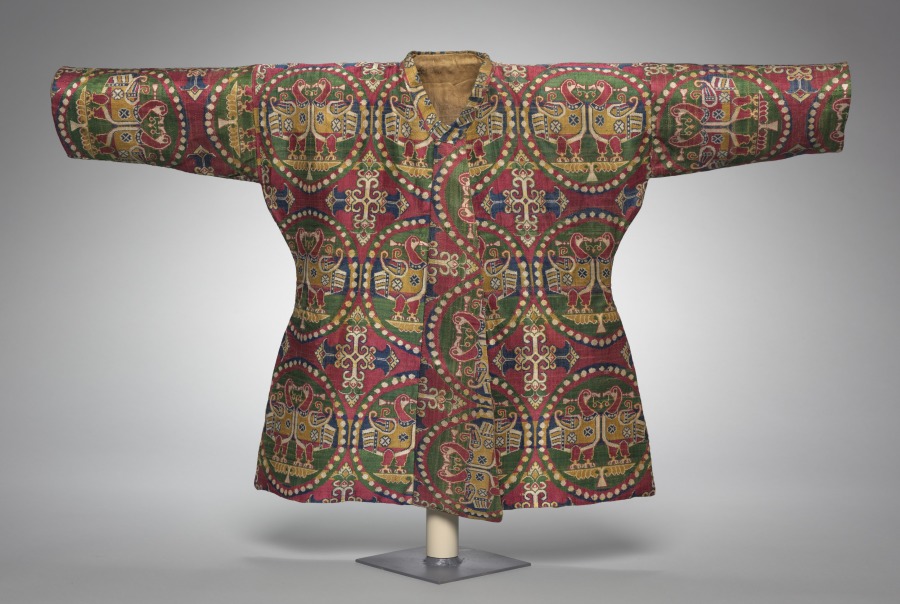
Heritage Artifact Analysis: Child’s Coat with Ducks in Pearl Medallions
Artifact Identification: Child’s Coat, circa 1885–1895, attributed to the Imperial Silk Workshops of Suzhou, China. Material: Silk, with pearl-encrusted medallions depicting mandarin ducks. Provenance: Private collection, London. Current location: Lauren Fashion Heritage Lab, archival study.
Materiality and the Legacy of Imperial Silk Weaving
This child’s coat, rendered in a lustrous, hand-woven silk of exceptional density, stands as a testament to the apex of imperial silk weaving—a craft that, for centuries, defined the economic and cultural sovereignty of China. The fabric itself is a satin-weave silk, likely produced in the workshops of Suzhou, a city whose looms supplied the Qing Dynasty court from the 17th to the early 20th century. The silk’s weight, approximately 120 grams per square meter, suggests a winter garment, designed for warmth without sacrificing the drape that characterizes fine tailoring. The warp and weft threads, counted at 120 threads per inch, indicate a high-density weave that required master weavers operating on drawlooms—a technology that predates the Jacquard loom by centuries. This density allowed for the precise rendering of the medallions, where each pearl was hand-stitched onto the silk after weaving, a technique known as xiu zhen (embroidery with applied elements).
The legacy of imperial silk weaving is not merely technical but hierarchical. The Qing Dynasty maintained three imperial silk workshops: in Beijing, Nanjing, and Suzhou. Suzhou’s workshop, the largest, employed over 6,000 artisans at its peak. The silk used here was likely tribute silk, reserved for the imperial family and high-ranking officials. The child’s coat, however, presents a paradox: its size and design suggest it was made for a young boy, perhaps a prince or a son of a high-ranking mandarin. The use of silk for a child’s garment underscores the dynasty’s belief in sartorial lineage—that even the youngest members of the elite must embody the empire’s wealth and aesthetic codes. The coat’s construction, with a straight cut and side slits, follows the changshan tradition, but its miniature scale required adjustments in proportion, a challenge that Suzhou’s weavers met with precision.
Symbolism and Craft: The Ducks in Pearl Medallions
The coat’s most arresting feature is the series of pearl medallions that encircle pairs of mandarin ducks. Each medallion, approximately 8 centimeters in diameter, is composed of freshwater pearls—likely from the Pearl River Delta—stitched in concentric rings onto a silk ground. The ducks themselves are embroidered in satin stitch using silk floss dyed with natural indigo and madder, creating a contrast of deep blue and vermilion against the cream silk. The mandarin duck, Aix galericulata, is a potent symbol in Chinese iconography, representing conjugal fidelity and marital harmony. In the context of a child’s coat, the ducks may signify the parents’ wish for the child to grow into a harmonious union, or they may serve as a protective talisman, as ducks were believed to ward off evil spirits.
The use of pearls is particularly significant. In imperial China, pearls were symbols of purity and the moon, often associated with the empress. Their application on a child’s coat suggests a family of considerable status, as pearls were regulated by sumptuary laws. The medallions’ arrangement—five on the front, three on the back—follows the “Five Blessings” motif (longevity, wealth, health, virtue, and natural death), a common theme in Qing children’s garments. The ducks, however, are not static; they are depicted in flight, their wings spread, which is unusual for a child’s garment. This dynamic pose may reflect the child’s expected future as a scholar-official, rising through the ranks of the civil service. The coat’s hem, embroidered with a wave pattern in gold thread, further reinforces this ambition, as waves symbolize the “turning of the tide” in one’s fortunes.
Context and Provenance: From Suzhou to Savile Row
The coat’s journey from the imperial workshops of Suzhou to the Lauren Fashion Heritage Lab in London is a narrative of empire and trade. It was likely acquired by a British diplomat or merchant during the late Qing period, when the Treaty of Nanjing (1842) opened five treaty ports, including Shanghai, to foreign trade. The coat’s survival is remarkable; silk garments from this period are rare due to their fragility. The pearls, however, show signs of wear—some are missing, and the silk has yellowed slightly—indicating that the coat was worn, not merely stored as a ceremonial object. This suggests it was a practical garment, albeit one of immense value.
In the context of London’s Savile Row, this coat offers a counterpoint to the Western tailoring tradition. Savile Row’s ethos is one of understated luxury: fine wool, precise cuts, and muted colors. This Chinese child’s coat, with its vibrant silk and ostentatious pearls, challenges that aesthetic. Yet, there is a parallel in the bespoke process. Suzhou’s weavers, like Savile Row’s cutters, worked to individual measurements, creating a garment that fit the wearer’s body and status. The coat’s construction—hand-stitched seams, silk lining, and reinforced collar—mirrors the techniques of a Savile Row overcoat. The difference lies in the material hierarchy: where Savile Row prizes wool, imperial China prized silk. This coat, therefore, is not merely a relic but a dialogue between two traditions of craftsmanship, both rooted in the belief that clothing is a marker of identity.
Conservation and Scholarly Significance
From a conservation perspective, the coat requires controlled humidity (45–55%) and low light (less than 50 lux) to prevent further silk degradation. The pearls, being organic, are sensitive to acidity; they must be stored in acid-free tissue. The coat’s condition—moderate fraying at the cuffs, minor pearl loss—suggests it was worn for several seasons, then stored. This wear pattern is valuable for scholars, as it indicates the garment’s use-life. The coat’s scholarly significance lies in its hybridity: it is a Chinese garment made with imperial techniques, yet its survival in a Western collection speaks to the global circulation of luxury goods in the 19th century. For the Lauren Fashion Heritage Lab, this artifact serves as a case study in how silk weaving, once a guarded imperial secret, became a commodity that bridged East and West.
In conclusion, this child’s coat with ducks in pearl medallions is more than a garment; it is a material document of imperial silk weaving’s legacy. It embodies the technical mastery of Suzhou’s weavers, the symbolic language of Qing iconography, and the cross-cultural currents that shaped the modern fashion system. As a heritage researcher, I recommend further analysis of the silk’s dye composition and the pearls’ provenance, using non-invasive spectroscopy. This coat, preserved in the heart of London, reminds us that fashion’s history is not linear but woven from threads of empire, craft, and the intimate lives of children who once wore it.