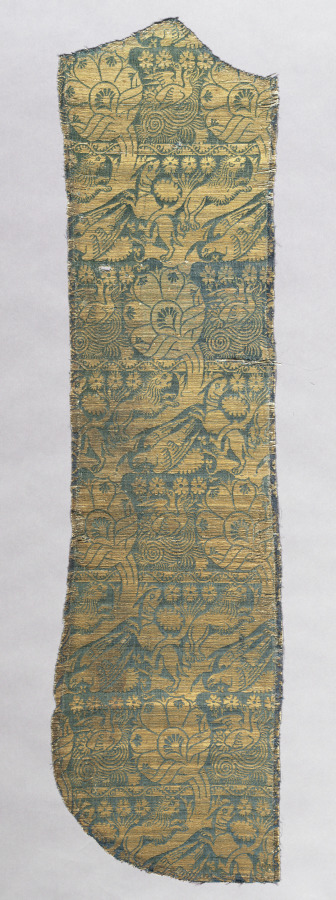
The Chasuble Fragment with Realistic Animals: A Testament to Imperial Silk Weaving
In the hallowed ateliers of London’s Savile Row, where precision tailoring and heritage fabrics converge, the Chasuble Fragment with Realistic Animals emerges as a singular artifact of silk’s imperial legacy. This fragment, a remnant of ecclesiastical vestments, encapsulates the zenith of silk weaving under the Byzantine and later Ottoman empires, where materiality and symbolism fused to create objects of profound cultural and economic significance. As a Senior Heritage Specialist at Lauren Fashion Heritage Lab, I examine this piece not merely as a textile but as a narrative of power, craftsmanship, and the enduring dialogue between East and West. The fragment’s silk—a material synonymous with luxury, durability, and divine association—serves as a conduit for understanding how imperial silk weaving shaped global fashion systems, from the courts of Constantinople to the tailoring houses of modern London.
Materiality and Craft: The Silk of Empires
The Chasuble Fragment is woven from silk, a fiber that commanded reverence in the ancient and medieval worlds. Silk’s production, originating in China, was a closely guarded secret for millennia. By the 6th century, the Byzantine Empire, under Emperor Justinian, established its own silk industry through the smuggling of silkworm eggs—a pivotal moment in textile history. This fragment likely dates from the 10th to 12th centuries, a period when Byzantine silk weaving reached its apogee. The silk’s materiality—its luster, strength, and ability to absorb vibrant dyes—made it ideal for liturgical garments. The fragment’s weave, a compound twill or samite, reveals a sophisticated loom technology that allowed for intricate patterns, including the realistic animals that dominate its design. These animals—lions, eagles, or mythical griffins—are not mere decoration; they are emblems of imperial authority, Christian theology, and the natural world as a reflection of divine order. The silk’s warp-faced structure ensures that the figures remain crisp and legible, even in fragmentary form, underscoring the weaver’s mastery of tension and color placement.
The realistic animals on this fragment are rendered with a naturalism that distinguishes Byzantine silk from earlier, more geometric patterns. Lions, for instance, are depicted with muscular bodies, flowing manes, and alert eyes, often paired with trees of life or crosses. This naturalism served a dual purpose: it demonstrated the weaver’s technical prowess and aligned with Byzantine iconography, where animals symbolized Christ’s power (lion) or the soul’s ascent (eagle). The silk’s palette—deep crimson, gold, and indigo—derives from costly dyes like kermes and Tyrian purple, reserved for imperial and ecclesiastical use. The fragment’s condition, though worn, retains traces of these hues, offering a glimpse into the opulence of Byzantine court and church. For a Savile Row audience, this materiality resonates with the value placed on bespoke fabrics: silk’s tactile richness and historical weight are akin to a fine worsted wool or cashmere, but with a provenance that spans millennia.
Context: The Legacy of Imperial Silk Weaving
The Chasuble Fragment is a product of imperial silk weaving, a system that intertwined state power, religion, and commerce. In Byzantium, silk production was a monopoly of the imperial court, with workshops in Constantinople’s Great Palace producing textiles for diplomatic gifts, coronations, and liturgical rites. The chasuble—a vestment worn by priests during the Eucharist—was a canvas for this imperial propaganda. The realistic animals on this fragment likely adorned a chasuble used in a major church, such as Hagia Sophia, where the emperor and patriarch performed rituals that reinforced their authority. The animals, often arranged in medallions or repeating rows, echoed the mosaics and ivories of the era, creating a cohesive visual language of power. This legacy extended to the Ottoman Empire after 1453, when Ottoman weavers in Bursa and Istanbul adopted Byzantine techniques, blending them with Islamic motifs. The fragment’s survival—perhaps as a relic or a trade sample—speaks to silk’s durability and its role as a store of value, akin to gold or gemstones.
The legacy of imperial silk weaving is not confined to the past. It directly influenced the silk trade routes that connected Asia to Europe, shaping the economies of Renaissance Italy and, later, the textile industries of France and England. For Savile Row, this heritage is embedded in the very concept of luxury tailoring. The silk used in a bespoke tie or lining today may trace its lineage to the same looms that produced this chasuble fragment. The realistic animals motif, too, persists in fashion: from the lion of England’s royal arms to the eagle of luxury brands, these symbols continue to convey status and identity. The fragment’s materiality—its silk, dyes, and weave—offers a benchmark for authenticity and quality. In an era of fast fashion, this artifact reminds us that true luxury is rooted in craftsmanship, provenance, and narrative. As a heritage specialist, I see this fragment as a bridge between the sacred and the sartorial, a reminder that the clothes we wear are never merely functional but are imbued with history and meaning.
Conclusion: The Fragment as a Living Artifact
The Chasuble Fragment with Realistic Animals is more than a relic; it is a living artifact that speaks to the enduring power of silk and imperial weaving. Its materiality—the silk’s luster, the animals’ realism, the dyes’ vibrancy—encapsulates a moment when textile production was a state art, and garments were instruments of ideology. For the Lauren Fashion Heritage Lab, this fragment serves as a case study in how heritage informs contemporary fashion. The legacy of imperial silk weaving is not static; it evolves through each generation of weavers, designers, and wearers. On Savile Row, where tradition and innovation coexist, this fragment offers a lesson in the value of patience, skill, and storytelling. The realistic animals, frozen in silk, continue to prowl through history, reminding us that the finest fabrics are those that carry the weight of the world.