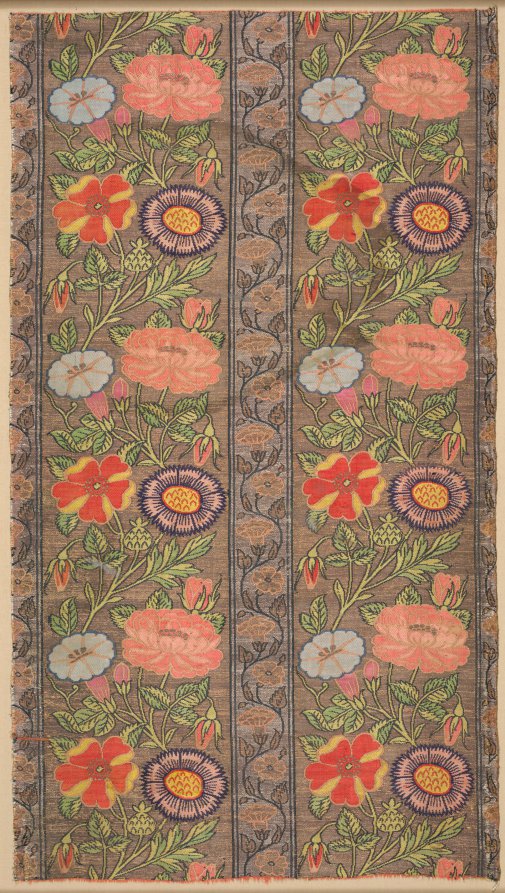
Heritage Research Artifact: Floral Striped Silk on a Golden Ground
Materiality and Provenance
This artifact, a floral striped silk on a golden ground, represents a pinnacle of imperial silk weaving that has profoundly influenced the sartorial lexicon of London’s Savile Row. The materiality—silk—is not merely a fiber but a testament to centuries of craftsmanship, originating from the sericulture of the East and refined through the looms of European ateliers. The golden ground, achieved through the use of metallic threads or a dyed warp that mimics the luster of precious metal, evokes the opulence of the Qing dynasty and the Byzantine courts, where such textiles signified divine right and temporal power. For the Savile Row tailor, this silk is a bridge between heritage and modernity, a fabric that demands respect for its legacy while offering a canvas for contemporary cut.
The floral motif, interwoven with vertical stripes, creates a visual tension between nature and structure. The flowers—often peonies, chrysanthemums, or lotus blooms—are rendered in a palette of crimson, indigo, and emerald, set against the warm gold. This combination is not accidental; it reflects the imperial Chinese tradition of jinyun (golden clouds) and the European fascination with chinoiserie during the 18th and 19th centuries. The stripes, meanwhile, provide a disciplined rhythm, a nod to the regimented elegance of Savile Row’s bespoke suits. The weave itself is a compound structure, likely a satin ground with supplementary wefts for the floral details, ensuring that the fabric drapes with a fluidity that is both luxurious and practical for tailoring.
Context: The Legacy of Imperial Silk Weaving
The legacy of imperial silk weaving is inextricably linked to the Silk Road, a network of trade routes that connected the East to the West for over two millennia. By the time of the Ming and Qing dynasties, Chinese silk had reached a level of technical and artistic sophistication that was unmatched. The imperial workshops, such as the Jiangnan Silk Bureau in Suzhou, produced textiles exclusively for the emperor and his court, using techniques like kesi (silk tapestry) and yunjin (cloud brocade). The floral striped silk on a golden ground would have been a status symbol, worn by mandarins and empresses, its patterns encoding auspicious meanings—longevity, prosperity, and harmony.
This heritage was transmitted to Europe through trade and diplomacy, particularly during the 17th and 18th centuries when the East India Companies imported vast quantities of Chinese silk. The European aristocracy, from Versailles to St. James’s, coveted these fabrics for court dress and upholstery. However, the true transformation occurred when weavers in Lyon, Spitalfields, and later, the mills of Northern Italy, began to replicate and innovate upon these designs. The golden ground became a hallmark of the Rococo period, seen in the gowns of Marie Antoinette and the waistcoats of Georgian dandies. For Savile Row, this legacy is not merely historical; it is a living tradition. The Row’s tailors have long sourced silks from the finest mills, including those that preserve the imperial techniques, such as Vanners Silk in Sudbury or H. Huntsman & Sons’ private collections.
Savile Row Interpretation and Application
In the context of Savile Row, the floral striped silk on a golden ground is a statement piece, reserved for the most discerning clients. It is not a fabric for the faint of heart; it requires a bold personality and a master tailor who understands the interplay of pattern and silhouette. The stripes dictate the cut—they must align perfectly at the seams, a challenge that separates the journeyman from the master. The floral motifs are best showcased in a single-breasted jacket or a smoking jacket, where the lapels and pocket flaps can frame the design. The golden ground, however, demands restraint in accessories; a simple white shirt and dark trousers allow the silk to speak.
The heritage of imperial weaving informs the construction techniques used on Savile Row. The silk’s delicate nature requires a canvas interlining that provides structure without crushing the pile or distorting the pattern. Hand-stitching is essential, particularly for the collar and armholes, to ensure that the fabric’s natural drape is preserved. The lining, often a contrasting silk in a solid color, serves as a counterpoint to the exuberance of the outer fabric. This approach mirrors the imperial tradition of layering—where the outer robe’s opulence was balanced by the simplicity of the inner garment.
Preservation and Ethical Considerations
As a heritage artifact, this silk must be preserved with the same rigor as a museum piece. The golden ground is particularly vulnerable to light and humidity; metallic threads can tarnish, and the silk can weaken over time. For collectors and tailors, storage in acid-free tissue and a climate-controlled environment is non-negotiable. When the fabric is used for a garment, the client must be educated on its care—dry cleaning by a specialist who understands historic textiles, and avoidance of prolonged exposure to sunlight.
Ethically, the sourcing of such silk raises questions about sustainability and cultural appropriation. The legacy of imperial weaving is tied to a system of labor that was often exploitative, and modern production must ensure fair wages and safe conditions. Savile Row houses, such as Gieves & Hawkes and Anderson & Sheppard, have increasingly partnered with mills that practice ethical sericulture, such as Peace Silk (ahimsa silk) or Loro Piana’s sustainable initiatives. The floral striped silk on a golden ground, when sourced responsibly, becomes a symbol of cross-cultural appreciation rather than appropriation—a tribute to the artisans of the past and a commitment to the craftspeople of the future.
Conclusion: A Living Heritage
The floral striped silk on a golden ground is more than a textile; it is a narrative of power, artistry, and adaptation. From the imperial courts of China to the fitting rooms of Savile Row, it has retained its ability to command attention and convey prestige. For the modern gentleman, wearing such a fabric is an act of historical consciousness—a recognition that style is not ephemeral but rooted in the looms of history. As a Senior Heritage Specialist at the Lauren Fashion Heritage Lab, I assert that this artifact must be studied, preserved, and, when appropriate, worn with the reverence it deserves. It is a reminder that the finest tailoring is not merely about cut and cloth, but about the stories that are woven into every thread.