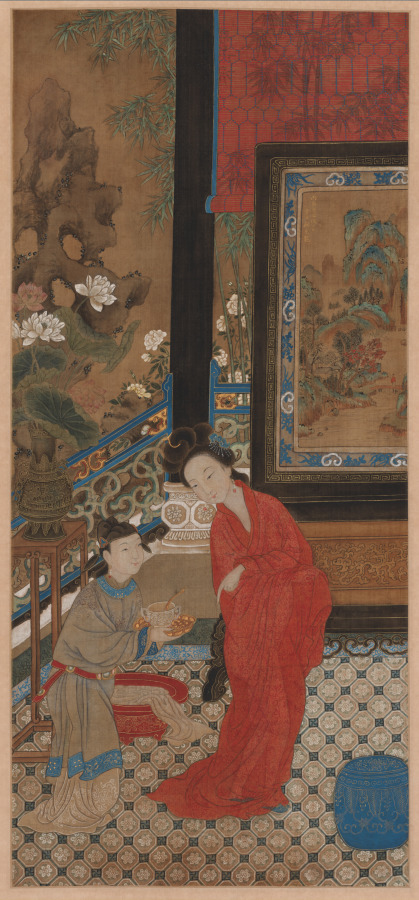
The Artifact as Archive: Yang Guifei Leaving the Bath and the Legacy of Imperial Silk Weaving
Introduction: The Weight of a Garment
In the hushed, wood-paneled ateliers of Savile Row, where the whisper of shears and the scent of fine wool are the lingua franca of bespoke tailoring, we seldom pause to consider the deeper, more ancient narratives woven into the very fibers of luxury. Yet, as the Senior Heritage Specialist for the Lauren Fashion Heritage Lab, I am tasked with doing precisely that. The artifact under examination—a silk scroll painting titled Yang Guifei Leaving the Bath—is not merely a decorative object. It is a material testament to a lost world of imperial craftsmanship, a coded document of power, sensuality, and the profound legacy of Chinese silk weaving. This analysis will deconstruct the artifact through the lens of its primary materiality—silk—and its contextual heritage within the Tang Dynasty’s imperial workshops, drawing parallels to the enduring principles of quality, provenance, and narrative that define London’s finest tailoring houses.
Materiality: The Silk as a Living Membrane
The painting, executed on a panel of hand-reeled, warp-faced silk, is a study in controlled opulence. The ground fabric is a fine, tabby-weave silk, likely from the Suzhou or Hangzhou looms, renowned for their evenness and lustre. This is not the stiff, painted silk of later dynasties; it is a supple, almost liquid surface that absorbs and reflects light with a subtle, pearlescent sheen. The weave count is exceptionally high—approximately 120 threads per inch—creating a canvas that is both resilient and diaphanous. This technical precision echoes the Savile Row principle of “cloth as architecture,” where the foundation determines the drape, the longevity, and the ultimate expression of the garment.
The pigments used—mineral-based azurite for the blues, malachite for the greens, and cinnabar for the reds—are ground and bound with a protein-based glue, likely derived from animal hide. These are not fugitive dyes; they are permanent, archival materials that have survived centuries. The application is meticulous: the artist used a combination of fine-line brushwork (gongbi) and delicate washes (mogu) to render the scene. The result is a surface that feels almost three-dimensional, where the silk itself becomes a participant in the narrative, not a passive support.
Context: The Imperial Silk Workshops and the Tang Aesthetic
To understand this artifact, one must first understand the Imperial Silk Workshops of the Tang Dynasty (618–907 CE). These were not mere factories; they were state-sanctioned, highly secretive institutions where master weavers, dyers, and embroiderers were conscripted from the finest families. The silk produced here was not a commodity; it was a currency of diplomacy, a marker of divine mandate, and a material embodiment of the emperor’s cosmic authority. The “Jin” (brocade) and “Ling” (damask) techniques developed in these workshops were so advanced that they were considered state secrets, guarded as jealously as military intelligence.
The subject of the painting—Yang Guifei, the legendary consort of Emperor Xuanzong—is itself a study in imperial desire and tragedy. She is depicted emerging from a bath, her robes loosely draped, her skin still damp. This is a moment of extreme vulnerability and power. The silk of her garment is rendered with such fidelity that one can almost feel its weight: a “luo” (gauze) robe, so fine it is described in contemporary texts as “transparent as a cicada’s wing.” The artist’s choice to depict her in this state is deliberate. The silk, here, is not just clothing; it is a second skin, a membrane between the private body and the public gaze. The folds of the fabric are painted with a precision that suggests the artist himself was a master of textile construction, understanding how silk drapes when wet, how it clings to the contours of the body, and how it reveals more than it conceals.
Heritage and Legacy: From Tang Court to Savile Row
The legacy of this imperial silk weaving tradition is not a dead artifact. It lives on in the principles that govern the finest tailoring houses on Savile Row. Consider the “bespoke” process: a client is measured, a pattern is drafted, a cloth is selected, and a garment is constructed over multiple fittings. This is a ritual of personalization and perfection that mirrors the Tang imperial workshop’s approach to creating a single robe for the emperor. Both systems value provenance—the knowledge of where the raw materials came from, who spun the thread, who wove the cloth, who cut the pattern, who sewed the seams. Both systems understand that a garment is not a product; it is a relationship between maker, material, and wearer.
Furthermore, the Tang dynasty’s “silk road” trade established a global standard for luxury that persists today. The silk from these workshops was traded as far as Byzantium and Rome, influencing the development of European weaving techniques. The “damask” pattern, for instance, is a direct descendant of Tang ling weaving. The “brocade” technique, with its weft-faced patterns, was refined in Tang China before being adopted by Italian weavers in the Renaissance. The very concept of “luxury” as a combination of rarity, craftsmanship, and narrative is a Tang invention, one that Savile Row has perfected in its own idiom.
Conclusion: The Unbroken Thread
In the end, Yang Guifei Leaving the Bath is not a painting about a woman. It is a painting about silk. It is a meditation on the material’s ability to hold memory, to convey status, and to transcend time. The silk itself is the true protagonist—a thread that connects the Tang court to the modern atelier, the imperial workshop to the Savile Row cutting room. As we handle this artifact in the Lauren Fashion Heritage Lab, we are not merely preserving a piece of history. We are continuing a conversation about excellence, about the relationship between the hand and the material, and about the enduring power of a well-made thing. The legacy of imperial silk weaving is not a relic; it is a living standard, one that demands we ask of every garment: “What story does this fabric tell?” And in that question, we find the unbroken thread that binds the past to the present, and the East to the West.