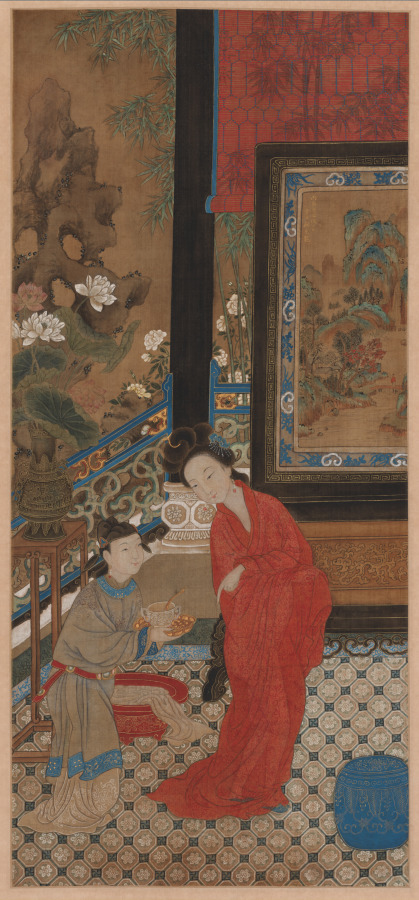
On the Material Conveyance of Imperial Narrative: A Consideration of 'Yang Guifei Leaving the Bath' in the Context of the Jiangnan Silk Legacy
The connoisseur of bespoke tailoring understands, implicitly, that the most profound statements are never merely worn; they are constructed. The canvas, the interlining, the hand-padded lapel—each element is a silent collaborator in articulating a legacy of craft. So it is with the subject of our present examination: the artistic motif of 'Yang Guifei Leaving the Bath,' rendered not upon common canvas, but upon the paramount surface of imperial China: silk. To appreciate this artifact is to engage in a forensic appreciation of materiality, where the medium is not a passive ground but the very essence of the narrative being conveyed. The legacy of imperial silk weaving, particularly from the Jiangnan workshops, provides the essential context—the equivalent of our own Savile Row’s ledger of master cutters and exclusive cloth merchants—without which the image remains merely decorative.
The Patronage of the Imperial Atelier: A Monopoly on Excellence
First, one must consider provenance. The imperial silk workshops of Suzhou, Hangzhou, and Nanjing operated under a system of direct patronage and meticulous oversight that would be familiar to any establishment catering to a discerning, regal clientele. These were not commercial enterprises in the common sense; they were state-sanctioned repositories of technical virtuosity. The finest silks—the *kesi* (silk tapestry) and *duan* (satin) weaves—were reserved for the court, their production governed by sumptuary laws as strict as any protocol governing court dress. The subject matter, therefore, is inseparable from this channel of manufacture. A depiction of the preeminent Tang consort, Yang Guifei, in a moment of intimate, legendary beauty, was not a theme for the commercial market. It was an imperial commission, a visual articulation of courtly mythology, rendered in the only material worthy of its subject and its patron.
The Tactile Language of Opulence: Silk as Narrative Device
The genius of the depiction lies in the weaver’s exploitation of silk’s inherent properties to serve the narrative. Consider the central figure. Yang Guifei’s post-bath dampness, her famed corporeal allure, is not merely painted; it is engineered through texture and reflectivity. The use of a fine, unpatterned satin ground for her skin would catch the light differently than the complex, figured weaves of her discarded robes or the garden surroundings. The sheen of the silk mimics the moisture on skin, a tactile suggestion no pigment alone could achieve. The trailing robes, likely rendered in *kesi* tapestry weave to allow for curvilinear, painterly detail, would possess a subdued, matte texture, contrasting with the luminosity of her figure. This is a sartorial intelligence of the highest order: using the cloth’s own language—its weight, its lustre, its hand—to delineate form and imply sensation. It is the precise equivalent of a master tailor using a spongy woollen barathea for a smoking jacket to suggest luxury and ease, against the sharp, luminous finish of a superfine worsted for daywear.
Technical Virtuosity as a Symbol of Sovereignty
The complexity of the weaving itself was a direct expression of imperial power. A scene of such pictorial sophistication, with its graduated colours and delicate line, required the labour of master weavers for months, if not years. The vertical loom was a throne of technical authority. Each colour change, each soft blending of hue in a cloud or a petal, was achieved through a meticulous, discontinuous weft technique, building the image thread by infinitesimal thread. This was not efficiency; it was conspicuous consumption of skill and time—a definitive demonstration that the court commanded resources beyond measure. The artifact thus operates on two levels: as a depiction of a beautiful woman and as a tangible ledger of controlled labour and peerless technique, a testament to the empire’s capacity to marshal its greatest artistic forces for a singular, non-utilitarian purpose. The value is embedded in the very hours it took to create.
Enduring Legacy: The Fabric of Cultural Memory
Finally, the survival of such pieces—or the persistence of the motif in the silk-weaving canon—speaks to silk’s role as a carrier of cultural memory. Silk is remarkably durable when preserved correctly, but its legacy is more than physical. The techniques refined in the Jiangnan ateliers for such works became the benchmark of quality, the silent standard against which all other textile production was measured. The motif of Yang Guifei, repeated across centuries in silk, became ingrained in the national consciousness not just as a story, but as a specific material experience of that story. It established an unbreakable association between supreme narrative art, imperial authority, and the silk upon which it was woven. This is a heritage that does not fade; it is woven into the fabric of history itself, thread by brilliant thread.
In conclusion, to regard 'Yang Guifei Leaving the Bath' as a mere painting on silk is to profoundly misunderstand its stature. It is a bespoke creation in the truest sense. From the imperial patronage that commissioned it, to the atelier that painstakingly executed it, to the material intelligence that animates its subject, every facet speaks of a consolidated, authoritative tradition. The Jiangnan silk legacy, like the finest tailoring traditions of the West, was built upon the unshakeable pillars of exclusive material, consummate technique, and narrative purpose. The artifact stands as a definitive statement: in the rarefied world of imperial expression, the medium was not simply the message; it was the mandate.