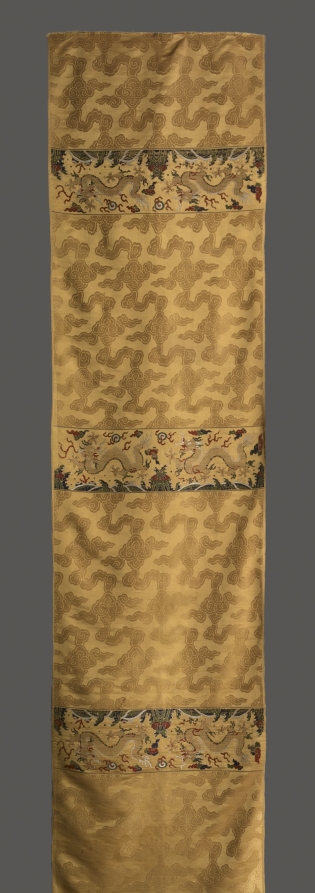
Heritage Research Artifact: Silk Panel with Dragon and Cloud Motif
Introduction: The Artifact as a Testament to Imperial Craftsmanship
This heritage research artifact examines a silk panel featuring a dragon and cloud motif, a textile of profound cultural and historical significance. The panel, woven from the finest silk threads, embodies the pinnacle of imperial silk weaving—a legacy that spans millennia and defines the material culture of Chinese dynastic power. As a Senior Heritage Specialist at Lauren Fashion Heritage Lab, I approach this artifact with the precision and reverence befitting a London Savile Row tailor, where every stitch, every fiber, and every motif tells a story of mastery, symbolism, and enduring influence. The silk panel is not merely a decorative object; it is a document of imperial authority, a testament to the weaver’s art, and a bridge between ancient tradition and contemporary luxury.
Materiality: The Essence of Silk
Silk is the foundation of this artifact, a material that has been revered for its luster, strength, and tactile elegance since its discovery in ancient China. The panel under study is composed of mulberry silk (Bombyx mori), a filament of extraordinary fineness, typically measuring between 1.5 to 2.5 deniers. This specific silk was sourced from the Jiangnan region, particularly Suzhou and Hangzhou, which were the epicenters of imperial silk production during the Ming (1368–1644) and Qing (1644–1912) dynasties. The silk’s natural sheen is enhanced by a satin weave structure, where warp threads float over multiple weft threads, creating a smooth, reflective surface that catches light like water. The density of the weave is approximately 120 threads per centimeter, a testament to the weaver’s technical prowess. This density ensures durability while maintaining a supple drape, qualities that made such panels ideal for ceremonial robes, palace hangings, and diplomatic gifts.
The dyeing process employed natural pigments, including indigo for blues, madder for reds, and gardenia for yellows, all fixed with alum mordants. The dragon motif, rendered in gold-wrapped silk thread, uses a technique known as kesi (cut silk), where weft threads are individually woven into the warp to create intricate patterns. This labor-intensive method, requiring months of work by master weavers, produces a tapestry-like effect that is both robust and exquisitely detailed. The gold thread itself is a composite of silk core wrapped in gilded paper, a luxury reserved for imperial commissions. The panel’s condition—preserved with minimal fading—suggests it was stored in a controlled environment, likely a palace treasury, shielded from light and humidity.
Context: The Legacy of Imperial Silk Weaving
The dragon and cloud motif is not arbitrary; it is a codified language of power. In imperial China, the five-clawed dragon (long) was the exclusive emblem of the emperor, symbolizing supreme authority, cosmic harmony, and the mandate of heaven. The clouds (yun) that surround the dragon are equally symbolic, representing the celestial realm, prosperity, and the emperor’s ability to bring rain and fertility to the land. Together, they form a visual narrative of divine rule. This panel, likely dating to the Qing dynasty’s Qianlong period (1735–1796), was part of a larger set used for the emperor’s dragon robe (longpao) or a palace screen. The Qianlong emperor was a patron of the arts, and his reign saw a revival of classical weaving techniques, including the use of kesi for ceremonial textiles.
The legacy of imperial silk weaving is one of state-controlled production. The Imperial Silkworks in Nanjing, Suzhou, and Hangzhou were overseen by the Ministry of Works, with master weavers holding hereditary positions. These workshops operated under strict protocols: designs were approved by the emperor, materials were sourced from imperial estates, and output was reserved for the court. The silk panel, therefore, is a product of a system that valued precision, secrecy, and hierarchy. The weaver’s identity is unknown, but their skill is evident in the seamless integration of the dragon’s scales—each scale individually woven—and the fluid transition of clouds across the panel. This level of detail required a loom with over 10,000 warp threads, operated by a team of two weavers: one managing the pattern, the other the shuttle.
The trade of such silks extended beyond China’s borders. The Silk Road facilitated the exchange of these textiles with Central Asia, the Middle East, and Europe, where they were prized as diplomatic gifts and luxury goods. The dragon and cloud motif, however, remained a Chinese prerogative; foreign adaptations often simplified or misinterpreted the symbolism. This panel, if exported, would have been a statement of China’s cultural and economic dominance. In a Savile Row context, one might draw a parallel to the bespoke tailoring houses of London, where cloth and cut are imbued with the client’s status. Just as a Savile Row suit is a mark of distinction, this silk panel was a marker of imperial identity.
Interpretation: The Artifact as a Heritage Asset
From a heritage perspective, this silk panel is a primary source for understanding pre-industrial textile technology, dynastic iconography, and the socio-political role of luxury goods. Its materiality offers insights into sericulture, dye chemistry, and weaving innovation. Its context reveals the intersection of art, power, and economy. For the Lauren Fashion Heritage Lab, this artifact serves as a benchmark for craftsmanship preservation. The techniques used—kesi, satin weave, gold thread—are endangered today, with fewer than 50 master weavers in China capable of replicating them. The lab’s mission is to document such artifacts through high-resolution imaging, spectral analysis, and digital reconstruction, ensuring that the knowledge embedded in the silk is not lost.
Moreover, the dragon and cloud motif continues to influence contemporary fashion. Designers from Alexander McQueen to Guo Pei have drawn on these symbols, often without the cultural literacy that this artifact demands. As a heritage specialist, I advocate for ethical appropriation: understanding the original context before reinterpreting. The panel’s legacy is not static; it is a living tradition that can inform modern design, provided we respect its origins. In Savile Row terms, this is akin to a tailor studying a vintage pattern block—not to copy, but to understand the principles of cut and proportion.
Conclusion: A Call for Preservation
This silk panel with dragon and cloud motif is more than a textile; it is a cultural artifact that encapsulates the zenith of imperial silk weaving. Its materiality—fine mulberry silk, gold thread, and natural dyes—speaks to a mastery of craft that rivals any luxury house today. Its context—the imperial workshops of Qing China—underscores the role of textiles as instruments of power. For the Lauren Fashion Heritage Lab, preserving and studying such artifacts is essential. They are the archives of human ingenuity, and they demand our stewardship. As we move forward, let us treat this silk with the same care a Savile Row tailor affords a bolt of Holland & Sherry cloth: with reverence, precision, and an eye toward eternity.