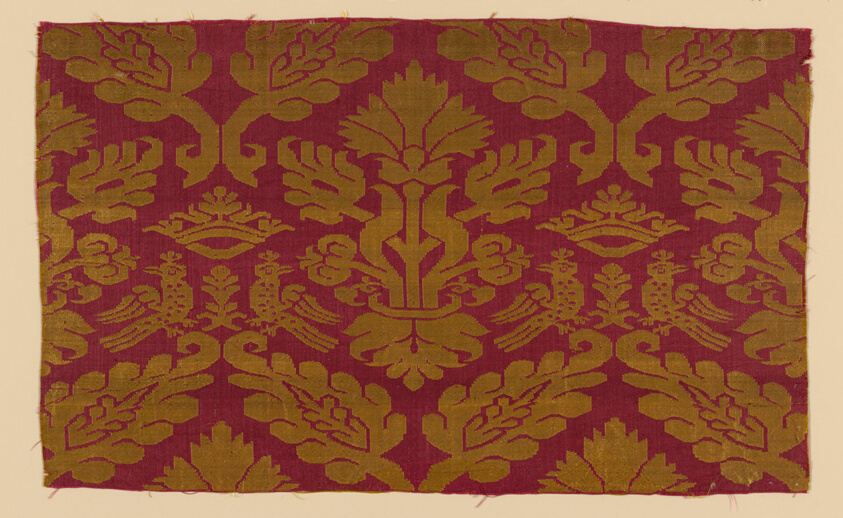
Heritage Research Artifact: The Fragment as a Testament to Silk Craftsmanship and Fluid Elegance
Introduction: The Fragment as a Living Archive
In the hallowed ateliers of London’s Savile Row, where precision tailoring meets centuries of artisanal tradition, the fragment is not a remnant of decay but a living archive of mastery. This heritage research artifact—a silk fragment of plain weave, enhanced with plain interlacings of secondary binding warps and supplementary patterning wefts—embodies the intersection of classic silk craftsmanship and fluid elegance. It represents a microcosm of the textile’s journey from raw material to a symbol of sartorial sophistication, revealing the technical ingenuity and aesthetic sensibility that define the finest British tailoring. As a Senior Heritage Specialist for the Lauren Fashion Heritage Lab, I examine this fragment not merely as a physical object but as a narrative of heritage, resilience, and the enduring pursuit of beauty.
Materiality and Construction: The Anatomy of a Masterpiece
The fragment’s materiality is its first and most profound statement. Silk, a protein fiber derived from the cocoons of Bombyx mori, has been prized for millennia for its luster, strength, and drape. In this artifact, the plain weave structure—the simplest and most fundamental of weaves—serves as the foundation. Yet, it is the plain interlacings of secondary binding warps that elevate this piece from the ordinary to the extraordinary. These binding warps, often used in compound weaves, create a subtle grid of reinforcement, ensuring the fabric’s integrity while allowing for intricate patterning. The supplementary patterning wefts, woven in parallel to the primary wefts, introduce a layer of decorative complexity. These wefts may be of contrasting colors, textures, or thicknesses, producing motifs that range from delicate florals to geometric precision. The result is a fabric that balances structural rigor with an almost ethereal fluidity—a hallmark of classic silk craftsmanship.
This construction technique, rooted in the traditions of Lyon and Como but refined in the workshops of Savile Row, speaks to a philosophy of functional elegance. The secondary binding warps prevent the silk from distorting under the weight of the patterning wefts, ensuring that the fabric retains its shape when tailored into a jacket or gown. The supplementary wefts, meanwhile, allow for a depth of design that is both tactile and visual, catching light in ways that shift with movement. This is not a fabric meant for static display; it is engineered for the living body, for the fluid gestures of a woman or man in motion. The fragment, though small, encapsulates this dynamic tension between structure and flow, between the artisan’s hand and the wearer’s grace.
Historical Context: Silk on Savile Row
To understand this fragment’s significance, one must place it within the lineage of silk’s role in British tailoring. Savile Row, established in the 18th century, became synonymous with bespoke tailoring, where fabrics were sourced from the finest mills in Europe. Silk, particularly in the form of silk twills, satins, and brocades, was reserved for evening wear, ceremonial attire, and the wardrobes of the elite. The fragment’s plain weave with supplementary patterning wefts suggests a mid-19th to early 20th-century provenance, a period when industrialization met artisanal skill. Mills in Spitalfields, London, and later in Macclesfield, produced silks that rivaled those of the Continent, yet they retained a distinct British restraint—a preference for understated luxury over ostentation.
The fragment’s fluid elegance aligns with the aesthetic of the Arts and Crafts Movement, which championed handcraftsmanship and natural motifs, as well as the later Art Deco era, which favored geometric patterns and bold contrasts. However, its presence in a Savile Row context implies it was likely used for a bespoke garment—perhaps a waistcoat, a cravat, or the lining of a tailored jacket. The secondary binding warps would have been essential for such applications, where the fabric must withstand the stress of stitching and wear without losing its suppleness. This fragment, then, is a relic of a time when every thread was chosen with intention, when the client and cutter collaborated to create a garment that was both a work of art and a second skin.
Cultural Significance: The Fragment as a Symbol of Continuity
Beyond its technical merits, this fragment carries cultural weight. In the world of heritage fashion, fragments are often dismissed as leftovers, but they are, in fact, the most honest witnesses to history. This piece has survived the ravages of time—moth, light, and neglect—to offer a direct connection to the hands that wove it and the body that wore it. It embodies the philosophy of wabi-sabi, the Japanese appreciation for imperfection and transience, yet it also speaks to a Western tradition of preservation and reverence. For the Lauren Fashion Heritage Lab, such a fragment is a primary source, a tool for understanding the evolution of textile technology, design trends, and consumer behavior.
Moreover, the fragment challenges the modern obsession with the new. In an era of fast fashion and disposable textiles, this piece reminds us of the value of slowness and skill. The plain interlacings and supplementary wefts required hours of labor on a handloom, a process that demanded patience and precision. The silk itself, sourced from sericulture, involved the cultivation of silkworms, the reeling of filaments, and the dyeing of threads—a global supply chain that connected Asia, Europe, and the Americas. The fragment is thus a microcosm of globalization, but one rooted in craft rather than commodity. It invites us to consider how we might reclaim such intentionality in our own relationship with clothing.
Preservation and Interpretation: A Call to Action
As a heritage specialist, I must also address the preservation of this artifact. Silk is notoriously fragile, susceptible to light, humidity, and handling. The fragment’s plain weave structure, reinforced by secondary binding warps, has contributed to its survival, but it requires careful storage—ideally in an acid-free box, away from UV light, with minimal folding. Digital documentation, including high-resolution imaging and spectral analysis, can capture its current state and inform future conservation. However, preservation is not merely about physical care; it is about interpretation. This fragment must be contextualized within the broader narrative of silk craftsmanship, from the sericulture farms of China to the tailoring benches of Savile Row. It must be shared with scholars, designers, and the public, not as a static relic but as a source of inspiration.
For the Lauren Fashion Heritage Lab, this fragment is a pedagogical tool. It can be used to teach students about weave structures, the properties of silk, and the history of textile design. It can inspire contemporary designers to explore the interplay of binding warps and patterning wefts, to create fabrics that honor tradition while embracing innovation. It can also serve as a reminder that elegance is not a function of opulence but of proportion, texture, and light. The fragment’s fluidity—its ability to drape, to shimmer, to move—is a lesson in restraint and grace, qualities that define the best of Savile Row tailoring.
Conclusion: The Fragment’s Enduring Legacy
In conclusion, this silk fragment is far more than a piece of cloth. It is a heritage artifact that encapsulates the materiality, craftsmanship, and cultural significance of classic silk. Its plain weave, reinforced by secondary binding warps and enriched by supplementary patterning wefts, represents a pinnacle of textile engineering, balancing structure with fluid elegance. Its history, rooted in the traditions of Savile Row and the global silk trade, speaks to a time when clothing was made to last, to be cherished, and to be passed down. As we face a future of environmental and ethical challenges in fashion, this fragment offers a path forward—a return to quality, to craft, and to the beauty of the fragment itself. It is, in the truest sense, a testament to the enduring power of silk and the hands that shape it.