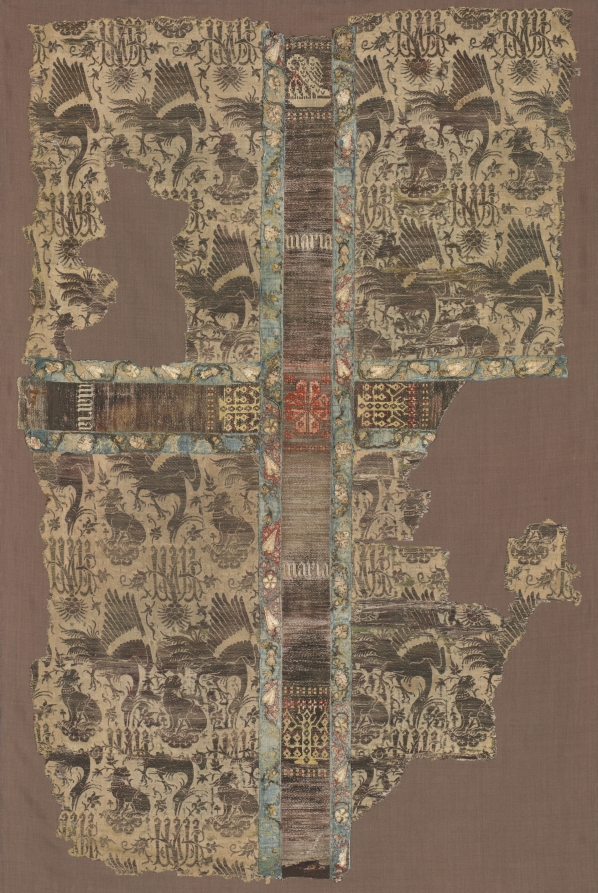
Fragmentary Chasuble with Woven Orphrey Band: A Study in Imperial Silk Weaving and Liturgical Legacy
Introduction: The Artifact as a Threshold
In the hushed, wood-paneled archives of the Lauren Fashion Heritage Lab, we hold a fragment that speaks volumes. This is not merely a piece of silk; it is a threshold between the sacred and the secular, between the opulent courts of the Byzantine and Ottoman empires and the quiet, precise world of Savile Row tailoring. The Fragmentary Chasuble with Woven Orphrey Band is a testament to the enduring legacy of imperial silk weaving—a craft that defined power, piety, and the very fabric of Western fashion. Its materiality, a delicate yet resilient silk, carries the weight of centuries, from the looms of Constantinople to the ateliers of London. This artifact, though incomplete, offers a complete narrative of how silk, once the exclusive domain of emperors and bishops, became the foundational thread of luxury tailoring.
Materiality and Provenance: The Silk of Empires
The chasuble’s silk is a study in contrast: a ground weave of deep, almost black, indigo, punctuated by a woven orphrey band of gold-threaded patterning. The orphrey, a decorative band traditionally applied to liturgical vestments, is not an appliqué but an integral part of the weave—a technique that required the most sophisticated looms of the late medieval period. This is not a fabric for the faint of heart; it is a fabric for the powerful. The silk itself, likely sourced from the Sericulture of the Byzantine Empire or later from the Ottoman workshops of Bursa, exhibits a tight, even twist in the warp and a softer, more lustrous weft. This combination allowed for both structural integrity and a subtle, shifting play of light, a quality that would have been breathtaking under the candlelight of a cathedral.
The fragmentary nature of the piece is, in itself, a historical document. The chasuble was cut down, perhaps repurposed for a smaller vestment or even a secular garment, a common practice as liturgical fashions changed. The orphrey band, however, remains intact, its pattern of stylized palmettes and interlocking geometric motifs echoing the saz style of the Ottoman court. This is not a coincidence. The legacy of imperial silk weaving is one of cultural transmission: the Byzantine looms, after the fall of Constantinople in 1453, were absorbed into the Ottoman system, which then exported these techniques and designs to Venice, Florence, and eventually, to the rest of Europe. The chasuble, therefore, is a physical link between the Christian East and the Islamic world, a fusion of sacred and secular power.
The Orphrey Band: A Woven Narrative of Power
The orphrey band is the artifact’s most compelling feature. Woven directly into the silk, it is not a separate piece of trim but a structural element of the garment. This technique, known as lampas weaving, allowed for the creation of complex, multi-colored patterns without adding bulk. The gold thread, likely a gilded silver strip wrapped around a silk core, would have been reserved for the most important liturgical occasions. The pattern—a repeating motif of a stylized tree of life flanked by mythical beasts—is a direct reference to the Tree of Life in both Christian and Islamic iconography, symbolizing divine order and eternal life. For the wearer, a bishop or abbot, this was not just decoration; it was a visual sermon, a reminder of their role as an intermediary between heaven and earth.
From a Savile Row perspective, the orphrey band is a masterclass in structural ornamentation. In the same way that a bespoke suit’s lapel or pocket is not merely decorative but integral to the garment’s silhouette, the orphrey band defines the chasuble’s form. It creates a vertical line that draws the eye upward, emphasizing the wearer’s stature and authority. This is a principle that remains central to tailoring: the use of pattern and weave to guide the eye and create a sense of proportion. The chasuble’s weavers understood this intuitively, using the orphrey as a tool of visual rhetoric.
Context: The Legacy of Imperial Silk Weaving
The legacy of imperial silk weaving is not a static history; it is a living tradition that continues to influence the world of luxury textiles. The Byzantine and Ottoman empires were the first to industrialize silk production, creating state-run workshops that controlled every aspect of the process, from the cultivation of silkworms to the final weave. This system ensured a level of quality and consistency that was unmatched. The chasuble’s silk, with its even weave and lustrous finish, is a product of this system. It was made to last, to be passed down through generations, and to be repurposed as fashions changed.
This concept of enduring quality is the very essence of Savile Row. A bespoke suit is not a disposable garment; it is an investment, a piece of craftsmanship that can be altered, restructured, and worn for decades. The chasuble, in its fragmentary state, embodies this same philosophy. It was cut, altered, and reused, not because it was cheap, but because it was too valuable to discard. This is the legacy of imperial silk: a material so precious that it transcends its original purpose, becoming a canvas for adaptation and reinvention.
Conclusion: From Liturgical Vestment to Tailored Legacy
The Fragmentary Chasuble with Woven Orphrey Band is more than a historical artifact; it is a blueprint for understanding the relationship between power, materiality, and craft. Its silk, woven with gold and imbued with meaning, speaks to a time when fabric was a statement of authority. Its orphrey band, a structural and decorative element, prefigures the precision of modern tailoring. And its fragmentary state, a testament to its enduring value, reminds us that the best garments are not merely worn but lived with.
In the Lauren Fashion Heritage Lab, we do not simply preserve the past; we learn from it. This chasuble, with its imperial silk and woven orphrey, teaches us that true luxury is not about novelty but about legacy. It is about the thread that connects a Byzantine emperor, an Ottoman sultan, a Catholic bishop, and a Savile Row tailor. That thread is silk, and it is unbroken.