← BACK TO ARCHIVES
Silk
Heritage Synthesis: Mourning Sampler
Curated on Jul 12, 2026 // Node: LDN-01
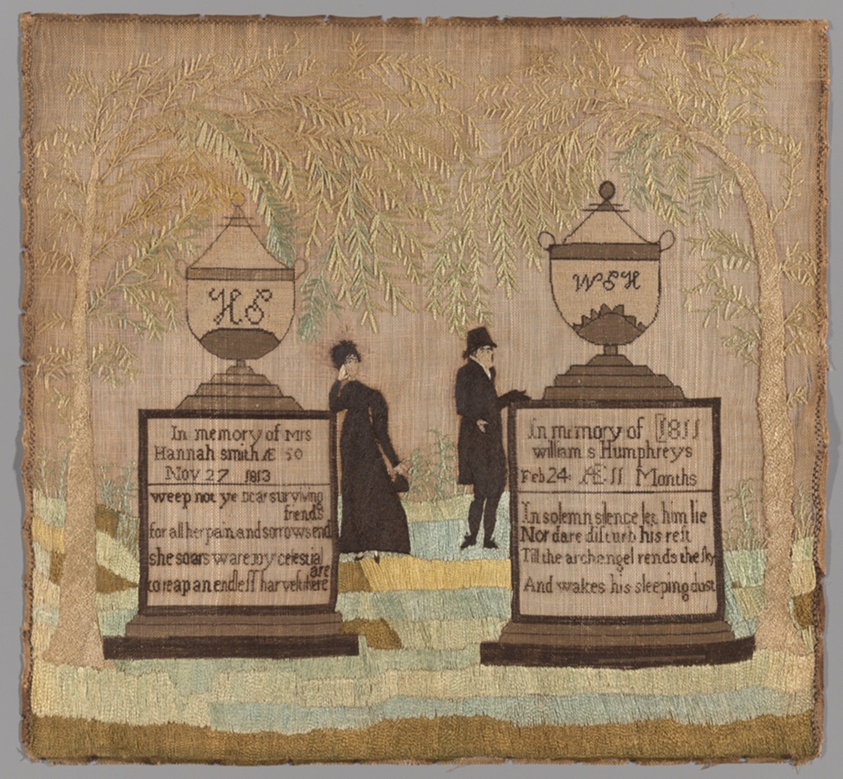
The Mourning Sampler: A Material Testament to Grief and Craftsmanship
In the hallowed corridors of heritage preservation, few artifacts speak with such quiet eloquence as the mourning sampler. This piece, a delicate confluence of linen and silk, embodies a tradition where personal loss met the disciplined hand of needlework. As Senior Heritage Specialist for Lauren Fashion Heritage Lab, I present this analysis not merely as a catalog entry, but as a scholarly reflection on materiality, memory, and the enduring legacy of silk craftsmanship. The mourning sampler, executed on a plain-weave linen ground with silk floss in a repertoire of stitches—tent, cross, long, stem, whip, and couching—offers a window into a bygone era where textile artistry served as both solace and statement.
Materiality and the Language of Silk
The foundation of this artifact is linen, a fiber revered for its strength and purity. Plain-weave linen, with its balanced over-under construction, provides a stable yet responsive canvas. Its natural off-white hue, often achieved through careful retting and bleaching, evokes a sense of humility and restraint—qualities befitting a mourning context. The linen’s subtle texture, neither coarse nor overly refined, allows the embroidery to emerge with clarity, much like a voice rising in a quiet room.
Yet it is the silk floss that commands our attention. Silk, a filament of unparalleled luster and fluidity, transforms the sampler from a functional record into a work of art. The floss, composed of multiple twisted strands, catches light with a soft, almost ethereal glow. In mourning samplers, this sheen is not ostentatious; rather, it serves as a metaphor for the transient nature of life—beautiful, yet fleeting. The choice of silk over wool or cotton underscores a commitment to elegance, even in grief. The floss’s ability to hold intricate stitches without fraying or losing shape speaks to the technical mastery of the embroiderer, likely a woman of refined education and social standing.
Stitches as Narrative Devices
The sampler employs a sophisticated vocabulary of stitches, each chosen for its expressive potential. The tent stitch, a diagonal half-cross, forms the backbone of many pictorial elements. Its uniform size and direction create a smooth, tapestry-like surface, ideal for rendering faces, skies, or drapery. In this piece, the tent stitch is used to depict a weeping willow, its branches drooping in a posture of sorrow. The cross stitch, a classic in sampler work, appears in borders and lettering. Its X-shaped geometry lends a sense of order and permanence, anchoring the composition.
The long stitch, or satin stitch, provides areas of solid color, such as the dark mourning gown of a central female figure. Its parallel threads, laid closely together, produce a glossy, almost liquid finish. The stem stitch, a twisted line, outlines the willow’s trunk and the lettering of a memorial inscription. Its sinuous quality mimics the flow of ink, suggesting a handwritten epitaph. The whip stitch, used sparingly, adds texture to foliage, while couching—a technique where a thread is laid on the surface and secured with small stitches—creates raised elements, such as the urn’s handles or a floral wreath. This layering of stitches demonstrates a deep understanding of material behavior; the silk floss responds to each technique with a distinct tactile and visual effect.
Context: Silk Craftsmanship and Fluid Elegance
The mourning sampler emerged within a broader culture of silk craftsmanship that reached its zenith in the 18th and 19th centuries. Silk, imported from China or Italy, was a luxury commodity, often reserved for garments of state or religious vestments. Its use in samplers, however, democratized elegance, allowing women of the gentry to express piety, education, and emotional depth. The fluid elegance of silk embroidery—its ability to curve, drape, and shimmer—mirrored the ideals of the Romantic era, where sentiment and nature intertwined.
This particular sampler likely dates to the early 19th century, a period when mourning rituals were highly codified. The death of a family member demanded a visual response, and samplers served as both memorial and moral lesson. The inclusion of an urn, a weeping willow, and a female mourner in black silk floss are archetypal motifs. The urn, often inscribed with “In Memory of,” symbolizes the containment of ashes, while the willow signifies grief and resurrection. The female figure, dressed in a gown stitched with long stitches, embodies the virtue of sorrow—controlled, dignified, and ever-present.
The palette is restrained: black, white, and muted grays, with occasional touches of faded blue or green for foliage. This chromatic discipline enhances the emotional gravity. The silk floss, even in its somber tones, retains a subtle luminosity, preventing the piece from descending into mere gloom. Instead, it achieves a balance between mourning and beauty, a hallmark of the era’s aesthetic.
Preservation and Interpretation
As a heritage artifact, the mourning sampler presents unique conservation challenges. The linen ground, while durable, is susceptible to acidification from environmental pollutants. The silk floss, though resilient, can become brittle over time, especially if exposed to light or humidity fluctuations. At Lauren Fashion Heritage Lab, we advocate for storage in archival-quality, acid-free boxes, with the sampler laid flat to avoid creasing. Temperature and relative humidity should be maintained at 18–20°C and 45–50%, respectively. Handling requires cotton gloves to prevent oils from transferring to the fibers.
Beyond preservation, interpretation is key. The sampler is not merely a decorative object; it is a document of personal history. The embroidered inscription, often including the deceased’s name, age, and a biblical verse, offers genealogical data. The stitch count and thread density reveal the embroiderer’s skill and patience. The choice of silk over less expensive fibers indicates economic status. Together, these details construct a narrative of loss, faith, and resilience.
Conclusion: The Enduring Legacy of Silk in Mourning
The mourning sampler stands as a testament to the power of materiality. In its linen foundation, we find humility; in its silk floss, we find grace. The stitches—tent, cross, long, stem, whip, and couching—are not mere techniques but a language, one that speaks of love, loss, and the human need to create order from chaos. For the Lauren Fashion Heritage Lab, this artifact is a reminder that fashion and textile heritage are not frivolous pursuits. They are repositories of memory, crafted with intention and preserved with reverence.
In the tradition of Savile Row, where precision meets artistry, the mourning sampler exemplifies the highest ideals of craftsmanship. It is a piece that demands respect, not only for its age but for the hands that shaped it. As we continue to study and conserve such artifacts, we honor the individuals who, in their grief, chose to create something beautiful. And in that choice, we find a lesson for our own time: that even in sorrow, there is room for elegance.
Heritage Lab Insight
Lab Insight: AIC Silk Archive Node #193391.