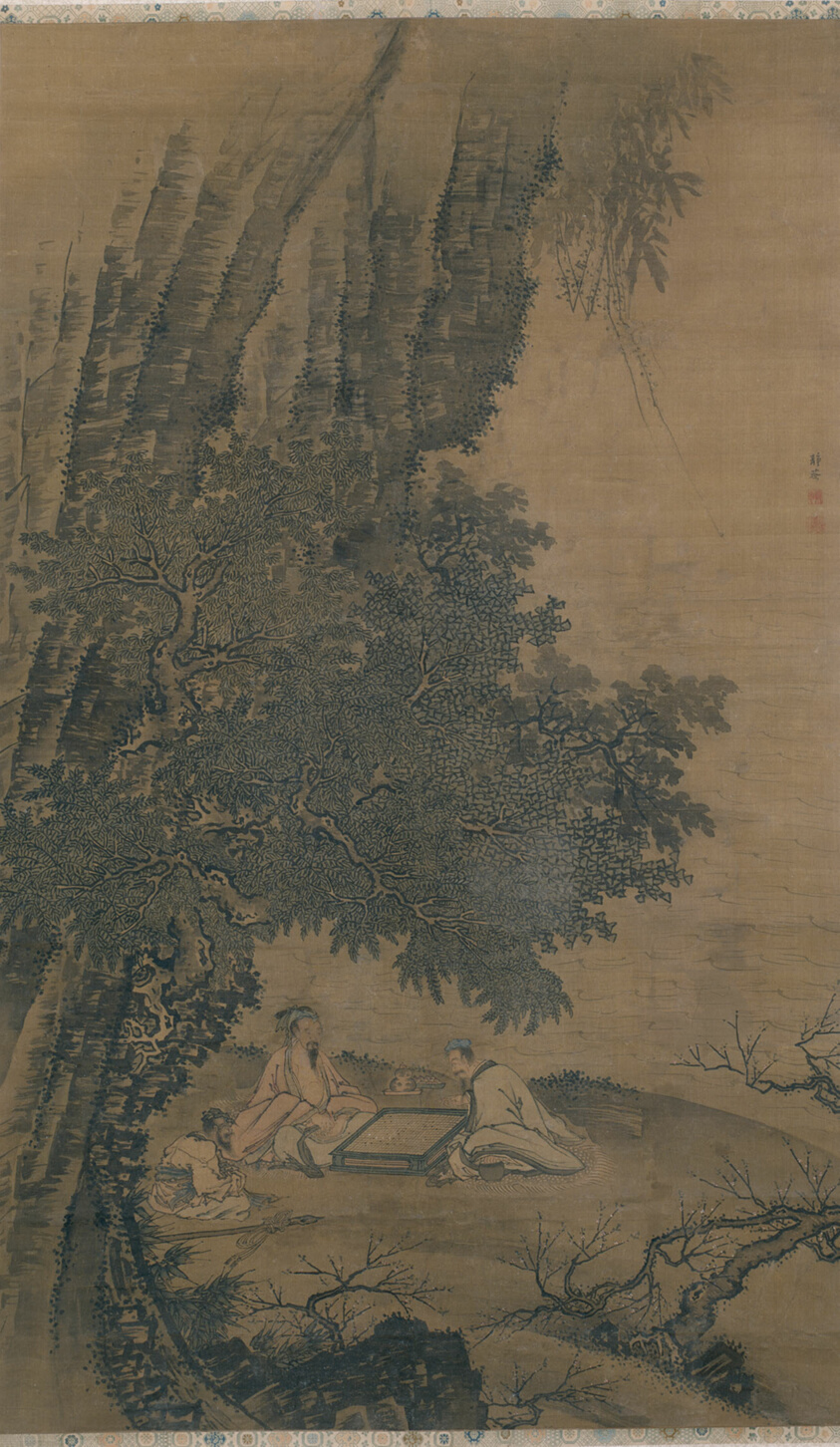
Heritage Research Artifact: *Landscape with Daoist Immortals Playing Weiqi*
Materiality and Provenance
This hanging scroll, executed in ink and colors on silk, represents a pinnacle of classical Chinese craftsmanship. The silk ground, woven with a fine, even warp and weft, exhibits a subtle sheen characteristic of high-grade tabby weave from the Ming dynasty (1368–1644). The material’s fluid elegance is not merely decorative; it is a structural choice that allows the brushwork to breathe, the ink to settle with precision, and the pigments—cinnabar, malachite, and azurite—to retain their luminosity over centuries. The scroll’s mounting, a deep indigo brocade with faint cloud motifs, frames the composition with restraint, echoing the Savile Row principle of understated luxury. The silk’s patina, a gentle ambering from age, speaks to its journey through time, a testament to the enduring dialogue between material and maker.
Iconography and Symbolism
The composition depicts two Daoist immortals, likely Lü Dongbin and Zhongli Quan, seated on a craggy outcrop above a mist-laden valley. They are engaged in a game of *weiqi* (Go), the ancient board game of strategic conquest. The immortals’ robes, rendered in flowing washes of indigo and ochre, contrast with the angularity of the pine branches that frame them. The game board, placed on a flat stone, is a microcosm of the cosmic order: black and white stones symbolize the interplay of yin and yang, while the immortals’ serene expressions suggest detachment from worldly outcomes. The landscape itself—a cascade of waterfalls, distant peaks shrouded in clouds, and a lone crane soaring above—functions as a metaphor for the Daoist pursuit of immortality. The crane, a symbol of longevity, and the pine, emblematic of resilience, reinforce the theme of transcendence. This is not a mere pastime; it is a visual meditation on the eternal dance between chaos and harmony.
Technical Mastery: Brushwork and Pigmentation
The artist’s command of gongbi (meticulous brushwork) is evident in the immortals’ facial features—each wrinkle and expression rendered with hair-thin strokes. The silk’s absorbency required a precise control of moisture; the ink must be applied with a confidence that borders on audacity. The landscape, by contrast, employs *xieyi* (freehand) techniques, with broad, wet washes for the mist and dry, textured strokes for the rock faces. The pigments are layered: a base of white lead under the malachite green to enhance its opacity, and a final glaze of animal glue to fix the colors. The *weiqi* board’s grid is drawn with a ruler and a fine brush, a testament to the artist’s discipline. This interplay of meticulous and spontaneous techniques mirrors the Daoist philosophy of balancing control with surrender—a lesson as relevant to a Savile Row tailor as to a painter.
Cultural and Philosophical Context
The *weiqi* game, known in the West as Go, originated in China over 4,000 years ago and was considered one of the four essential arts of the scholar-official class, alongside music, calligraphy, and painting. In Daoist thought, the game’s infinite complexity—more possible board positions than atoms in the universe—reflects the ineffable nature of the Dao. The immortals’ engagement in this game on a remote mountain peak underscores the Daoist ideal of *wu wei* (effortless action): they play not to win, but to embody the flow of the universe. The scroll’s hanging format, designed for vertical display in a scholar’s studio, invites the viewer to enter the landscape mentally, to become a third immortal observing the game. This interactive quality aligns with the Confucian tradition of self-cultivation through art, where the scroll serves as a mirror for the mind.
Conservation and Legacy
Preserving such a work requires a deep understanding of silk’s fragility. The scroll is stored in a climate-controlled environment at 20°C and 50% relative humidity, mounted on a custom-made roller of Paulownia wood to prevent acid migration. The silk’s surface is cleaned only with a soft, static-free brush; any moisture would risk bleeding the pigments. The mounting’s brocade is reinforced with Japanese *washi* paper at the edges, a technique borrowed from textile conservation. This scroll is a living document, not a static artifact. Its condition—minor flaking in the malachite, a faint crease across the upper left quadrant—tells a story of handling, of being unrolled for scholars and connoisseurs over generations. It is a reminder that heritage is not about freezing the past, but about enabling its continued dialogue with the present.
Conclusion: The Art of the Enduring
In the spirit of Savile Row’s commitment to timelessness, this scroll embodies the principle that true elegance is found in the marriage of material and meaning. The silk, the pigments, the brushwork, and the philosophy are not separate elements; they are a single, cohesive statement. The immortals’ game of *weiqi* is a metaphor for the art of living—a strategic, patient, and ultimately transcendent engagement with the world. As a heritage artifact, this scroll offers a lesson in craftsmanship that transcends cultural boundaries: that the finest work is that which appears effortless, yet is built on centuries of knowledge, discipline, and a profound respect for the materials at hand. It is, in every sense, a masterclass in the art of the enduring.