The Dialectics of Presence and Absence: Terracotta Fragments and the Architecture of Old Money Silence
Introduction: The Fragment as Philosophical Vessel
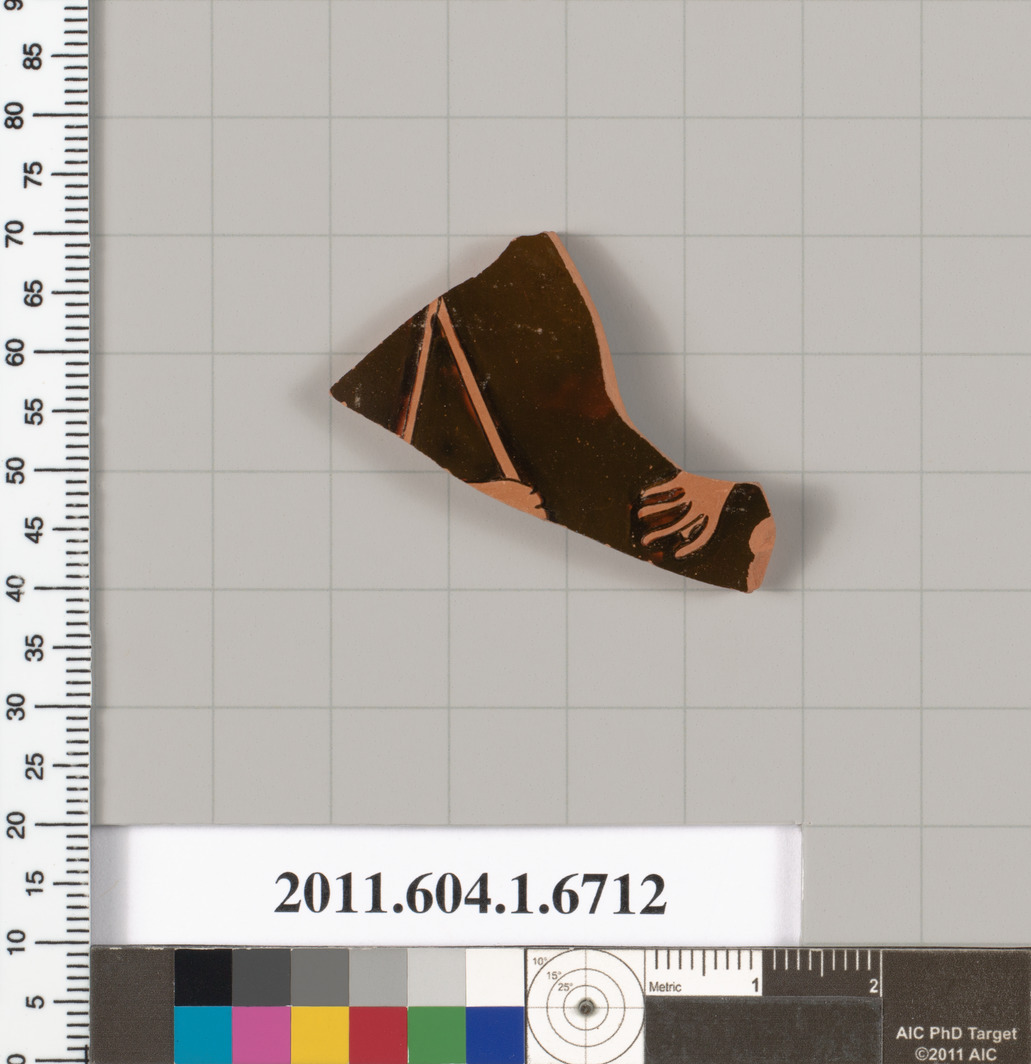
The Terracotta fragment of a Greek Attic kylix—a drinking cup designed for symposia—arrives in the Lauren Fashion Heritage Lab as more than an archaeological curiosity. It is a shattered witness to a civilization that understood the profound relationship between vessel, ritual, and the void. This fragment, with its broken rim and faded black-figure decoration, speaks directly to the internal genetic code that defines the Lauren House aesthetic: the tension between the violent immediacy of the hunt and the contemplative emptiness of the temple plaque. In the 2026 Old Money silhouette, this dialectic finds its most refined expression—not in ornament, but in the deliberate withholding of presence. The kylix fragment teaches us that true luxury is not what is displayed, but what is withheld; not the kill, but the space left after the arrow has passed.
I. The Kylix as a Stage for the Hunt
The Attic kylix was never merely a drinking vessel. Its shallow bowl, designed to be cradled in the hand during philosophical discourse, often bore painted scenes of mythological hunts, athletic contests, or symposiastic revelry. The fragment in our collection preserves the hindquarters of a stag and the taut curve of a hunter’s bow—a frozen moment of potential violence. This is the same aesthetic logic that governs the medieval hunting tapestry described in our internal code: the celebration of the critical threshold between life and death, between the drawn bow and the released arrow. The kylix, like the tapestry, affirms the presence of the body in space, the muscular tension of the hunt, the dust of the chase. The Greek symposium was itself a ritualized hunt for truth, where wine and conversation circled the kylix as hunters circle their prey.
Yet the fragment’s broken state introduces a crucial counterpoint. We do not possess the complete kylix; we possess only a shard. The missing portions—the stag’s head, the hunter’s face, the landscape—are absences that haunt the fragment. This is where the kylix begins to speak the language of the Utanhua Temple Plaque. The fragment, like the plaque, is defined by what it cannot show. The violence of the hunt is present only in its trace, just as the Utanhua flower exists only as a promise. The kylix fragment thus becomes a bridge between the two poles of our aesthetic inheritance: the Western celebration of immanent presence and the Eastern meditation on transcendent absence.
II. The Architecture of Old Money Silence
The 2026 Old Money silhouette, as interpreted through this kylix fragment, rejects the ostentatious display of wealth in favor of a hermetic restraint. The silhouette is characterized by clean, unbroken lines that suggest the rim of the kylix—a perfect circle interrupted only by the wear and tear of time. Jackets are cut with minimal shoulder padding, trousers fall with a straight, uninterrupted drape, and colors are drawn from the terracotta palette: burnt sienna, Attic black, limestone white, and the deep umber of aged clay. These are not colors of celebration; they are colors of patina, of surfaces that have absorbed centuries of touch, of wine, of silence.
The key innovation is the negative space within the silhouette. Where a traditional suit might feature a pocket square, the 2026 Old Money silhouette leaves the breast pocket empty—a deliberate void. Where a shirt might display cufflinks, the cuffs are left bare, the buttonholes unfilled. This is the Utanhua logic applied to tailoring: the most powerful statement is the one that is not made. The wearer does not need to prove their status through ornament; their status is proven by their comfort with absence. The kylix fragment, with its missing scenes, teaches us that what is missing is more eloquent than what remains.
III. The Hunt and the Void: Two Silhouettes in Dialogue
Within the 2026 collection, two distinct silhouettes emerge, each embodying one pole of the kylix fragment’s dialectic. The Hunt Silhouette is sharp, angular, and dynamic—a nod to the muscular tension of the kylix’s painted hunters. Jackets are cut with a pronounced waist suppression, shoulders are slightly extended, and trousers taper aggressively. Fabrics are heavy wool or cashmere in deep forest greens, charcoal, and midnight blue—colors of the chase. This silhouette is for the active pursuit of power, for the boardroom and the gala, for the moment when the arrow is drawn.
The Void Silhouette, by contrast, is loose, flowing, and contemplative. Garments are cut with excess fabric that pools and drapes like the folds of a chiton. Shoulders are soft, waists are undefined, and hems fall to the ankle. Fabrics are linen, silk, or lightweight wool in the muted tones of aged terracotta—pale ochre, dusty rose, ash gray. This silhouette is for the contemplative retreat, for the gallery opening and the private library, for the moment after the arrow has been released and the hunter stands in silence, watching the flight.
The genius of the 2026 Old Money silhouette is that it does not choose between these two poles. Instead, it allows the wearer to oscillate between them, to inhabit both the hunter and the philosopher, the kylix and the plaque. The same man who wears the Hunt Silhouette to a morning meeting can slip into the Void Silhouette for an evening meditation. The fragment teaches us that completion is not the goal; the goal is the tension between presence and absence, between the drawn bow and the empty space where the arrow will never land.
IV. Materiality as Philosophy
The terracotta of the kylix fragment is not a neutral material. It is porous, fragile, and earth-bound. It absorbs moisture, stains, and the oils of human hands. Over centuries, it develops a craquelure—a network of fine cracks that map the history of its use and abuse. This is the material philosophy that underpins the 2026 Old Money silhouette. Fabrics are chosen not for their perfection, but for their capacity to age with dignity. Heritage-Black wool is woven with a slight irregularity, a slub that catches the light differently with each wear. Cashmere is left unbrushed, its surface slightly napped, like the weathered surface of the kylix. Linen is crumpled, not pressed, its creases telling the story of the body that inhabited it.
This is a luxury that refuses to be new. It is a luxury of accumulated time, of surfaces that have been touched and released, of voids that have been filled and emptied. The kylix fragment, broken and incomplete, is more valuable than any intact vessel because it contains the memory of its own destruction. The 2026 Old Money silhouette, with its empty pockets and unadorned cuffs, contains the memory of its own restraint. It is a garment that knows its own mortality and wears that knowledge as its greatest ornament.
Conclusion: The Eternal Return of the Fragment
The terracotta fragment of the Attic kylix, the medieval hunting tapestry, and the Utanhua temple plaque are not separate artifacts. They are three fragments of the same broken vessel, each containing a piece of the truth about human existence. The kylix shows us the beauty of the hunt; the tapestry shows us the violence of the kill; the plaque shows us the emptiness that remains. The 2026 Old Money silhouette is the garment that holds all three fragments together, that allows the wearer to inhabit the full arc of the human condition—from the drawn bow to the silent prayer, from the symposium to the temple, from the shard to the whole.
In the end, the Old Money silhouette is not about money at all. It is about inheritance—not of wealth, but of wisdom. It is the inheritance of the kylix fragment, which teaches us that what remains is never the whole story. It is the inheritance of the Utanhua plaque, which teaches us that the flower never blooms, and yet we wait. It is the inheritance of the hunt, which teaches us that the arrow is always drawn, and always released into the void. The 2026 silhouette is the garment of the eternal fragment, the broken vessel that holds more than any whole could ever contain.