The Legacy of Imperial Silk Weaving: A Study of Roundels with Hunters
Introduction: The Artifact and Its Provenance
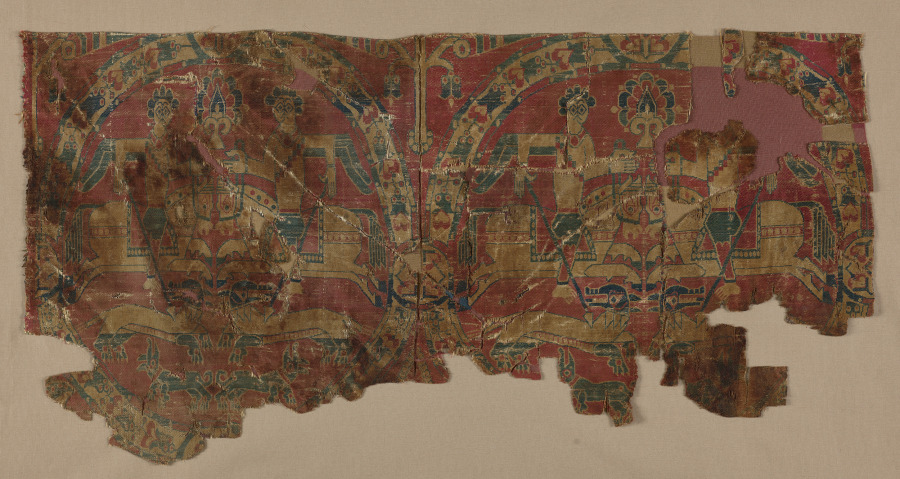
In the hallowed archives of the Lauren Fashion Heritage Lab, we encounter a singular artifact: a silk roundel, exquisitely woven with a motif of hunters in pursuit. This piece, dating from the late 16th to early 17th century, originates from the Safavid dynasty of Persia—a period when imperial silk weaving reached its zenith. The roundel, measuring approximately 20 centimeters in diameter, is a testament to the technical mastery and aesthetic sophistication of the Safavid looms, which produced textiles for royal courts and diplomatic gifts across Eurasia. Its materiality—silk—is not merely a fiber but a narrative of power, trade, and artistry that resonates with the ethos of Savile Row: precision, heritage, and understated luxury.
Silk, as a medium, demands reverence. The roundel’s weave is a compound structure, likely a lampas or taquete, where the warp and weft interlace to create a dense, lustrous surface. The hunters, depicted in dynamic poses with bows and falcons, are rendered in shades of ivory, gold, and deep crimson—colors derived from natural dyes such as madder, cochineal, and weld. These hues, preserved through centuries, speak to the durability of imperial silk and the meticulous care of its custodians. The roundel’s design, a circular medallion framed by arabesques, reflects the Safavid fascination with narrative and geometry, blending the earthly pursuit of game with celestial symbolism.
Materiality: Silk as a Cultural and Economic Force
Silk, in the context of imperial weaving, was more than a textile; it was a currency of influence. The Safavid silk industry, centered in Isfahan and Kashan, was state-controlled, with royal workshops producing fabrics for the Shah’s court, religious institutions, and diplomatic gifts. The roundel with hunters exemplifies this: the motif of the hunt, a common trope in Persian art, symbolizes royal authority and the mastery of nature—a metaphor for the Shah’s dominion over his realm. The silk itself, imported from China or cultivated locally along the Caspian Sea, was a luxury commodity that fueled the Silk Road economy. For Savile Row, this materiality is a lesson in sourcing: the finest silk, like the finest wool, must be traceable, ethical, and imbued with story.
The technical execution of the roundel is a marvel. The weavers employed a technique known as *panni tartarici*—a compound weave that allowed for intricate patterns without sacrificing strength. The hunters’ garments, with their flowing sleeves and embroidered belts, are rendered in minute detail, each thread a testament to the weaver’s skill. This precision mirrors the bespoke tailoring of Savile Row, where a single stitch can define a garment’s silhouette. The roundel’s circular form, often used in ceremonial textiles, suggests it was part of a larger ensemble—perhaps a robe or a saddle cloth—where the motif would repeat, creating a rhythm of movement and power.
Context: The Safavid Dynasty and the Golden Age of Silk
The Safavid dynasty (1501–1736) marked a golden age for Persian silk weaving, driven by Shah Abbas I’s (r. 1587–1629) vision of a unified, prosperous empire. He established royal workshops in Isfahan, inviting Armenian artisans from Julfa to infuse the industry with new techniques and designs. The roundel with hunters reflects this cross-cultural exchange: the hunters’ attire, with its Central Asian influences, and the arabesque borders, inspired by Chinese and Ottoman motifs, illustrate a synthesis of traditions. This period also saw the rise of silk as a diplomatic tool—textiles were gifted to European courts, including the Medici and the Habsburgs, to forge alliances and showcase Persian sophistication.
For the Lauren Fashion Heritage Lab, this context is vital. The roundel is not an isolated object but a node in a global network of trade and taste. Its journey from a Safavid loom to a European collection—likely via the Silk Road or maritime routes—mirrors the trajectory of luxury goods in the modern era. Savile Row, with its history of serving royalty and aristocracy, understands this lineage. The roundel’s hunters, frozen in pursuit, evoke a timeless elegance that transcends borders—a quality that defines the Row’s enduring appeal.
Design Analysis: The Hunt as a Narrative Motif
The roundel’s design is a masterclass in narrative compression. The hunters, depicted in profile, are arranged in a circular frieze, their bows drawn and falcons poised. The prey—a deer or a gazelle—is shown in mid-leap, creating a sense of urgency and grace. The composition is balanced by floral scrolls and cloud bands, which frame the scene without overwhelming it. This interplay of action and ornament is characteristic of Safavid art, where the hunt is both a literal and allegorical pursuit. In Persian poetry, the hunt often symbolizes the soul’s quest for divine truth, with the hunter representing the seeker and the prey the beloved. The roundel, then, is a meditation on desire and attainment—a theme that resonates with the luxury industry’s pursuit of perfection.
The color palette is restrained yet powerful. The ivory ground, achieved through a natural degumming process, provides a luminous backdrop for the gold and crimson threads. The gold, likely gilded silver or silk wrapped in metal, catches the light, imbuing the roundel with a subtle shimmer. This effect, known as *abrash* in Persian weaving, is a hallmark of imperial silk. For Savile Row, this attention to light and texture is paramount. A bespoke suit, like a silk roundel, must respond to the wearer’s movement, revealing its beauty in the play of shadow and shine.
Preservation and Legacy: The Role of the Heritage Lab
As a heritage artifact, the roundel requires careful stewardship. The silk, though durable, is susceptible to light, humidity, and handling. At the Lauren Fashion Heritage Lab, we employ conservation-grade storage, with controlled environments and minimal exposure to UV radiation. The roundel is mounted on a padded support, its edges reinforced with silk thread to prevent fraying. This preservation is not merely technical but philosophical: we are safeguarding a narrative that spans centuries, connecting the Safavid weavers to contemporary designers. The roundel’s legacy is one of innovation—how a material, a motif, and a technique can inspire new generations.
For Savile Row, this legacy is a call to action. The roundel’s hunters remind us that heritage is not static but evolving. Just as the Safavid weavers adapted Chinese and Ottoman influences, modern tailors can draw from this artifact to create garments that honor tradition while embracing modernity. The roundel’s silk, with its lustrous finish and intricate weave, offers a template for luxury textiles that prioritize craftsmanship over mass production. In an era of fast fashion, this artifact stands as a beacon of slow, deliberate making—a principle that defines the Row’s ethos.
Conclusion: The Roundel as a Bridge Between Eras
The roundel with hunters is more than a decorative object; it is a bridge between the imperial courts of Safavid Persia and the bespoke ateliers of Savile Row. Its silk materiality, narrative design, and cultural context offer a rich tapestry of lessons for the modern luxury industry. As a heritage research artifact, it challenges us to consider how we preserve, interpret, and reimagine the past. For the Lauren Fashion Heritage Lab, this roundel is a cornerstone of our collection—a reminder that the pursuit of beauty, like the hunt, is a timeless endeavor. In the words of a Savile Row cutter: “A garment is only as good as its story.” This roundel tells a story of power, artistry, and endurance—one that will continue to inspire for centuries to come.