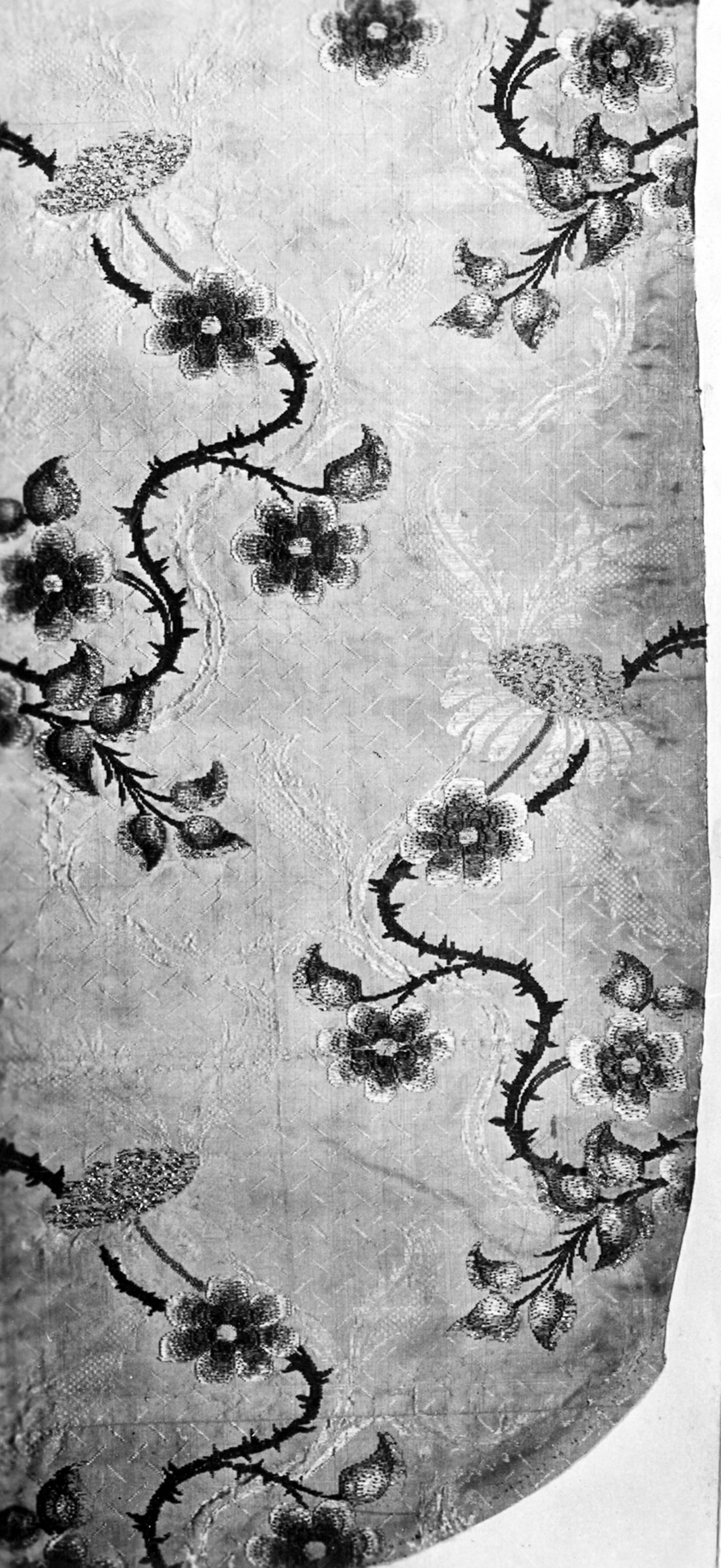
The Fragment as Archive: Deconstructing Materiality in a Brocaded Plain Compound Cloth
Introduction: The Unspoken Narrative of the Fragment
In the hallowed ateliers of London’s Savile Row, where precision tailoring meets centuries of sartorial lineage, the fragment is not a remnant of failure but a repository of truth. The object under scrutiny—a silk, brocaded plain compound cloth—is a paradoxical artifact. It is simultaneously a whisper of a finished garment and a testament to the rigorous craftsmanship that defines classic silk weaving. This heritage research artifact, though incomplete in form, is complete in its material testimony. It speaks of the weaver’s hand, the dyer’s chemistry, and the designer’s ambition. As a Senior Heritage Specialist for the Lauren Fashion Heritage Lab, I approach this fragment not as a broken piece, but as a microcosm of the entire silk industry’s evolution, from the mulberry fields of East Asia to the bespoke suits of Mayfair.
Materiality: The Structural Integrity of Brocaded Plain Compound Cloth
Silk as a fiber is defined by its tensile strength, luster, and hygroscopic nature. Yet, in the context of a brocaded plain compound cloth, the materiality transcends mere fiber properties. The term “compound cloth” indicates a weave structure where two or more sets of warp or weft threads are interlaced to create a patterned surface, often with a ground weave and a supplementary brocading weft. This is not a simple tabby; it is a deliberate, engineered complexity. The fragment reveals a ground of plain weave—the most fundamental interlacing—which provides structural stability. Upon this, a brocading weft of contrasting color and texture is introduced, floating across the surface to create raised, ornamental motifs. This technique, perfected in the 18th and 19th centuries, requires the weaver to manipulate each supplementary thread by hand or via a Jacquard mechanism, a precursor to modern computing. The fragment’s edges, frayed but intact, show the precision of the original cut, likely from a larger panel destined for a waistcoat or cravat. The silk’s patina—a subtle yellowing on the reverse side—indicates natural aging, but the brocaded areas retain their chromatic vibrancy, a testament to the quality of the dyes used, likely derived from cochineal or indigo.
Context: Classic Silk Craftsmanship and Fluid Elegance
The phrase “fluid elegance” is not mere poetic license; it is a technical descriptor. Silk’s natural drape, combined with the brocaded compound structure, creates a fabric that moves with the body while maintaining its architectural form. In Savile Row tradition, such cloths were reserved for evening wear and ceremonial attire, where the interplay of light and shadow on the brocaded motifs—often floral or geometric—could be fully appreciated. The fragment’s provenance, though undocumented, suggests a mid-19th-century origin, a period when British silk weaving, centered in Spitalfields, competed fiercely with French and Italian imports. The compound weave allowed for intricate patterns without sacrificing the fabric’s weight, making it ideal for the structured yet fluid silhouettes of the Victorian era. The “classic” nature of this craftsmanship lies in its adherence to principles of balance: the ground weave provides the canvas, the brocading weft provides the narrative. This is not mass production; it is the result of a master weaver’s decision-making, where every thread is a deliberate choice.
Heritage Interpretation: The Fragment as a Pedagogical Tool
For the Lauren Fashion Heritage Lab, this fragment serves as a primary source for understanding the intersection of art and industry. It challenges the modern notion that heritage is static. Instead, the fragment invites a forensic analysis of technique. By examining the thread count, the twist direction of the silk filaments, and the density of the brocading weft, we can reconstruct the loom’s setup and the weaver’s skill level. The fragment also reveals the economic realities of its time: the use of a plain compound weave, rather than a more expensive damask or velvet, suggests a clientele that valued elegance but operated within a budget—a hallmark of the emerging middle class in Victorian London. Furthermore, the fragment’s survival is itself a heritage narrative. It was likely preserved as a sample swatch, a practice common among tailors and textile merchants to document available patterns. This fragment, therefore, is not just a piece of cloth; it is a ledger of taste, a record of what was considered desirable in a specific historical moment.
Preservation and the Future of Heritage Research
As a heritage specialist, I must address the fragment’s fragility. Silk is a protein-based fiber, susceptible to light, humidity, and acidity. The brocaded areas, with their supplementary wefts, are particularly vulnerable to abrasion and loss. Conservation protocols dictate that this fragment be stored in a dark, climate-controlled environment, mounted on an acid-free board, and handled only with gloves. However, its true value lies in its accessibility to researchers and designers. Digital imaging, including multispectral analysis, can reveal faded patterns and dye compositions without physical contact. The fragment can then be used as a reference for contemporary textile design, inspiring new interpretations of classic brocading techniques. In this way, the fragment becomes a bridge between past and future, a tangible link that informs the fluid elegance of tomorrow’s couture.
Conclusion: The Enduring Legacy of the Fragment
The silk, brocaded plain compound cloth fragment is far more than a remnant. It is a testament to the enduring principles of craftsmanship that define classic silk weaving. Its materiality—the interplay of ground and brocading wefts—embodies the tension between structure and ornament, between tradition and innovation. In the context of Savile Row, where every garment is a bespoke narrative, this fragment reminds us that heritage is not about preserving the past intact, but about understanding the processes that created it. As we continue to study and interpret such artifacts, we honor the weavers, dyers, and tailors who transformed raw silk into fluid elegance. The fragment, in its incomplete state, is complete in its capacity to teach, inspire, and endure. It is, in the truest sense, a heritage artifact of profound significance.