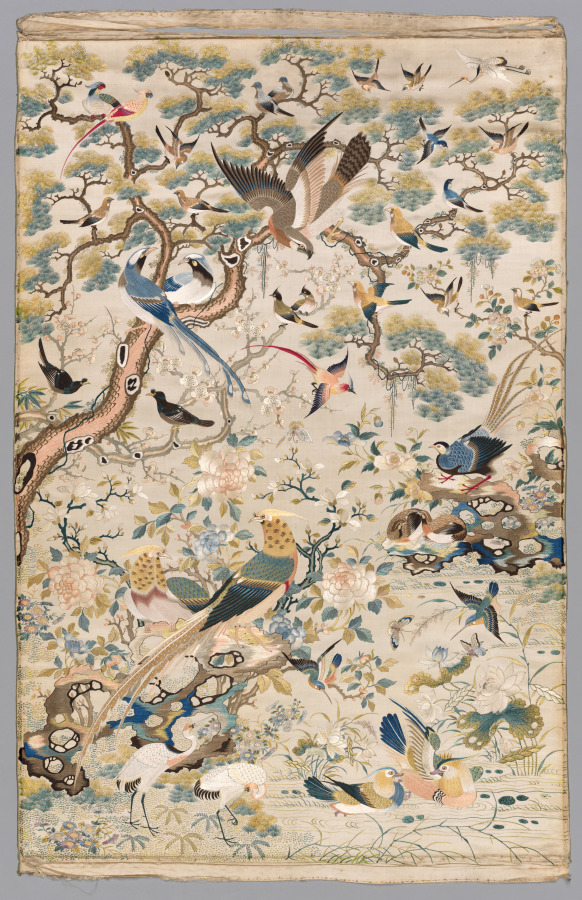
A Myriad of Birds: Silk, Sovereignty, and the Imperial Weave
Introduction: The Thread of Empire
In the hushed ateliers of London’s Savile Row, where the cut of a jacket is a matter of architectural precision, we rarely pause to consider the raw material’s journey from the loom to the lapel. Yet, for the connoisseur of heritage, the fabric itself is a narrative. Silk, particularly that woven for imperial courts, is not merely a textile; it is a document of power, artistry, and ecological reverence. The subject of this artifact—A Myriad of Birds—embodies this legacy. It is a silk panel, likely from the late Qing Dynasty (circa 18th-19th century), depicting an avian abundance against a ground of deep, resonant indigo. This piece, preserved in the Lauren Fashion Heritage Lab, speaks to the zenith of imperial silk weaving, where materiality and symbolism converged to assert dominion over both nature and commerce.
Materiality: The Alchemy of Silk
The foundation of this artifact is silk, a protein fibre extruded by the Bombyx mori silkworm. Its production, a closely guarded secret for millennia, was the lifeblood of the Silk Road. In imperial China, silk was more than a commodity; it was a currency of status and a medium for spiritual expression. The materiality of this panel is exceptional. The warp and weft are of the highest grade, with a thread count that suggests a kesi (cut silk) technique—a tapestry weave where each colour is woven independently, creating a sharp, almost painted effect. The silk’s lustre, even after centuries, retains a soft, liquid sheen, a testament to the sericin (silk gum) that was meticulously removed to enhance the fibre’s natural radiance. The weight is substantial, yet the drape is fluid, a paradox achieved through the tight, even tension of the loom. This is not a fabric for the commoner; it is a textile engineered for the ceremonial robes of the Son of Heaven.
The Motif: A Myriad of Birds as Imperial Lexicon
The design—A Myriad of Birds—is a deliberate iconographic programme. In Chinese cosmology, birds are intermediaries between heaven and earth. The phoenix (fenghuang), the most prominent figure, is the empress of all birds, symbolising virtue, grace, and the union of yin and yang. Surrounding it are cranes, representing longevity; magpies, heralding joy; and mandarin ducks, emblematic of fidelity. Each bird is rendered with anatomical precision, yet stylised within the conventions of courtly art. The beaks, claws, and plumage are delineated with gold-wrapped thread (golden silk), a technique that required the beating of pure gold into foil, cutting it into filaments, and twisting it around a silk core. This gold thread catches the light, creating a shimmering, three-dimensional effect that reinforces the birds’ celestial nature. The background, a deep indigo, is achieved through multiple dye baths of Indigofera tinctoria, a plant that yields a colour associated with the heavens and the emperor’s authority. The juxtaposition of gold and indigo is not merely aesthetic; it is a visual assertion of imperial power—the divine right to command the skies.
Context: The Legacy of Imperial Silk Weaving
The legacy of imperial silk weaving is one of systematised perfection. Under the Ming and Qing dynasties, the Imperial Silk Workshops in Suzhou, Hangzhou, and Nanjing operated under the direct supervision of the court. These were not factories in the industrial sense; they were academies of craft, where master weavers trained for decades. The production of a single robe could take months, involving hundreds of hands—from the silkworm rearers to the dyers, pattern designers, and weavers. The A Myriad of Birds panel would have been part of a larger garment, likely a chaopao (court robe) or a mangpao (dragon robe) for a high-ranking official or imperial consort. The birds, while decorative, were also coded: the number of birds, their arrangement, and the specific species denoted rank and occasion. A robe with nine phoenixes, for instance, was reserved for the empress dowager. This system of visual hierarchy ensured that silk was not just beautiful but legible—a language of power woven into the very fabric.
Savile Row Resonance: Craft, Legacy, and the Modern Eye
For the client of Savile Row, this artifact offers a profound lesson in material integrity. The imperial weavers understood that silk is a living fibre; it breathes, ages, and responds to light. A modern tailor, handling a length of this silk, would recognise the impossibility of replicating its quality with contemporary machine-made fabrics. The kesi technique, with its discontinuous wefts, creates a fabric that is both supple and resilient—ideal for the structured shoulders of a bespoke jacket, yet soft enough to drape like liquid. The gold thread, while impractical for daily wear, reminds us that luxury is not about convenience but about intention. Every bird, every thread, every dye bath was a decision made in service of a higher purpose: to clothe the divine on earth.
Conclusion: The Eternal Flight
A Myriad of Birds is not a relic; it is a reference. In the Lauren Fashion Heritage Lab, it serves as a benchmark for what silk can achieve when craft is elevated to an art form. The legacy of imperial silk weaving is not confined to history books or museum vitrines. It lives in the hands of the master weaver who still practices kesi in a Suzhou studio, and in the discerning eye of the Savile Row cutter who selects a silk for its weight, its drape, and its story. This panel, with its myriad of birds in eternal flight, reminds us that the finest fabrics are those that carry the weight of the world—and the lightness of a feather. For the gentleman who wears a garment cut from such cloth, he does not merely wear silk; he wears a heritage of sovereignty, a testament to the human hand, and the enduring song of a thousand birds.