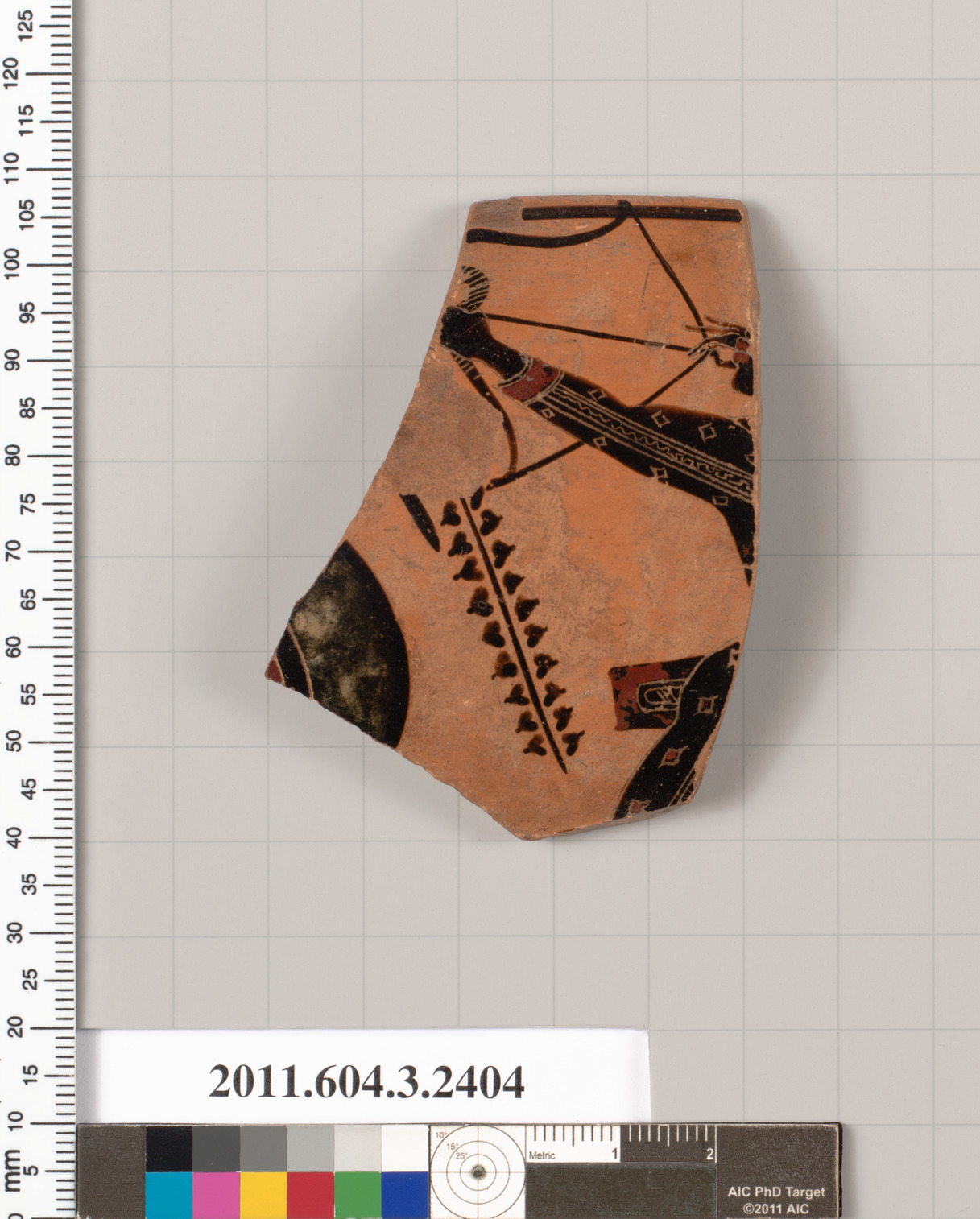
From Terracotta Fragment to Tailored Silence: The Kylix Eye-Cup as a Hermeneutic of Old Money Restraint in the 2026 Lauren Collection
The Lauren Fashion Heritage Lab’s internal genetic code, which juxtaposes the Renaissance’s The Agony in the Garden with the modern vapor-traced Below, I Saw the Vaporous Contours of a Human Form, reveals a profound dialectic: the tension between material certainty and immaterial presence. This dialectic finds an unexpected, yet remarkably fertile, archaeological analogue in the museum artifact under consideration—a terracotta rim fragment of a kylix, specifically an Attic eye-cup (drinking cup). At first glance, a shard of painted earthenware from the 6th century BCE seems an unlikely interlocutor for a 2026 Old Money silhouette. Yet, within this broken rim, with its iconic apotropaic eye, lies a masterclass in the very aesthetic principles that define the Old Money ethos: discretion, durability, and a silent command of presence through absence. This paper argues that the terracotta eye-cup fragment, through its materiality, its function, and its visual logic, provides a foundational hermeneutic for the 2026 Lauren collection’s exploration of Old Money silhouettes—a lexicon of form that speaks not through ostentation, but through a curated, almost archaeological, restraint.
I. The Materiality of Silence: Terracotta as a Proto-“Heritage-Black”
The chosen category, Heritage-Black, is not a color but a condition. It is the black of aged patina, of deep shadow in a portrait by Velázquez, of the void between stars in the Agony’s night sky. The terracotta fragment, fired from common clay, is the antithesis of precious metals or vibrant dyes. Its value is not in its raw material but in its crafted resilience. This is the first lesson for the 2026 silhouette: Old Money does not announce itself through novelty of fiber, but through the authority of endurance. Just as the kylix’s clay has survived millennia, the 2026 collection’s “Heritage-Black” garments—think a double-faced cashmere overcoat or a tailored wool suit—derive their power from a material presence that feels both ancient and inevitable. The terracotta’s porous, matte surface, its slight irregularity of hand-thrown form, teaches us that true luxury is not about flawless perfection, but about a tactile history. The 2026 silhouette, therefore, rejects the high-shine of synthetic luxury; it embraces the matte finish, the subtle slub of a silk faille, the weight of a wool that drapes like a second skin. It is a materiality that whispers, never shouts.
II. The Eye-Cup’s Gaze: The Apotropaic Function of the Old Money Silhouette
The defining feature of the kylix fragment is the painted eye—large, staring, unblinking. On a drinking cup, this eye served an apotropaic function: to ward off the evil eye, to protect the drinker during the vulnerable act of consumption. In the context of the 2026 Old Money silhouette, this eye becomes a metaphor for the garment’s own protective, commanding presence. The Old Money silhouette is not merely clothing; it is a visual boundary. A sharply tailored jacket, a high-necked cashmere turtleneck, a floor-sweeping coat—these are not just coverings. They are architectural shields that deflect the casual, invasive gaze of the contemporary world. They create a zone of privacy, a “sacred precinct” around the wearer, much like the kylix’s eye created a zone of spiritual safety around the drinker.
This is the “vaporous contour” made solid. Where the modern artwork in our genetic code presents a dissolving form, the Old Money silhouette, informed by the kylix, presents a deliberately fixed, almost monumental form. It is the antidote to digital dissolution. The broad shoulder of a 2026 coat, the strict line of a trouser—these are not merely stylistic choices; they are acts of resistance against the blurring of identity. They say: “I am here. I am substantial. I am not a vapor.” This is the “Agony in the Garden” made wearable—a form that contains, with immense discipline, a profound interiority. The silhouette does not reveal the soul; it protects it.
III. The Fragment and the Whole: Silhouette as Archaeological Gesture
The museum artifact is a fragment. It is a part that implies a lost whole. This is a crucial design principle for the 2026 Old Money aesthetic. The collection does not present a complete, finished “look” in the manner of a fast-fashion mannequin. Instead, it offers silhouettes that feel like fragments of a larger, more enduring wardrobe—a wardrobe that has been curated over decades, not purchased in a season. A single, perfectly cut blazer is not an outfit; it is a fragment of a life. The 2026 silhouette, therefore, emphasizes modularity and timelessness. A cashmere crewneck is not a trend; it is a foundational shard of a personal canon. The garment’s cut—its “silhouette”—becomes the rim of the kylix: the defining edge that suggests the entire vessel of the wearer’s character.
This archaeological approach also informs the silhouette’s relationship to the body. The Old Money garment is not a second skin; it is a shell, a vessel. It creates a space between the fabric and the flesh—a negative space that is as important as the positive form. This is the “vaporous contour” rendered as a tailored void. The shoulder of a 2026 coat does not cling; it stands away, creating an air of quiet authority. The trouser falls with a clean break, not a tight grip. This is not about hiding the body, but about elevating it into a sculptural presence. The garment becomes a terracotta effigy—a durable, dignified form that houses the living, breathing individual within.
IV. The Color of Time: Heritage-Black and the Patina of Use
Finally, the terracotta fragment teaches us about color. The fired clay is not a pure black; it is a deep, earthy brown-black, a color born of fire and time. The Heritage-Black of the 2026 collection is not the flat, synthetic black of a new polyester garment. It is a living black that absorbs and reflects light differently depending on the weave and the wear. It is the black of a well-worn leather shoe, of a vintage wool coat that has been brushed for decades, of a silk tie that has developed a subtle, iridescent bloom. This is a black that carries memory—the memory of the kiln, the memory of the tailor’s hand, the memory of the wearer’s life.
In the Agony in the Garden, the night sky is a deep, resonant black that holds the promise of dawn. In the Vaporous Contours, the form is a ghostly black against a lighter void. The 2026 Old Money silhouette, channeling the kylix, occupies a third space: it is a black that is solid, present, and enduring. It is the black of the earth from which the clay was taken, the black of the shadow cast by a body of substance. It is, in essence, the color of gravity. It does not try to be invisible; it seeks to be unforgettable in its quiet permanence.
Conclusion: The Unblinking Garment
The terracotta eye-cup fragment, a broken relic of a symposium long ended, offers the 2026 Lauren collection a profound design philosophy. It teaches that the ultimate luxury is not novelty, but presence; not display, but protection; not completeness, but the eloquence of the fragment. The Old Money silhouette, as interpreted through this artifact, becomes an apotropaic garment—a wearable eye that stares back at the chaos of the contemporary world with unwavering, silent authority. It is a silhouette carved from the Heritage-Black of time itself, a form that contains the agony of existence and the vapor of identity within a single, unbroken line. It is, in the end, a garment that does not ask to be seen, but commands to be felt—a terracotta shard of a life well-lived, worn with the quiet confidence of one who knows that true power needs no explanation.