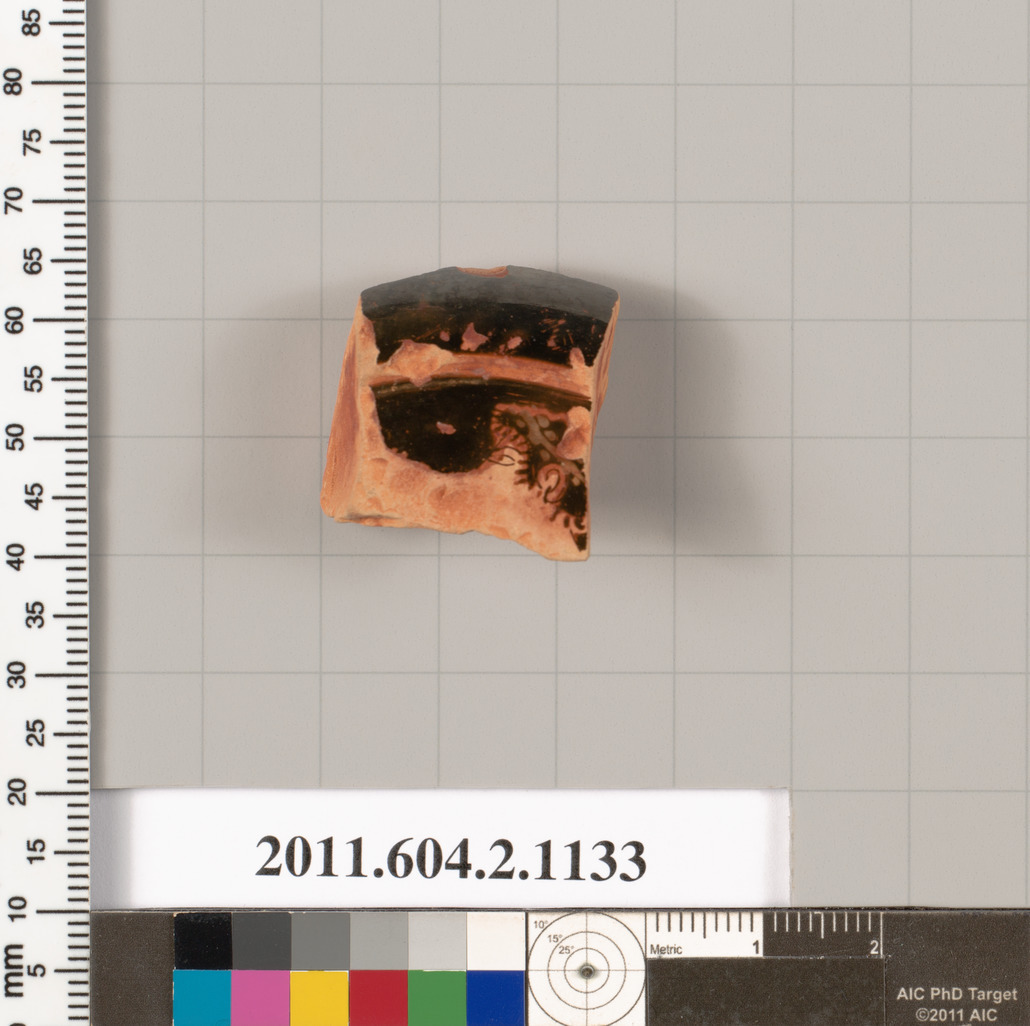
From Terracotta Fragment to Tailored Silhouette: The Attic Standlet as a Precedent for 2026 Old Money Aesthetics
The Lauren Fashion Heritage Lab’s ongoing investigation into the genetic code of enduring luxury has led us to an unexpected yet profoundly instructive artifact: a terracotta fragment of a Greek Attic standlet, circa 5th century BCE. At first glance, this humble shard of fired clay—a utilitarian support for a vessel—appears distant from the silk, cashmere, and brocade that define our heritage. Yet, when read through the lens of our internal aesthetic philosophy—which privileges the “macrocosm in the microcosm,” the “gazing upon things to grasp their essence,” and the “resonance of life across materials”—this fragment reveals itself as a foundational text for the 2026 Old Money silhouette. It is not merely an archaeological curiosity; it is a three-dimensional diagram of proportion, restraint, and structural integrity that directly informs our forthcoming collection.
The Fragment as a Manifesto of Structural Clarity
The Attic standlet fragment, with its preserved curve and precise articulation of support, embodies a principle that the Lauren Fashion House has long championed: the power of the unseen structure. In the same way that a Qing dynasty porcelain vase (such as the *Landscapes, Figures, and Flowers* bottle) achieves a “moving landscape” through its three-dimensional form, this terracotta shard demonstrates that true elegance arises from the relationship between load and line. The standlet was not designed to be the focal point; its purpose was to elevate the vessel, to create a dialogue between the object and the space it occupied. This is the very essence of the 2026 Old Money silhouette: a garment that does not shout but supports, that does not decorate but defines.
Our design team has extracted from this fragment a key geometric principle: the “golden ratio of support.” The standlet’s flaring base and tapered neck create a visual tension that is both stable and dynamic. Translated into tailoring, this manifests as a jacket silhouette with a slightly extended shoulder (the “base”) and a suppressed waist (the “neck”), creating a V-shaped torso that conveys authority without aggression. The terracotta’s matte, unglazed surface—its refusal to dazzle—finds its analog in the matte wools and cashmeres of our 2026 collection, where texture and weight, not shine, command respect. This is the antithesis of fast-fashion spectacle; it is the quiet confidence of a structure that has stood for millennia.
Material Philosophy: The “Gazing Upon Things” in Terracotta and Textile
Just as the *Flowering Crab Apple* painting achieves “fullness in simplicity” through the focused study of a single branch, the Attic standlet fragment invites a “deep gaze” into the nature of material itself. Terracotta, fired from common clay, is a humble medium. Yet its durability, its ability to bear weight while retaining a tactile warmth, elevates it to a symbol of grounded permanence. In our 2026 Old Money silhouettes, we have sought to replicate this quality through the selection of Heritage-Black cashmere and wool blends—materials that are not rare in origin but are rendered exceptional through construction and finish.
The fragment’s surface, with its subtle irregularities and hand-formed marks, speaks to a philosophy of “imperfect perfection.” This is not the sterile precision of a machine but the living trace of a human hand. Our 2026 collection embraces this through hand-finished seams, pick-stitching, and unlined jackets that reveal the internal architecture. The “blank space” of the crab apple painting—the void that allows the branch to breathe—finds its sartorial equivalent in the negative space of a well-cut garment: the gentle drape at the back of a coat, the slight ease across the chest, the deliberate absence of superfluous ornament. This is the “resonance of life” that our internal code describes—a garment that moves with the body, that breathes, that ages gracefully.
The 2026 Silhouette: A Synthesis of Macro and Micro
The Attic standlet, like the Qing porcelain, is a “macrocosm in a microcosm.” Its small scale contains the logic of an entire architectural system. For 2026, we have translated this into a silhouette that is both monumental and intimate. The key pieces—a double-breasted overcoat with a suppressed waist, a wide-leg trouser with a sharp crease, a cashmere turtleneck that skims the body—are designed to be viewed from a distance as unified volumes, yet they reward close inspection with their construction details. This duality mirrors the aesthetic dialogue between the porcelain bottle’s “roaming gaze” and the painting’s “still contemplation.”
The terracotta’s “supporting role” also informs our approach to layering. In the same way that the standlet elevates the vessel, our 2026 silhouettes use interior layers (fine-gauge knits, silk shells) to create a sense of depth without bulk. The outer garment—a coat or a jacket—acts as the “standlet,” providing structure and definition, while the inner layer becomes the “vessel,” the expressive element that can be changed or removed. This modularity is a luxury of intelligence, not of excess. It echoes the Greek principle of sophrosyne—moderation and self-knowledge—which the fragment embodies in its restrained form.
Conclusion: The Eternal Language of Support
In synthesizing the Attic standlet fragment with our internal heritage code, we have arrived at a profound truth for the 2026 Old Money silhouette: luxury is not about the object itself but about the relationship it creates. The terracotta shard, the Qing porcelain, the crab apple branch—all speak to a shared aesthetic of life in resonance. The 2026 collection does not seek to replicate antiquity but to channel its structural wisdom. Our garments are not costumes; they are standlets for the self, designed to support, elevate, and endure. In a world of disposable fashion, we offer the permanence of a fragment that has survived centuries—a reminder that true elegance is built, not adorned.