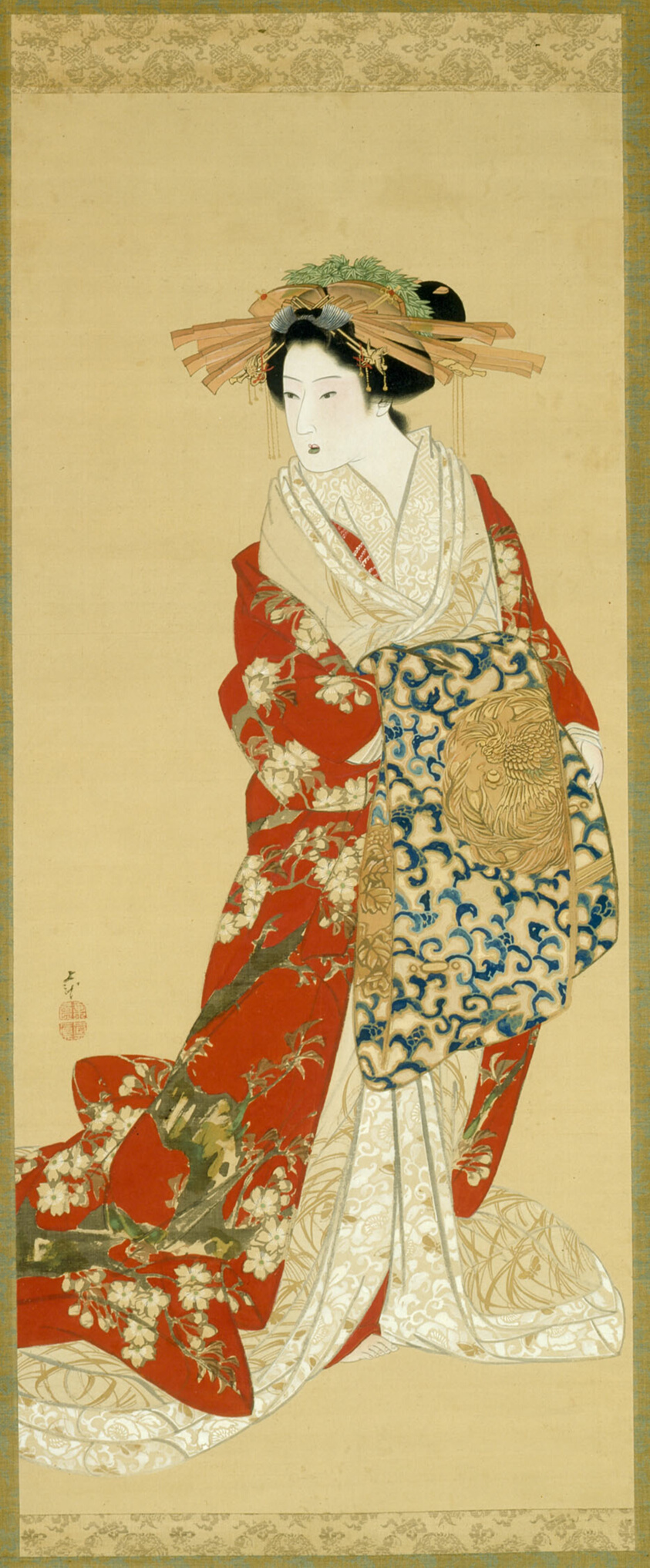
The Materiality of Influence: A High Ranking Courtesan in Ink, Color, and Gold on Silk
In the rarefied echelons of heritage craftsmanship, where the thread count of history is measured in microns of gold leaf and the warp of societal power is woven with silk, the artifact before us commands a distinct and profound reverence. This is not merely a painting; it is a testament to the symbiotic relationship between materiality and status, a dialogue between the artisan’s hand and the subject’s aura. The piece, depicting a high-ranking courtesan of the late Edo period, is rendered in ink, color, and gold on silk. It is a masterclass in the language of luxury, spoken in the dialect of classic silk craftsmanship and fluid elegance. To understand this artifact is to understand the very fabric of influence—a fabric that, like a well-tailored suit from Savile Row, is cut from precision, lined with tradition, and finished with an unspoken authority.
The Silk as Canvas: A Foundation of Prestige
Silk is not a passive substrate in this composition; it is the primary protagonist. In the context of Japanese heritage, silk was the exclusive domain of the elite—a material so precious that its production was a guarded state secret for centuries. The choice of silk as the ground for this courtesan’s portrait is a deliberate assertion of her elevated station. Unlike paper or wood, silk possesses a luminous, almost breathing quality. The fibers catch and refract light, creating a subtle, shifting depth that mirrors the courtesan’s own performative nature. This is not a static image; it is a living surface, one that responds to the ambient light of a room, much as the courtesan herself would have commanded the attention of a dimly lit tea house.
The silk here is of the finest grade, likely a habutae or rinzu weave, characterized by its smooth, unblemished surface and a slight, almost imperceptible sheen. This is the canvas of a connoisseur, not a commoner. The artisan has prepared the silk with a sizing of alum and animal glue, a painstaking process that ensures the ink and pigments bond without bleeding—a metaphor for the courtesan’s own controlled composure. The materiality of the silk speaks to a lineage of craftsmanship that values patience over speed, quality over quantity. It is the same ethos that underpins the bespoke tailoring of Savile Row, where a single jacket may require 50 hours of hand-stitching. Here, the silk is the bespoke cloth, and the courtesan is the garment.
Ink and Color: The Architecture of Elegance
The application of ink and color on this silk is a study in restraint and precision. The courtesan’s kimono, rendered in layers of vermillion, indigo, and ochre, is not merely decorative; it is a coded language of status. The deep, saturated reds—derived from safflower or cochineal—were prohibitively expensive, reserved for those who could afford to wear their wealth. The indigo, a color of depth and stability, speaks to her cultivated interiority. The artisan has used sumi ink for the outlines and hair, a material that requires a steady hand and an intimate understanding of brush pressure. Each stroke is deliberate, each line a declaration of the courtesan’s poise.
What elevates this piece beyond mere portraiture is the fluid elegance of the brushwork. The kimono’s folds are not rigid; they flow with a liquid grace, suggesting movement even in stillness. The courtesan’s posture—slightly turned, one shoulder lowered, a fan held with delicate tension—is a choreography of allure. The ink lines are thin and precise around her face, thickening slightly at the edges of her sleeves, mimicking the way silk itself drapes and gathers. This is not a photographic reproduction; it is an interpretation of presence. The color palette, while rich, is never garish. It is the palette of a woman who understands that true power is not in shouting, but in whispering. This is the same principle that governs the finest tailoring: a suit should never scream for attention; it should command it through fit and fabric.
Gold on Silk: The Luminescence of Authority
The inclusion of gold is the artifact’s most potent signifier. Applied as kinpaku (gold leaf) or surihaku (gold dust), the metal is not used indiscriminately. It appears in the courtesan’s hair ornaments, the subtle patterning of her obi, and the faint, almost ethereal halo around her silhouette. This is not ostentation; it is a strategic deployment of light. Gold on silk creates a dynamic interplay of reflection and absorption. As the viewer moves, the gold catches the eye, drawing attention to specific details—the curve of her neck, the intricate knot of her sash, the delicate fan she holds. It is a form of visual architecture, guiding the gaze with the same precision that a Savile Row cutter uses a chalk line.
The gold also serves a symbolic function. In Japanese culture, gold was associated with the divine, the eternal, and the unassailable. For a high-ranking courtesan, gold was a marker of her ability to transcend her social station. She was not merely a provider of pleasure; she was a curator of culture, a patron of the arts, and a confidante to the powerful. The gold on this silk is a declaration of her sovereignty. It is the equivalent of a bespoke watch or a hand-stitched lapel—a detail that only the discerning eye would recognize, but one that speaks volumes to those who understand the language of luxury.
Classic Silk Craftsmanship: The Unseen Hand
Behind this artifact lies a tradition of classic silk craftsmanship that is as rigorous as it is reverent. The silk itself was woven by artisans who spent decades perfecting their trade, often working in near-silence to maintain the tension of the threads. The preparation of the pigments—grinding minerals, mixing binders, testing hues—was a science as much as an art. The application of gold required a steady hand and a breath held in check, for a single tremor could ruin hours of work. This is craftsmanship that does not seek recognition; it seeks perfection. It is the same ethos that defines the ateliers of Savile Row, where a master tailor may spend a lifetime perfecting a single shoulder seam.
The courtesan’s portrait is, therefore, a collaboration between the subject and the artisan. She provided the presence; he provided the permanence. Together, they created an artifact that transcends its material components. The silk, ink, color, and gold are not just materials; they are the vocabulary of a visual language that speaks of power, grace, and the fleeting nature of beauty. This is a heritage artifact that does not simply depict a high-ranking courtesan; it embodies her. It is a piece of history that, like a well-worn suit, carries the memory of its making and the weight of its context.
Conclusion: The Enduring Thread
In the world of heritage research, we often speak of provenance and condition, of attribution and technique. But what this artifact demands is a deeper reading—a reading that acknowledges the materiality of influence. The high-ranking courtesan, rendered in ink, color, and gold on silk, is a testament to the power of craftsmanship to elevate the human subject. She is not just a figure in a painting; she is a statement of what is possible when skill, material, and intention converge. For the connoisseur of heritage, this piece is a reminder that true elegance is never accidental. It is engineered, stitched, and gilded with the same meticulous care that defines the finest traditions of silk craftsmanship. And like the best of Savile Row, it will endure—not because it is preserved in a vault, but because it continues to speak to those who understand the language of quality.