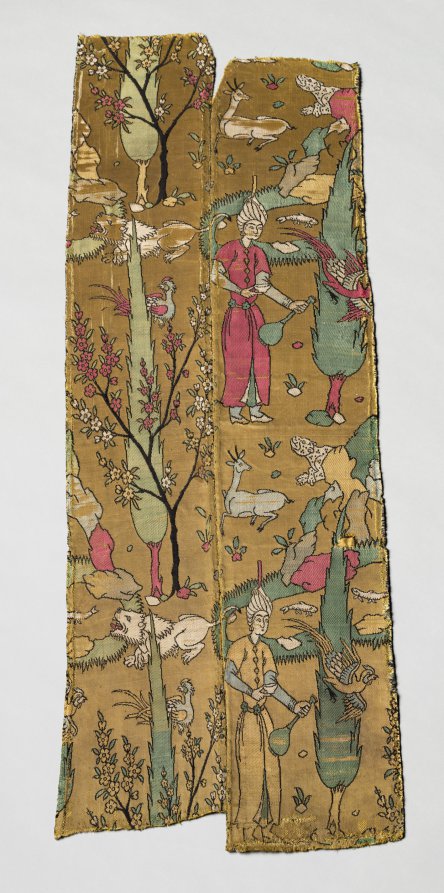
An Exegesis of Thread and Topography: The Wine Bearer Motif in Imperial Silk Weaving
To engage with this fragment—a depiction of wine bearers within a cultivated landscape, rendered not in pigment but in silk—is to accept a commission of the most profound order. One is not merely examining a textile; one is conducting an audit of cultural capital, woven over centuries upon the most exacting of looms. The materiality is not incidental; it is the very thesis. Silk, here, is the absolute and non-negotiable substrate of imperial expression, a fibre so imbued with sovereignty that its very production was, for epochs, a state secret guarded under penalty of death. To clothe an idea in silk is to elevate it beyond the pictorial; it is to encode it within the very fabric of power, rendering it tactile, wearable, and transmissible.
The Commission: Landscape as an Assertion of Dominion
The scene presented—figures bearing amphorae through a terrain of gentle rises and scholarly retreats—is, to the untutored eye, merely pastoral. This is a misapprehension of the highest order. In the canon of imperial silk weaving, the landscape is never a mere backdrop; it is a meticulously composed statement of territorial and philosophical control. The ordered vines, the harmonious integration of human activity within the natural undulation, the serene passage of the bearers: this is a topography of ideal governance. It depicts a world rendered bountiful and compliant through enlightened administration. The robe upon which this was woven did not simply adorn a body; it enveloped the wearer in a metaphor of their own benevolent rule, a constant, whispering reminder that their person was the axis upon which this perfected world turned.
The Figures: Ritual and Service Woven in Code
Consider the wine bearers themselves. They are not peasants; they are functionaries in a serene, eternal ritual. Their posture, the careful balance of their vessels, the rhythmic progression implied by their placement—these are not the erratic movements of labour, but the measured steps of a ceremonial duty. In the context of the imperial court, wine was never merely a beverage. It was the lubricant of diplomacy, the sacrament of poetry competitions, the medium through which favour was pledged and loyalty toasted. The bearer is thus a crucial conduit of statecraft. To immortalise this figure in silk is to acknowledge the silent, seamless machinery of service that underpins the visible spectacle of power. The weave captures them in perpetual, graceful motion, an idealised vision of a social order functioning without friction.
The Loom as Legislative Chamber
The execution, of course, is everything. The legacy we address is that of imperial silk weaving—a discipline that married artistic vision with technical tyranny. We speak of workshops like those of Suzhou or Nanjing, operating under imperial patronage, where patterns were decreed from the centre and executed with precision that bordered on the fanatical. The complex landscape, with its varying depths and the delicate folds of the bearers' garments, would have demanded a kesi (slit-tapestry) technique or a sophisticated satin-weave derivative. This is where the true heritage resides: in the unbearable tension between fluid, pictorial ambition and the grid-locked binary of warp and weft. Each subtle gradation in the hill, each suggestion of cloud, is a hard-won victory over the loom's inherent geometry. The design is not printed; it is built, thread by strategic thread, a pixelated masterpiece achieved centuries before the digital age. The resulting artifact possesses a depth and a durability of both colour and concept that lesser methods cannot hope to replicate.
A Legacy in the Modern Bale
What, then, is the enduring bequest of such a piece for the contemporary connoisseur, the modern purveyor of heritage? It is a masterclass in the articulation of identity through material. The imperial silk weavers understood that cloth is communication. Every element—the fibre, the motif, the technique—was a conscious choice contributing to a singular, authoritative narrative. In an age of disposable imagery, this fragment reminds us that true presence is cultivated. It argues for the considered application of symbol, for the weight of history carried in a pattern, and for the irreducible value of craftsmanship that submits to no shortcut. The wine bearers, in their serene traversal of an eternal landscape, are not simply figures from a past era. They are emissaries from a paradigm where quality was sovereign, where detail was dogma, and where an individual's standing was irrevocably intertwined with the calibre of the silk they had the privilege to wear. To study this artifact is to understand that heritage is not a faint echo from a museum case. It is a vibrant, demanding dialogue between the past's most exacting standards and the present's potential for equivalent rigour. The loom may be silent, but its lesson—that excellence is woven, one deliberate thread at a time—resonates with undiminished clarity.