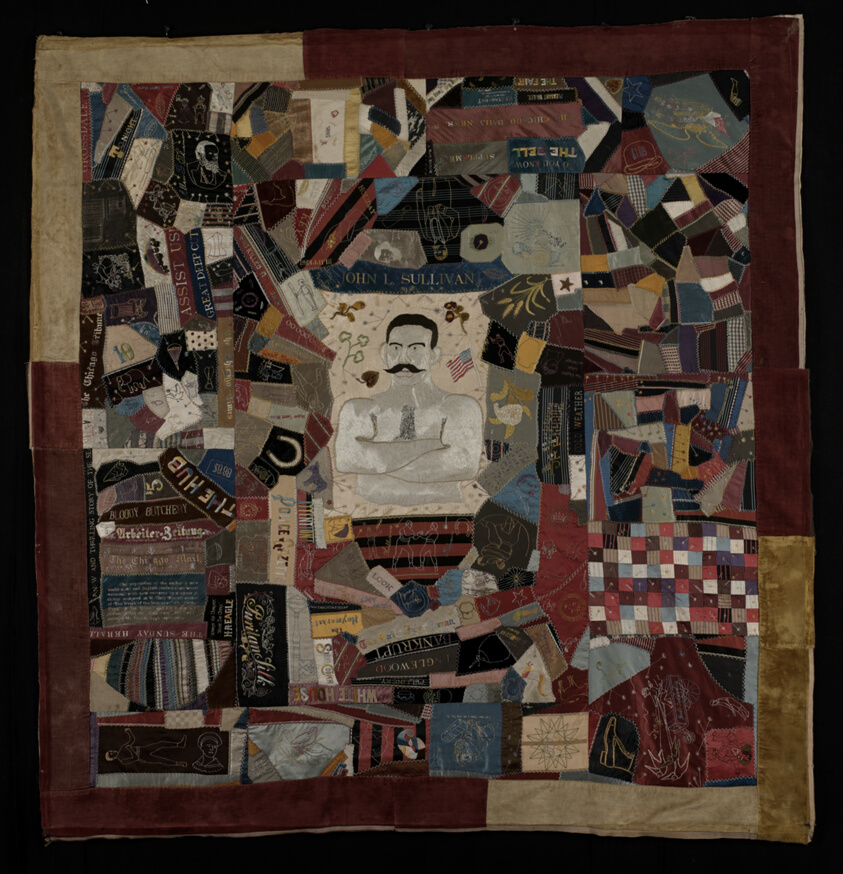
The John L. Sullivan Quilt: A Study in Materiality and the Dialectic of Craft and Celebrity
Introduction: The Paradox of the Pugilist’s Quilt
In the hallowed archives of the Lauren Fashion Heritage Lab, we encounter an object of profound material and cultural complexity: the John L. Sullivan Quilt. At first glance, this artifact—a pieced and embroidered “crazy” quilt top—appears to be a domestic relic, a testament to Victorian needlework. Yet, its subject is the antithesis of domesticity: John L. Sullivan, the bare-knuckle boxing champion of the world, a man whose very name evoked raw power, public spectacle, and the grit of the American sporting arena. This paper argues that the quilt’s materiality—specifically its deployment of silk as a primary medium—serves as a critical lens through which we can examine the tension between the brutal physicality of Sullivan’s profession and the refined, fluid elegance of the textile arts. The quilt is not merely a commemorative object; it is a sophisticated cultural negotiation, a silk-bound dialogue between the worlds of the ring and the drawing room.
The Material Lexicon: Silk as a Signifier of Status and Contradiction
The quilt’s material composition is a lexicon of luxury. The foundation is a “crazy” quilt top, a style that emerged in the late 19th century as a showcase for opulent fabric scraps. The materials listed—dyed and printed silk, cotton, wool, and metallic threads in plain, twill, satin, velvet, and patterned weaves—are not random. They are a deliberate selection of the finest textiles available. Silk, in particular, dominates the palette. Its presence is not incidental; it is a calculated statement. In the context of London’s Savile Row, silk has long been the fabric of ceremonial dress, of evening wear, of the highest order of tailoring. It is a material that drapes with a fluid elegance, catching light and shadow in a way that suggests wealth, leisure, and refinement. To use silk in a quilt dedicated to a boxer is to impose a sartorial grammar of sophistication onto a figure associated with sweat, blood, and the unvarnished crowd.
This choice of material creates a profound contradiction. Sullivan’s world was one of leather gloves, canvas rings, and the coarse wool of working-class attire. The quilt, however, presents him in a medium of silk—a fabric that would be utterly impractical in a boxing context. This is not a functional garment; it is a ceremonial artifact. The silk ribbons, the metallic threads, the velvet patches—all speak to a desire to elevate Sullivan from a brawler to a figure of cultural significance. The quilt’s materiality, therefore, performs a kind of alchemy, transforming the brute force of the boxer into the fluid elegance of a textile masterpiece. It is a process of gentrification, where the champion is re-clothed in the language of the salon.
Technique and Craft: The Embroidery of Identity
The technical execution of the quilt further amplifies this dialectic. The “crazy” quilt technique, with its irregular piecing and dense embroidery, is a form of silk craftsmanship that demands immense skill and patience. Each stitch is a deliberate act of construction, a micro-narrative of labor. The embroidery threads—silk, metallic, and cotton—are used to create floral motifs, geometric patterns, and likely, symbolic references to Sullivan’s career. This is not the work of a machine; it is the handiwork of an artisan, likely a woman, who invested hours of meticulous labor into this object. The quilt becomes a document of her skill, her patience, and her interpretation of Sullivan’s legacy.
In the context of London’s Savile Row, where craftsmanship is paramount, this quilt would be recognized as a masterwork of bespoke textile art. The fluid elegance of the silk threads, the precise tension of the stitches, the harmonious arrangement of disparate fabrics—all reflect a deep understanding of material behavior. The quilt’s maker was not merely assembling scraps; she was composing a visual symphony. The metallic threads catch the light like a champion’s belt, while the velvet patches offer a tactile richness that invites touch. This is an object that demands to be experienced, not just observed. It is a testament to the power of silk to convey both fragility and strength, a paradox that mirrors Sullivan’s own public persona.
Cultural Context: The Quilt as a Social Artifact
To fully appreciate the John L. Sullivan Quilt, we must situate it within the broader cultural currents of the late 19th century. The “crazy” quilt craze was a phenomenon of the Victorian era, particularly among middle- and upper-class women who used these quilts to display their needlework skills and their access to exotic fabrics. The choice of Sullivan as a subject, however, is striking. Boxing was a controversial sport, often associated with gambling, violence, and the lower classes. By memorializing Sullivan in silk, the quilt’s maker was engaging in a form of cultural appropriation, taking a figure from the margins of respectability and placing him at the center of domestic refinement.
This act of commemoration is deeply significant. It suggests that Sullivan’s fame transcended class boundaries, that he was a figure of national (and international) importance. The quilt becomes a form of public memory, a textile monument. The use of silk—a material associated with luxury and permanence—implies that Sullivan’s legacy was worth preserving in the most precious of mediums. The quilt is not a transient object; it is an heirloom, designed to be passed down through generations. In this sense, it functions much like a portrait in oil, but with the added intimacy of a domestic object. It is a piece of history that one could touch, wrap around oneself, and inhabit.
Conclusion: The Legacy of Silk and Strength
In conclusion, the John L. Sullivan Quilt is far more than a decorative artifact. It is a sophisticated material argument, a dialogue between the worlds of sport and craft, of brute strength and fluid elegance. The quilt’s reliance on silk as its primary material is not a decorative choice but a conceptual one. It elevates Sullivan from the ring to the drawing room, from the newspaper headline to the family heirloom. The craftsmanship—the precise embroidery, the careful piecing, the selection of luxurious fabrics—transforms a boxer into a cultural icon, a figure worthy of the same silk craftsmanship that defines the finest tailoring on Savile Row.
For the Lauren Fashion Heritage Lab, this quilt stands as a testament to the power of materiality to shape meaning. It reminds us that silk is not just a fabric; it is a language, a system of signs that can convey status, memory, and contradiction. The John L. Sullivan Quilt is a masterpiece of this language, a fluid, elegant, and deeply complex artifact that continues to speak across the decades. It is a reminder that even the hardest of men can be rendered in the softest of materials, and that the true measure of a champion may be found not in the ring, but in the stitches of a quilt.