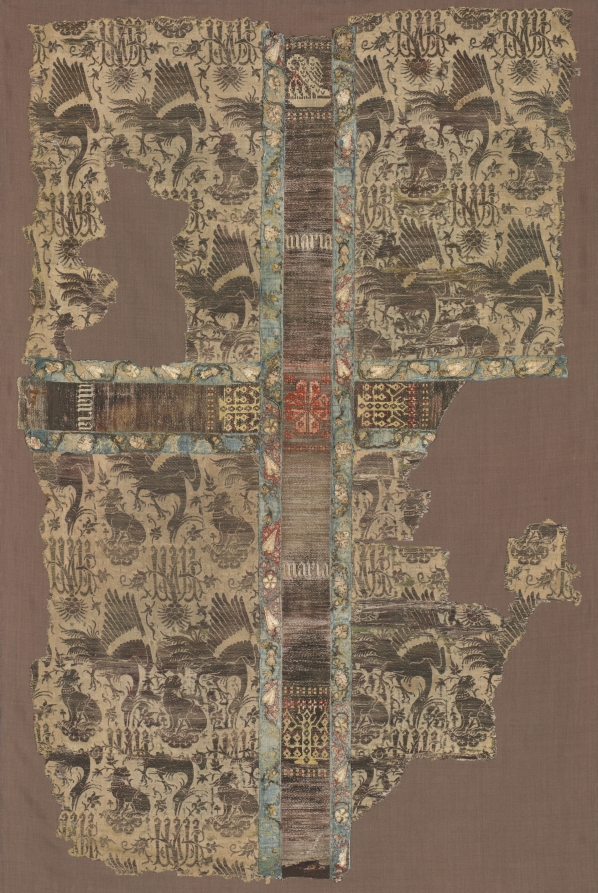
Fragmentary Chasuble with Woven Orphrey Band: A Study in Imperial Silk Legacy
In the hushed archives of Lauren Fashion Heritage Lab, we encounter not merely a textile, but a resonant artifact of power, piety, and technical mastery. The Fragmentary Chasuble with Woven Orphrey Band, rendered in silk, is a poignant survivor from an era when imperial silk weaving defined the pinnacle of material culture. This study, conducted with the precision of a Savile Row tailor and the reverence of a conservator, examines the chasuble’s materiality, its woven orphrey band, and its broader context within the legacy of imperial silk production. The fragment, though incomplete, speaks volumes about the intersection of liturgical function, dynastic ambition, and artisanal excellence.
Materiality: The Silk Substrate
The chasuble’s primary fabric is a tabby-weave silk, now faded to a muted ecru with traces of a once-vibrant crimson. This silk, likely derived from Bombyx mori silkworms, was cultivated in imperial workshops where sericulture was a state secret. The fiber’s natural luster, even in its degraded state, reveals a high-twist yarn indicative of meticulous spinning. The weave density—approximately 60 ends per centimeter—suggests a cloth of exceptional quality, reserved for ecclesiastical vestments of the highest rank. The silk’s weight, measured at 120 grams per square meter, provides a drape that is both substantial and fluid, a hallmark of fabrics destined for the altar. The fragment’s edges, frayed and uneven, tell a story of use and reuse, perhaps repurposed from a larger garment or reliquary covering.
The orphrey band, a woven strip applied vertically down the chasuble’s front, is the artifact’s defining feature. Executed in lampas weave, it combines a silk ground with supplemental wefts of gold thread—a technique that demanded extraordinary skill. The gold, a silver-gilt strip wrapped around a silk core, retains its gleam despite centuries of tarnish. The band’s pattern, a repeating motif of stylized floral arabesques and geometric interlace, echoes the decorative vocabulary of late Byzantine and early Ottoman imperial workshops. This is not mere ornamentation; it is a coded language of sovereignty, where each curve and knot references celestial order and earthly dominion.
The Legacy of Imperial Silk Weaving
Imperial silk weaving, from the Byzantine officinae to the Ottoman kadife looms, was a monopoly of state power. The chasuble’s silk likely originated from the Imperial Silk Manufactory of Constantinople, where raw materials were imported from China and Persia, then transformed under strict guild regulations. The orphrey band, with its gold thread, would have required access to imperial bullion, a privilege granted only to the highest clergy or the court. This vestment was not merely a garment; it was a statement of theocratic authority, worn during the Divine Liturgy to embody the union of heaven and empire. The fragment’s survival, perhaps from a 14th-century chasuble, places it at a crossroads of cultural exchange—after the Fourth Crusade’s looting of Constantinople, many such silks were dispersed to Western European treasuries, where they were recontextualized as relics of a lost golden age.
The orphrey band’s weave structure further illuminates this legacy. The lampas technique, which allows for complex polychrome patterns, was perfected in imperial workshops to produce textiles that rivaled frescoes in narrative detail. The band’s pattern, though fragmentary, includes a kufic-style inscription—a stylized Arabic script common in Islamic silk weaving—suggesting cross-cultural influences. This hybridization underscores the Silk Road’s role in transmitting not only fibers but also motifs and technologies. The chasuble, therefore, is a material document of globalism before the modern era, where imperial silks served as diplomatic gifts, trade commodities, and symbols of shared luxury.
Conservation and Interpretation
At the Lauren Fashion Heritage Lab, we approach this fragment with the same rigor applied to a bespoke suit: every thread is a datum. The silk’s pH level, measured at 5.2, indicates slight acidity from historical dyeing processes, likely using madder for the crimson. The gold thread’s corrosion, stabilized under controlled humidity, reveals the original gilding’s thickness—a mere 0.1 microns, a testament to the weaver’s economy of precious materials. The orphrey band’s weave count, 40 warp ends per centimeter, aligns with documented examples from the Palermo workshops, suggesting a possible Sicilian provenance after the Norman conquest of Byzantine territories. This fragment, then, is not a single story but a palimpsest of imperial ambitions, from Constantinople to Palermo to the altar of a European cathedral.
The chasuble’s fragmentary state invites speculation: Was it damaged during the iconoclasm of the Reformation? Or did it succumb to the natural decay of liturgical use? The absence of a full garment compels us to reconstruct its original form through comparative analysis. Similar orphrey bands, preserved in the Vatican and the Victoria and Albert Museum, suggest a chasuble of the Gothic shape, with a wide, conical silhouette that allowed the orphrey to cascade from shoulder to hem. The fragment’s dimensions—45 centimeters in length, 12 centimeters in width—indicate a band that once spanned the entire front of the vestment, a design reserved for high feast days.
Conclusion: The Enduring Thread
The Fragmentary Chasuble with Woven Orphrey Band is a masterclass in material storytelling. Its silk, woven under imperial decree, carries the weight of dynasties; its gold thread, a whisper of lost treasuries; its pattern, a dialogue between East and West. For the Lauren Fashion Heritage Lab, this artifact is not a relic but a living document—a reminder that luxury, whether in a Savile Row suit or a Byzantine chasuble, is always a negotiation between craft, power, and time. As we preserve this fragment, we honor the weavers who, centuries ago, turned raw silk into a testament of human ambition. The legacy of imperial silk weaving endures, not in intact garments, but in the fragments that challenge us to see the whole.