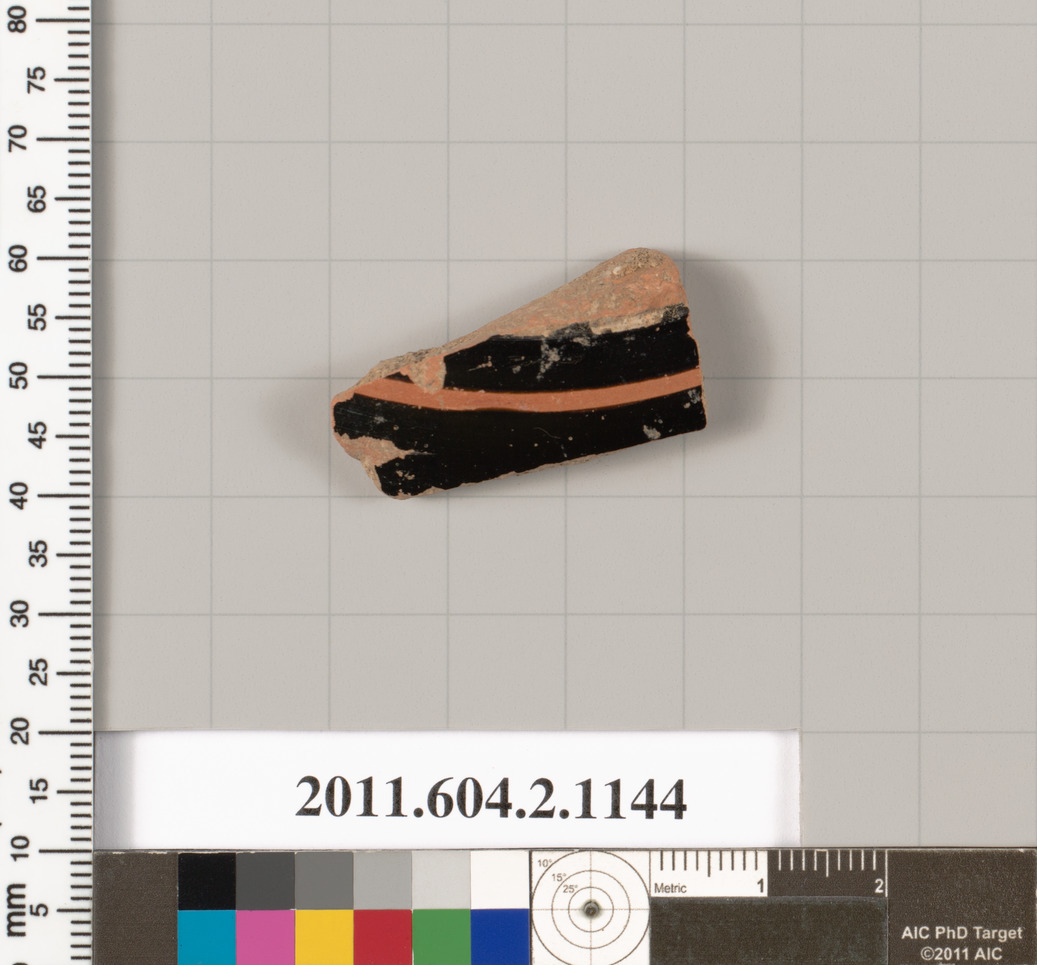
From Attic Fragment to Old Money Silhouette: The Terracotta Pyxis Lid as a Hermeneutic Vessel for 2026 Lauren Heritage
Introduction: The Archaeology of Departure and the Logic of Containment
The internal genetic code of Lauren Fashion Heritage Lab—rooted in the dialectic between the poem and the vessel—finds an unexpected yet profoundly resonant analogue in a humble terracotta fragment from a pyxis lid (Greek, Attic, ca. 5th century BCE). While the Chinese Poem of Farewell to Liu Man and the Square Wine Container (Fangyou) articulate the aesthetics of separation through language and bronze, this Attic shard offers a third modality: the fragment as a container of absence. For the 2026 Old Money silhouette, this artifact is not merely a decorative reference but a structural and philosophical blueprint. It teaches us that true luxury—what we call Heritage-Black—is not about display but about withholding, about the dignified silence of form that holds memory without narrating it.
I. The Pyxis as a Technology of Farewell
The pyxis, a cylindrical box used by Greek women to hold cosmetics, jewelry, or personal trinkets, is an intimate object. Its lid, now fragmented, once sealed contents that were both precious and private. In the context of farewell—whether a bride leaving her natal home or a woman preparing for a journey—the pyxis becomes a material metaphor for the containment of emotion. Unlike the Fangyou, which ritualizes departure within a public, cosmological frame, the pyxis operates within the domestic sphere. Its terracotta surface, once painted with geometric or floral motifs, now bears the patina of time: a crack here, a missing edge there. This is not decay; it is the aesthetic of the incomplete, which the Old Money sensibility elevates to a principle.
For the 2026 collection, this fragment informs a silhouette that is enclosed, structured, and deliberately unfinished. Consider a tailored coat in Heritage-Black wool, cut with a severe, almost architectural shoulder—reminiscent of the pyxis’s cylindrical form—but with a hem that is left raw, or a sleeve that is asymmetrically cropped. This is not negligence; it is an acknowledgment that the most powerful garments are those that suggest a narrative beyond their own edges. The pyxis lid, broken yet still recognizable as a lid, teaches us that absence can be a form of presence.
II. The Geometry of Restraint: Order as Emotional Armor
The Attic pyxis lid is not chaotic; its fragmentary state still reveals a commitment to order. The surviving curve, the faint trace of a painted band, the precision of the wheel-thrown clay—all speak to a discipline of form. This is the same discipline that governs the Fangyou’s square geometry and the Poem of Farewell’s regulated verse. In the Old Money lexicon, this translates into silhouettes that prioritize structure over drape, line over volume. The 2026 Heritage-Black aesthetic will feature sharp, clean cuts: a double-breasted blazer with a notched lapel that terminates in a precise point, trousers that fall with a straight, unbroken crease, a sheath dress that skims the body without clinging.
This geometry is not cold. Like the terracotta fragment, it is warm in its materiality. The clay’s porous surface, its earthy hue, its tactile grain—these qualities are echoed in the choice of fabrics: a heavy, brushed cashmere that feels ancient, a silk twill with a subtle slub, a wool crepe that holds its shape but yields to the hand. The Heritage-Black palette is not a negation of color but a concentration of it: deep charcoal, ink, obsidian, with occasional flashes of oxidized copper or faded ochre, as if the pigment had been excavated from the same Attic soil.
III. The Fragment as a Signifier of Lineage
In the Old Money imagination, luxury is not new; it is inherited. The terracotta fragment, broken and incomplete, is more valuable than a pristine replica because it carries the weight of time. Similarly, the 2026 silhouette will incorporate visible signs of wear as markers of authenticity. A jacket might feature a mended elbow in a contrasting thread, a skirt a discreet patch of fabric from a previous season, a coat a lining that is slightly faded. These are not flaws; they are heritage signatures, akin to the crack in the pyxis lid that tells us it was once used, once loved, once sealed over a woman’s most intimate possessions.
This approach redefines the concept of “newness” in fashion. The 2026 Old Money customer does not seek the pristine; she seeks the patinated. The garment must feel as though it has always existed, as though it has been passed down through generations, even if it is being produced for the first time. This is the paradox of heritage luxury: the new must look old, but not in a nostalgic or theatrical way. It must look inevitable.
IV. The Emotional Architecture of the Vessel
Returning to the internal genetic code, the pyxis lid, like the Fangyou and the poem, is a vessel for emotion. But where the Chinese artifacts transform farewell into cosmic order, the Greek fragment transforms it into intimate memory. The 2026 silhouette, in Heritage-Black, will serve a similar function: it will contain the wearer’s inner life without exposing it. A high-necked, long-sleeved dress in matte silk, with a hidden pocket over the heart; a coat with an interior strap that can be tightened, as if to hold something close; a pair of gloves that are too long, suggesting a gesture of withdrawal. These are not garments for performance; they are garments for presence.
The terracotta fragment also teaches us about scale and proportion. The pyxis lid is small, intimate, meant to be held in the hand. The Old Money silhouette, by contrast, is often expansive—a long coat, a wide-leg trouser, a sweeping cape. But the relationship between the body and the garment should mirror the relationship between the hand and the pyxis: the garment should enclose the body, not overwhelm it. This is achieved through precise tailoring, through the use of internal structures (canvas, horsehair, boning) that create a second architecture, a shell that is both protective and expressive.
Conclusion: The Eternal Fragment
The Attic terracotta fragment from a pyxis lid, broken and incomplete, is not a relic of loss but a blueprint for enduring elegance. It teaches the 2026 Lauren Heritage collection that the most powerful garments are those that withhold as much as they reveal, that structure can be emotional, and that absence is a form of presence. In the Heritage-Black silhouette, the fragment lives again—not as a copy of an ancient form, but as a principle of design: a commitment to the incomplete, the inherited, the intimate. Like the Poem of Farewell to Liu Man and the Square Wine Container, the pyxis lid reminds us that the deepest emotions are not spoken but contained, and that the most luxurious garment is the one that holds its silence with grace.