← BACK TO ARCHIVES
Heritage-Black
Heritage Synthesis: Wheat Field with Cypresses
Curated on Jul 14, 2026 // Node: LDN-01
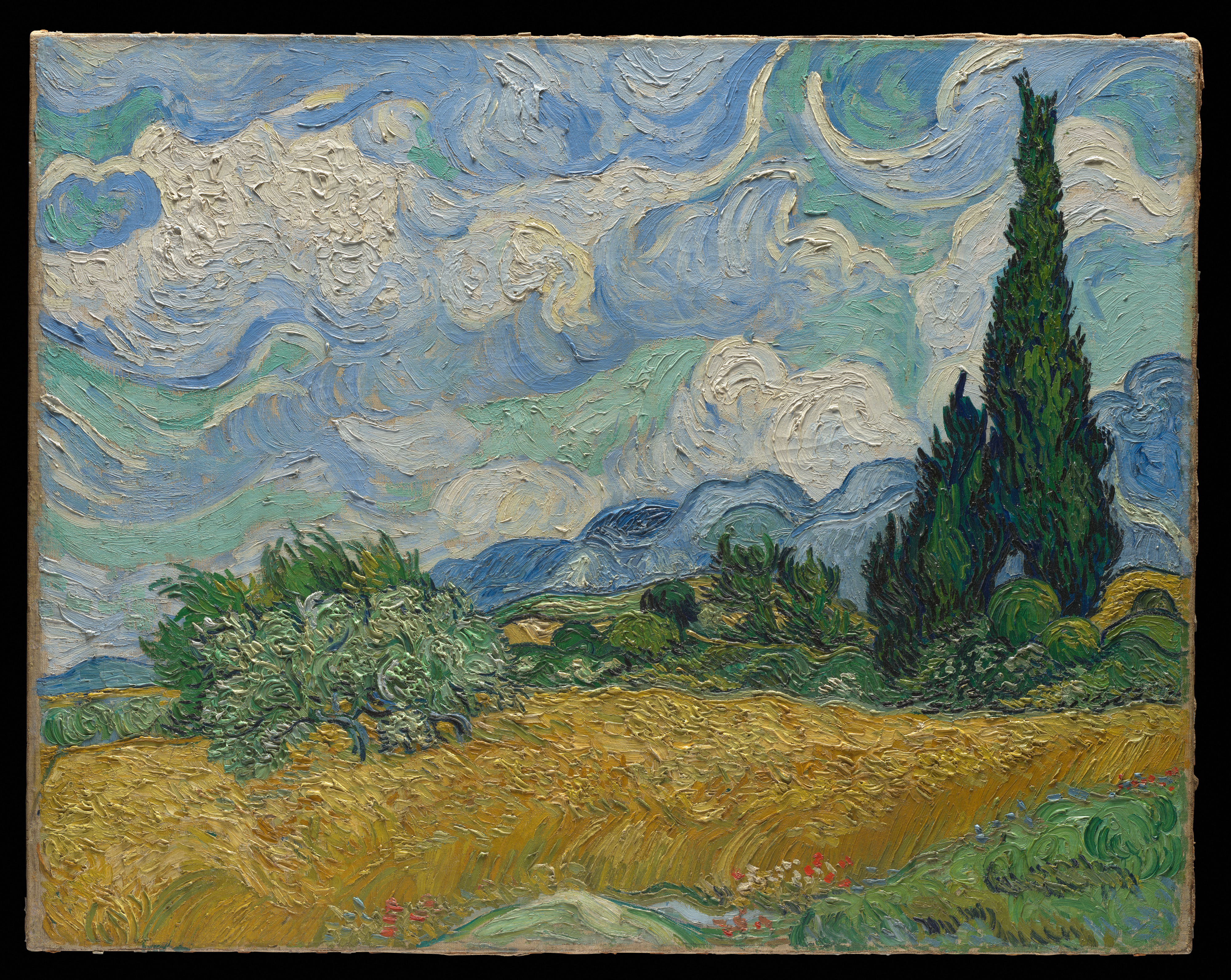
The Threshold of Form: Van Gogh’s *Wheat Field with Cypresses* and the Architectural Sublime in 2026 Old Money Silhouettes
In the vast constellation of art historical references that inform the Lauren Fashion Heritage Lab, Vincent van Gogh’s *Wheat Field with Cypresses* (1889) occupies a singular position—not as a document of pastoral tranquility, but as a radical treatise on the physics of spiritual tension. Painted during the artist’s internment at Saint-Paul-de-Mausole, this oil-on-canvas masterpiece is a visual manifesto of what we might call “tectonic sublimity.” The cypress, that dark vertical spire, does not merely stand; it *erupts* from the earth with the force of a geyser, its flames of green-black foliage reaching toward a sky that churns with the same agitated energy. The wheat field below is not a passive expanse; it is a sea of rhythmic, directional strokes that bend and surge as if caught in a gale of cosmic consequence. This is not a landscape. It is a portrait of a threshold—the precise point where earth meets heaven, where the finite body of the painter meets the infinite turbulence of the soul.
For the 2026 Old Money silhouette, this painting offers a profound reorientation. The Old Money aesthetic has long been associated with a quiet, understated permanence—the weight of a cashmere blazer, the unbroken line of a wool trouser, the silent authority of a heritage-black coat. Yet Van Gogh’s *Wheat Field* challenges this stasis. It proposes that true heritage is not static but *seismic*—a continuous negotiation between discipline and release, between the rigid architecture of tradition and the volatile energy of the living self. The 2026 silhouette must therefore be understood not as a garment, but as a *structure of tension*: a form that holds its shape precisely because it is under constant, internal pressure.
The Cypress as Vertical Imperative: The New Silhouette’s Spinal Column
The cypress tree in Van Gogh’s composition is the painting’s most assertive element. It is a dark, almost black column that rises with an unnatural, flame-like intensity. It does not blend into the landscape; it *interrupts* it. This is the first lesson for the 2026 silhouette: the vertical line must be reimagined as an act of will, not of habit. In traditional Old Money tailoring, the vertical is achieved through the clean fall of fabric—a wool coat that drapes from the shoulder, a silk dress that skims the body. But Van Gogh’s cypress suggests a different verticality: one that is *active*, *combustive*, and *self-assertive*.
For 2026, we propose the “Cypress Coat”—a heritage-black, double-breasted greatcoat in a dense wool-cashmere blend. The silhouette is not merely long; it is *aspirational*. The shoulder line is sharply defined, almost architectural, while the fabric itself is cut to create a subtle, controlled flare from the waist downward, mimicking the cypress’s upward expansion. The lapels are notched but elongated, drawing the eye upward in a continuous line from hem to collar. This is not a coat for concealment; it is a coat for *declaration*. It says: I am rooted, but I am also reaching. The internal structure—a hidden canvas interlining, reinforced seams, a weighted hem—ensures that the garment holds its form against the body’s movement, just as the cypress holds its shape against the wind. The “agony” of the painting—the visible strain of the tree against the sky—becomes the garment’s hidden strength.
The Wheat Field as Horizontal Field of Force: The Trousers and Skirt as Dynamic Ground
Below the cypress, Van Gogh’s wheat field is a field of *vectors*. The brushstrokes are not random; they are directional, sweeping from left to right, rising and falling in waves that suggest both growth and agitation. This horizontal energy is the counterpoint to the cypress’s vertical thrust. In the 2026 silhouette, this translates into a reimagining of the lower half of the body—the trousers and skirts that form the “ground” of the ensemble.
For the male silhouette, we propose the “Wheat Field Trouser” in a heavyweight wool flannel. The cut is wide-legged but not baggy, with a subtle, almost imperceptible taper at the ankle. The fabric is pleated at the waist, allowing for a generous drape that moves with the body, but the pleats are *pressed*—not soft—creating a series of sharp, directional lines that echo Van Gogh’s brushwork. The hem is finished with a deep, uncuffed turn-up, adding weight and ensuring the trouser falls with a deliberate, sculptural gravity. For the female silhouette, a midi-length A-line skirt in a textured silk-wool blend, with knife pleats that are stitched down at the hip and release into a fluid, undulating hem. The pleats are not decorative; they are *functional*, creating a visual rhythm that mirrors the wheat field’s movement. The skirt is lined in a contrasting silk charmeuse, a hidden luxury that reveals itself only in motion.
The Sky as Atmosphere: The Heritage-Black Outer Layer as Canvas of Tension
Van Gogh’s sky is not a passive backdrop; it is a vortex of blue and white, a swirling mass that seems to pull the cypress upward even as the wheat field anchors it below. This atmospheric tension is the third element of the 2026 silhouette. The heritage-black outer layer—the coat, the jacket, the cape—must function as a *canvas of tension*, a surface that absorbs and redirects the energy of the garments beneath.
The “Agony Coat” (a development of the Cypress Coat) is constructed in a double-faced wool-cashmere, with one side a deep, matte heritage-black and the other a subtle, heathered charcoal. The collar is designed to be worn up or down, creating a different silhouette for each configuration. When worn up, it frames the face like the dark spire of the cypress; when worn down, it reveals the charcoal underlayer, a flash of the “sky” beneath the “earth.” The sleeves are set with a slight forward pitch, echoing the directional sweep of Van Gogh’s brushstrokes. The coat is unlined, allowing the internal structure—the canvas interlining, the taped seams, the weighted hem—to be felt against the body. This is not comfort; this is *presence*.
The Threshold Garment: Where Earth Meets Sky
The most radical insight from *Wheat Field with Cypresses* for the 2026 Old Money silhouette is the concept of the *threshold garment*—a piece that exists at the precise point where the vertical and horizontal forces meet. In the painting, this is the cypress itself, which is both tree and flame, both earth and sky. In the wardrobe, this is the vest or the waistcoat.
The “Threshold Vest” is cut from a single piece of heritage-black wool, with no side seams. The front is structured with a deep V-neck and a single, hidden button closure at the waist. The back is cut lower than the front, creating a subtle, asymmetrical line that mimics the cypress’s upward thrust. The vest is lined in a silk twill printed with a custom pattern derived from Van Gogh’s brushstrokes—a micro-abstract of the wheat field’s movement. This lining is invisible when the vest is worn closed, but revealed when the wearer moves, a secret acknowledgment of the painting’s dynamic energy. The vest is not an accessory; it is the *fulcrum* of the ensemble, the point where the vertical imperative of the coat meets the horizontal force of the trousers or skirt.
Conclusion: The Enduring Agony of Form
Van Gogh’s *Wheat Field with Cypresses* is not a painting of peace. It is a painting of *strain*—the strain of the tree against the sky, the wheat against the wind, the painter against his own mind. For the 2026 Old Money silhouette, this strain is not a flaw to be hidden but a truth to be embodied. The garments we propose are not comfortable; they are *necessary*. They hold their shape through internal tension, just as the cypress holds its form through the force of its own growth. The heritage-black wool, the weighted hems, the hidden canvas interlinings—these are not technical details; they are the material expression of a spiritual condition.
In the end, the Old Money aesthetic has always been about the visible manifestation of invisible values: lineage, discipline, restraint. But Van Gogh reminds us that these values are not static. They are *lived*—and living is always a form of agony. The 2026 silhouette is not a return to tradition; it is a *re-encounter* with the threshold where tradition meets the turbulence of the present. It is the cypress in the wheat field, the dark spire against the churning sky, the garment that holds its shape precisely because it is under the pressure of becoming. This is the heritage of the future: not a relic, but a revelation.
Heritage Lab Insight
Genetic Bridge: Archive node focusing on Heritage-Black craftsmanship.