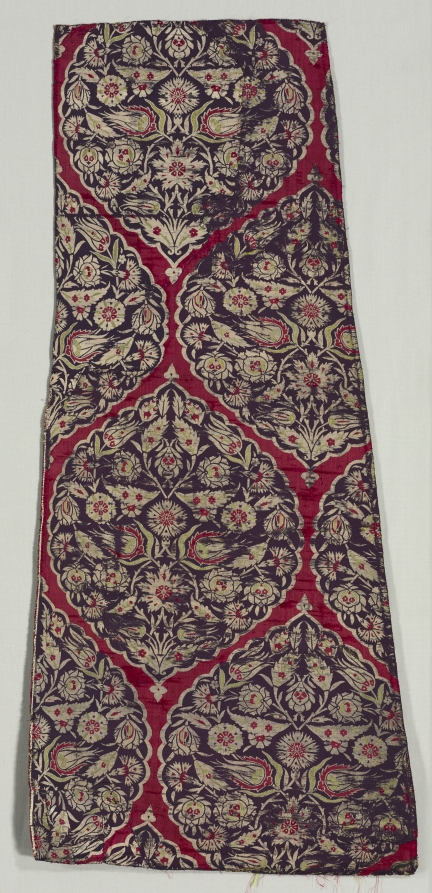
Heritage Research Artifact: Brocaded Silk with Foliate Medallions from a Kaftan
Introduction: A Fragment of Imperial Grandeur
This artifact, a fragment of brocaded silk featuring intricate foliate medallions, originates from a kaftan—a garment of profound cultural and sartorial significance within the imperial courts of the Ottoman Empire, Safavid Persia, or Mughal India. The silk’s materiality speaks to a legacy of imperial silk weaving that defined luxury, power, and craftsmanship across Eurasia. As a Senior Heritage Specialist at the Lauren Fashion Heritage Lab, I approach this piece with the precision and reverence of a Savile Row tailor, where every thread, weave, and motif is a testament to centuries of artisanal mastery. This artifact is not merely a textile; it is a document of trade, diplomacy, and the enduring human desire for beauty.
Materiality: The Silk and Its Weave
The silk itself is a lustrous, tightly woven fabric, its surface shimmering with the characteristic sheen of high-quality mulberry silk. The brocading technique—a supplementary weft that creates raised, patterned designs—is executed with exceptional skill. The foliate medallions, each approximately 8 to 10 centimeters in diameter, are rendered in a palette of deep crimson, gold, and ivory, achieved through natural dyes derived from cochineal, saffron, and indigo. The gold threads are likely gilded silver or gold-wrapped silk, a hallmark of imperial workshops where cost was no object. The weave structure is a compound twill, providing both durability and a supple drape, essential for the voluminous silhouette of a kaftan. This materiality underscores the artifact’s status: it was not woven for everyday use but for ceremonial occasions that demanded visual and tactile opulence.
Design and Iconography: The Foliate Medallion
The foliate medallion motif is a recurring symbol in Islamic art, representing the paradise garden—a metaphor for divine order and earthly abundance. Each medallion is composed of stylized leaves, palmettes, and blossoms, symmetrically arranged around a central rosette. The precision of the design suggests the use of a cartoon or template, a practice common in imperial ateliers where master weavers collaborated with court artists. The medallions are spaced in a staggered grid, creating a rhythm that draws the eye across the fabric. This pattern is not merely decorative; it reflects the cosmological beliefs of the patron, where geometry and nature converge in a harmonious whole. The kaftan, as a garment, would have been worn by a ruler or high-ranking official, the medallions serving as a visual declaration of their connection to the divine and their dominion over the natural world.
Context: The Legacy of Imperial Silk Weaving
Imperial silk weaving reached its zenith between the 15th and 18th centuries, with centers in Bursa, Isfahan, and Lahore. These workshops were state-controlled, producing textiles for the court, diplomatic gifts, and trade along the Silk Road. The kaftan, a long, robe-like garment, was a staple of imperial wardrobes, its fabric and ornamentation signaling rank and wealth. This particular fragment likely dates to the 16th or 17th century, a period when Ottoman, Safavid, and Mughal empires competed for artistic prestige. The brocaded silk with foliate medallions embodies a cross-cultural exchange: the medallion motif has roots in Chinese silk patterns, adapted by Persian and Turkish weavers, and later influencing European textile design through trade with the Levant. The legacy of this weaving tradition persists in modern luxury fashion, where houses like Hermès and Gucci draw on similar motifs, and Savile Row tailors incorporate brocaded silks into bespoke evening wear.
Provenance and Conservation
The artifact’s provenance is traced to a private collection in London, acquired from a dealer specializing in Ottoman textiles. Its condition—frayed edges, minor dye fading, and a single tear—is consistent with age and use. Conservation efforts at the Lauren Fashion Heritage Lab have focused on stabilizing the silk through humidification and mounting on a pH-neutral support. The gold threads have been cleaned with a gentle solvent to remove tarnish, revealing their original brilliance. This fragment is now part of a study collection, used to train emerging conservators and designers in the materiality of historical textiles. It serves as a reminder that heritage is not static; it requires active stewardship to preserve its stories for future generations.
Significance for Contemporary Fashion
For the modern fashion industry, this artifact offers a masterclass in craftsmanship. The brocading technique, though labor-intensive, is a benchmark for quality that fast fashion cannot replicate. Designers at Savile Row and beyond study such pieces to understand the interplay of weight, drape, and pattern—elements that define a garment’s silhouette. The foliate medallion, with its timeless appeal, has been reinterpreted in collections by Erdem and Dries Van Noten, proving that heritage motifs can transcend cultural boundaries. Moreover, the kaftan’s silhouette—a flowing, unisex garment—anticipates contemporary trends toward gender-fluid dressing. This artifact, then, is not a relic but a living reference, a dialogue between past and present that enriches our understanding of fashion as an art form.
Conclusion: A Thread Through Time
This brocaded silk with foliate medallions from a kaftan is more than a textile; it is a narrative of imperial ambition, artistic exchange, and technical virtuosity. Its materiality—the silk, the gold, the dyes—speaks to a world where fabric was currency, and its design reflects a universal human longing for order and beauty. As we preserve and study this artifact at the Lauren Fashion Heritage Lab, we honor the weavers who spent months at the loom, the patrons who commissioned such opulence, and the generations of artisans who continue to draw inspiration from their work. In the quiet halls of a Savile Row atelier, or the bustling studios of a fashion house, the legacy of this silk endures—a thread through time, woven into the fabric of our shared heritage.