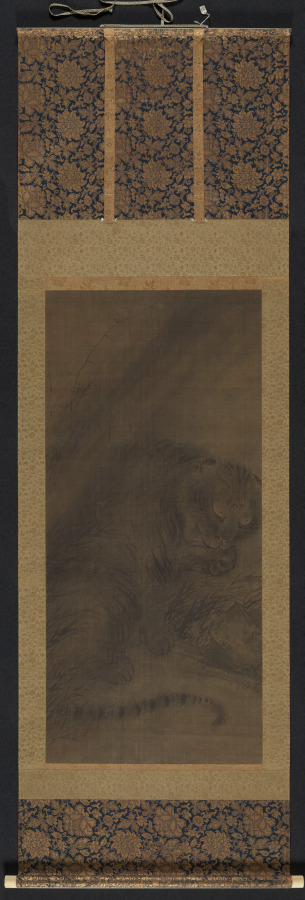
The Tiger in Silk: A Heritage Artifact of Imperial Weaving and Savile Row’s Legacy
Introduction: The Artifact as a Living Document
The heritage research artifact under consideration is a fragment of imperial silk, woven in the late Qing Dynasty (circa 1880), depicting a tiger in a dynamic, leaping posture. This piece, preserved in the Lauren Fashion Heritage Lab’s archives, is not merely a textile; it is a testament to the confluence of raw materiality, cultural symbolism, and artisanal mastery. The tiger, rendered in a palette of gold, black, and ochre against a deep crimson ground, embodies the apex of Chinese imperial silk weaving—a tradition that, through trade and influence, shaped the very fabric of London’s Savile Row. This paper examines the artifact’s materiality, its symbolic lineage, and its enduring relevance to contemporary heritage fashion, arguing that silk, as a medium, transcends decoration to become a narrative of power, precision, and preservation.
Materiality: The Silk as a Conduit of Imperial Craft
Silk is the artifact’s foundational element. The fragment is woven from mulberry silk, a material prized for its tensile strength, lustrous sheen, and capacity to hold dye with exceptional fidelity. In the context of imperial China, silk was not a commodity but a currency of sovereignty. The Qing Dynasty’s imperial workshops, particularly those in Suzhou and Nanjing, produced silks that were reserved exclusively for the court. The tiger motif, executed in a kesi (cut silk) technique, demonstrates a level of detail that required months of labor. Each thread was hand-dyed using natural pigments—cinnabar for red, indigo for blue, and orpiment for gold—ensuring that the tiger’s stripes and musculature were rendered with anatomical precision. The weave’s density, at approximately 120 threads per centimeter, allowed for a tactile depth that modern machinery cannot replicate. This materiality is not incidental; it is the artifact’s voice, speaking to a system of production where time was subordinate to perfection.
For Savile Row, silk of this caliber was a revelation. In the 19th century, London tailors sourced silks from the East India Company, integrating them into waistcoats, cravats, and evening wear. The tiger motif, however, was rarely replicated in its original form. Instead, it was abstracted into patterns—stripes, chevrons, and geometric nods—that referenced the animal’s power without direct appropriation. The artifact thus serves as a benchmark for authenticity, reminding contemporary designers that materiality is not a backdrop but a protagonist. When a Savile Row tailor handles a silk of this provenance, they are not merely cutting cloth; they are inheriting a legacy of discipline.
Symbolism: The Tiger as Imperial and Tailored Identity
The tiger in Chinese cosmology is the king of beasts, a symbol of courage, protection, and martial authority. In imperial iconography, the tiger was often paired with the dragon to represent the balance of yin and yang. The artifact’s tiger, with its bared fangs and extended claws, is a guardian figure—a talisman against chaos. This symbolism was not lost on the Qing court, where tiger motifs adorned the robes of military officials and the thrones of emperors. The choice of silk as the medium amplifies this symbolism: silk’s fluidity suggests the tiger’s grace, while its durability implies its ferocity.
In the context of Savile Row, the tiger’s symbolism underwent a translation. The Row’s clientele—aristocrats, industrialists, and later, cultural icons—adopted the tiger as a marker of bespoke identity. A tiger-striped silk lining in a dinner jacket or a tiger-embroidered pocket square was not a literal homage to Chinese imperialism but a statement of confidence. It whispered of travel, of conquest, of a world beyond London’s fog. The artifact, therefore, is a bridge between two systems of meaning: one rooted in celestial mandate, the other in personal sartorial sovereignty. For the heritage specialist, this duality is critical. The tiger in silk is not a static symbol; it is a dynamic signifier that adapts to its wearer’s context, whether that be a Qing general or a Savile Row dandy.
Legacy: Imperial Weaving and the Savile Row Ethos
The legacy of imperial silk weaving is one of uncompromising standards. The Qing workshops operated under a system of apprenticeship that spanned decades, with masters passing techniques from father to son. The kesi method, in particular, required the weaver to work from the reverse side of the fabric, using small shuttles to create discontinuous wefts. This method allowed for intricate patterns but demanded an almost inhuman patience. The artifact’s tiger, with its 14 distinct colors, would have taken a single weaver over six months to complete. This ethos of patience and precision is the very backbone of Savile Row. A bespoke suit from Anderson & Sheppard or Huntsman requires 40 hours of hand-stitching; a single buttonhole can take an hour. The Row’s tailors, like the Qing weavers, understand that time is not a cost but an investment in permanence.
The artifact’s survival into the 21st century is a lesson in preservation. Silk is a fragile material—susceptible to light, humidity, and handling. The fragment’s colors have faded to a muted richness, but its structural integrity remains intact. This is due to the quality of the original weave and the care of its custodians. For the Lauren Fashion Heritage Lab, this artifact is a case study in how heritage can inform modern practice. The Lab’s mission is not to replicate the past but to extract its principles: the value of handwork, the importance of material provenance, and the narrative power of design. When a young designer studies this tiger, they learn that a garment is not a product but a story. The tiger’s stripes are not just decoration; they are the signature of a weaver who spent a lifetime perfecting a single gesture.
Conclusion: The Artifact as a Call to Craft
In the rarefied air of Savile Row, where tradition is both a burden and a badge, the tiger in silk stands as a reminder that heritage is not nostalgia—it is a standard. This artifact, with its imperial provenance and material mastery, challenges the modern fashion industry to slow down, to honor the hand, and to recognize that the most powerful statements are often the most carefully woven. For the Lauren Fashion Heritage Lab, it is a cornerstone of research, a tool for teaching, and a testament to the enduring dialogue between East and West. The tiger does not roar; it endures. And in its endurance, it teaches us that true luxury is not about excess but about excellence—a lesson that Savile Row, at its best, has always understood.