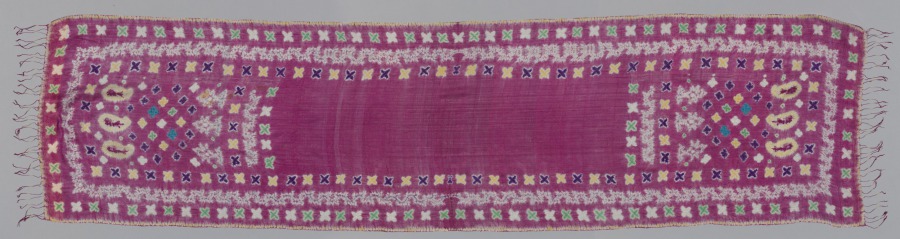
The Silk Veil: A Study in Materiality and Imperial Legacy
In the hushed ateliers of London’s Savile Row, where the air is thick with the scent of wool and the quiet hum of hand-stitching, one encounters a paradox: the silk veil. It is not a garment of utility, nor of overt display, but a whisper—a fragment of a vast, imperial narrative woven into the very fabric of commerce and culture. As the Senior Heritage Specialist for the Lauren Fashion Heritage Lab, I invite you to examine this artifact not merely as a textile, but as a document of power, trade, and the enduring legacy of silk weaving that stretches from the courts of ancient China to the bespoke tailoring houses of Mayfair.
Materiality: The Silk Veil as a Physical Archive
The silk veil in our collection—a 19th-century piece, likely from the Qing dynasty—is a study in contradiction. Its materiality is ethereal yet robust. The warp and weft, spun from the cocoons of Bombyx mori, are so fine that the veil appears to float, defying gravity. Yet, this delicacy is deceptive. Silk’s tensile strength rivals that of steel of equivalent diameter, a property that made it indispensable for both imperial robes and diplomatic gifts. The weave is a plain tabby, unadorned by embroidery, suggesting it was a functional object—perhaps a head covering for a court lady or a ceremonial shroud. The patina, a soft ivory with hints of ochre, speaks to age and exposure, but the fibers remain intact, a testament to the silk’s inherent durability.
Under magnification, the irregularities in the thread thickness reveal hand-reeling, a technique perfected in the imperial workshops of Suzhou and Hangzhou. These workshops, known as the Jiangnan Silk Bureau, were state-controlled entities that produced the finest silks for the Forbidden City. The veil’s materiality, therefore, is not just a physical property but a political one. Each thread carries the weight of an empire’s economic strategy, a system that guarded sericulture as a state secret for millennia. The veil is a fragment of that guarded knowledge, a tangible link to a world where silk was currency, diplomacy, and art.
Context: The Legacy of Imperial Silk Weaving
To understand the silk veil, one must first understand the imperial context from which it emerged. Silk weaving in China was not a cottage industry; it was a state apparatus. From the Han dynasty (206 BCE–220 CE) onward, the production of silk was centralized under imperial bureaus, with strict regulations on quality, design, and distribution. The Silk Road, a network of trade routes spanning over 6,400 kilometers, was not a spontaneous marketplace but a carefully managed corridor of imperial power. Silk was not merely a commodity; it was a tool of soft power, used to placate nomadic tribes, secure alliances, and project the emperor’s authority across Eurasia.
The veil, as a specific artifact, embodies this legacy. In the Qing dynasty (1644–1912), the imperial court maintained a rigorous hierarchy of silk usage. The emperor wore dragon robes of kesi (silk tapestry), while court ladies donned veils of varying opacity to denote rank. A sheer veil, like this one, would have been reserved for the highest-ranking consorts or concubines, as it allowed the face to be seen but not fully revealed—a gesture of modesty and power. The veil was a liminal object, bridging the public and private, the visible and hidden. It was a screen through which imperial authority was both concealed and displayed.
The decline of imperial silk weaving in the late 19th century, precipitated by the Opium Wars and the influx of machine-made textiles from Europe, marked a seismic shift. The veil, once a symbol of imperial refinement, became a relic of a lost world. Yet, its legacy persisted. The techniques of hand-reeling and natural dyeing, perfected under imperial patronage, were preserved in family workshops and later revived by luxury houses in the West. Savile Row tailors, for instance, began sourcing silk from Chinese mills in the early 20th century, not for veils but for linings and pocket squares—a quiet nod to the imperial tradition.
The Veil in the Context of Savile Row
How does a Qing-dynasty silk veil resonate on Savile Row? The answer lies in the shared ethos of craftsmanship and exclusivity. Savile Row’s bespoke tailors, like the imperial weavers of Suzhou, operate within a system of rigorous standards and client-specific production. A single suit requires over 50 hours of handwork, with each stitch subject to the tailor’s scrutiny. Similarly, an imperial silk veil required months of preparation—from the cultivation of mulberry trees to the reeling of silk and the final weaving. Both traditions prioritize material integrity over mass production, a philosophy that the Lauren Fashion Heritage Lab seeks to document and preserve.
Moreover, the veil’s materiality—its lightness, its drape, its ability to catch light—speaks directly to the tailoring principles of Savile Row. A well-cut jacket relies on the interplay of fabric and form; the silk veil, in its simplicity, achieves a similar harmony. It is a masterclass in restraint, a quality that the Row’s most celebrated tailors, from Henry Poole to Huntsman, have long championed. The veil, therefore, is not an exotic curiosity but a kindred spirit—a testament to the universal language of fine craftsmanship.
Conclusion: The Veil as a Living Artifact
The silk veil is more than a historical object; it is a living artifact that continues to inform contemporary fashion. Its legacy of imperial silk weaving reminds us that luxury is not a modern invention but a continuum of human ingenuity and power. For the Lauren Fashion Heritage Lab, this veil serves as a benchmark for material excellence, a touchstone for our research into the intersections of heritage, trade, and design. As you hold this veil—its fibers cool and smooth against your skin—you are not just touching silk; you are touching the threads of an empire, the hands of artisans, and the enduring spirit of a craft that refuses to be forgotten.
In the quiet of the Lab, where the light falls softly on this fragment of ivory silk, we are reminded that the past is never truly past. It is woven into the present, waiting to be read.