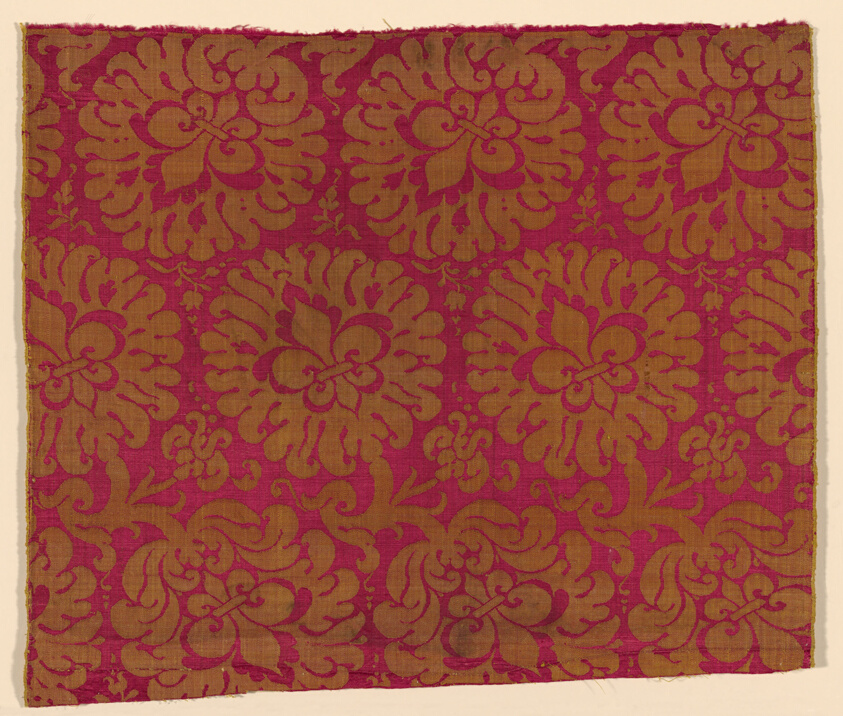
A Fragment of Unspoken Grammar
To the untrained eye, it is merely a scrap. A quiet, unassuming artefact of textile, perhaps mislaid from a larger work. Yet, to the connoisseur—to the individual who understands that true luxury resides not in proclamation but in silent, structural integrity—this fragment speaks in the precise, technical dialect of the atelier. It is a specimen of pure, self-referential craft. The material is silk, of course, but to state only that is to describe a Savile Row suit merely as ‘wool’. The essence lies in the execution: a satin weave, self-patterned by the reversing of faces. Herein lies a philosophy, a quiet manifesto of elegance, encoded in thread.
The Architecture of Fluidity
Consider first the foundational principle: the satin weave. Unlike the robust, democratic plain weave or the diagonal declaration of the twill, the satin weave is an exercise in calculated omission. It is a structure built on long, floating ‘overs’, where the warp threads dominate the face, with weft bindings spaced just frequently enough to maintain cohesion. This strategic distancing creates a surface unbroken by the frequent intersections of lesser weaves. The result is a plane of unparalleled light capture and release—a liquefaction of luminosity. The fabric possesses an inherent, fluid drape, a consequence of these extended floats granting a pliancy that heavier, more interlocked structures cannot mimic. It is the textile equivalent of a perfectly balanced silhouette; the structure enables the elegance, but is itself discreet to the point of invisibility.
The Discipline of Self-Patterning
It is in the second act of craftsmanship where this fragment elevates itself from the merely excellent to the intellectually profound. This is a self-patterned fabric. There is no applied jacquard, no supplementary brocade, no embroidered flourish. The pattern—likely a subtle play of light and shadow, a geometric motif, or a restrained organic form—is born solely from the loom. It is achieved by the deliberate, precise reversal of the fabric’s faces. In one area, the warp floats present their luminous front; in the adjacent area, the craftsman has orchestrated a shift, allowing the weft-faced back of the satin weave to become the surface.
This reversal is not a mere technical trick. It is a discipline of the highest order. It demands that the weaver hold two distinct textile architectures in mind simultaneously, executing a flawless transition between them. The pattern is not ‘on’ the cloth; it is the cloth. The difference is everything. It confers a sublime unity and a peerless durability; the design cannot fray, cannot peel, for it is integral to the fabric’s very being. The aesthetic effect is one of restrained depth. The pattern reveals itself not through colour contrast, but through a subtle dialogue of sheen and matte, a whisper of texture discernible more to the caress of light—and the hand—than to the blunt instrument of the glance.
Context: The Heritage of the Unseen
This fragment, therefore, is a direct heir to the most revered principles of classic silk craftsmanship. It speaks of a tradition where the value was placed not on ostentation, but on the authority of the hidden. In the great weaving centres of Lyon or Spitalfields, the mastery was in achieving complexity through structural ingenuity, not applied decoration. The ‘fluid elegance’ referenced in its context is not a happenstance of handling; it is the direct, inevitable consequence of this architectural choice. The satin weave provides the fluidity; the self-patterning provides the intellectual elegance.
To hold this fragment is to understand a fundamental tenet of enduring style: that the most powerful statements are often those that do not shout. The fabric’s beauty is reactive, dependent on the movement of the wearer and the fall of light. It is a collaborative elegance. In an age of relentless visual noise, this artefact advocates for a return to inherent rather than imposed value. It champions the grammar over the vocabulary, the sentence structure over the shouted word.
A Legacy in Silence
Thus, this silk fragment transcends its physical dimensions. It is a benchmark. It reminds us that in textiles, as in tailoring, the true cost is measured in forethought and precision, not in superficial embellishment. The satin weave’s luminous face is the public persona—polished, impeccable. The reversed sections, the self-pattern, represent the private discipline, the internal architecture that makes the public face possible. One cannot exist without the other; together, they form a complete and sophisticated whole.
It stands as a corrective to contemporary impatience. Here, pattern is not printed in an instant; it is built, thread by consequential thread, with the loom as its sole and demanding author. The resulting ‘fluid elegance’ is therefore earned, not assumed. This fragment, for all its silence, delivers a most articulate lecture on integrity. It proposes that the finest heritage is not a museum piece, but a continuing standard—a quiet, uncompromising logic of making, where the beauty of the finished article is but the visible echo of its flawless, and now fragmentarily revealed, construction.