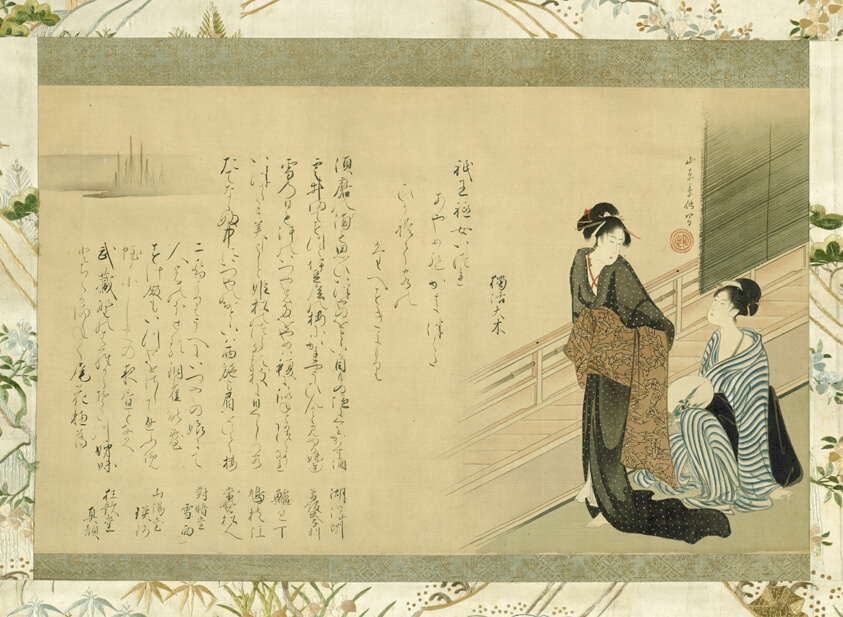
Two Beauties on a Veranda: A Study in Materiality and Elegance
Introduction: The Artifact as a Testament to Silk’s Legacy
The hanging scroll, *Two Beauties on a Veranda*, executed in ink and colors on silk, stands as a profound artifact within the canon of East Asian visual culture. Its materiality—the very substance of silk—is not merely a support for artistic expression but a narrative thread that weaves together centuries of craftsmanship, cultural symbolism, and aesthetic refinement. For the Lauren Fashion Heritage Lab, this piece offers a singular opportunity to dissect the interplay between luxury textiles and visual storytelling, a dialogue that resonates deeply with the principles of Savile Row tailoring: precision, heritage, and an unyielding commitment to quality. This paper examines the scroll through the lens of materiality, contextualizing its silk foundation as both a medium and a message, while drawing parallels to the enduring ethos of bespoke craftsmanship.
The Materiality of Silk: Craftsmanship and Cultural Resonance
Silk, as a material, occupies a unique position in the hierarchy of luxury textiles. Its production, originating in China over 5,000 years ago, demanded an intricate process of sericulture, reeling, and weaving that was guarded as a state secret for millennia. The silk used in *Two Beauties on a Veranda* is no exception; its fine, even weave and lustrous surface suggest a high-grade fabric, likely sourced from regions such as Suzhou or Hangzhou, renowned for their mastery of silk craftsmanship. The scroll’s support—a meticulously prepared silk panel—was sized with alum and glue to create a receptive yet resilient ground for the application of ink and mineral pigments. This preparation mirrors the rigorous standards of Savile Row, where a tailor’s choice of cloth—whether Super 150s wool or silk-cashmere blends—is paramount to the garment’s drape, durability, and overall presence.
The fluid elegance of the silk’s surface is integral to the scroll’s aesthetic. Unlike paper, which absorbs ink with a certain porosity, silk allows for a subtle interplay of translucency and opacity. The artist’s brushstrokes, applied with controlled spontaneity, exploit this quality: the ink settles into the weave, creating soft gradations of tone that evoke the delicate textures of the beauties’ robes and the veranda’s wooden lattice. The mineral pigments—cinnabar for vermilion, malachite for green, and azurite for blue—are ground to a fine powder and mixed with animal glue, adhering to the silk with a luminous depth that shifts under ambient light. This effect is not unlike the way a well-cut suit catches the eye in a dimly lit club on Savile Row, where the fabric’s weave and finish speak volumes before a single word is exchanged.
Contextualizing the Scene: Elegance and the Veranda as a Stage
The composition of *Two Beauties on a Veranda* is a masterclass in spatial harmony. Two women, adorned in layered robes of contrasting hues, stand on a wooden veranda that overlooks a garden hinted at by a single flowering branch. The veranda itself—a liminal space between interior and exterior—serves as a stage for their quiet interaction. One figure gazes outward, her hand resting on the railing, while the other adjusts a sleeve, her posture suggesting a moment of intimate reflection. The silk’s materiality enhances this narrative: the robes’ folds are rendered with fine lines that follow the fabric’s natural drape, while the veranda’s grain is suggested through dry brush techniques that mimic the texture of aged wood.
This scene is emblematic of the Ming and Qing dynasty literati tradition, where beauty was often conflated with moral virtue and scholarly refinement. The women are not merely decorative; they are embodiments of *fengliu* (elegant refinement), a concept that prized understated grace over overt display. The silk scroll, as a medium, amplifies this ethos. Its fragility and preciousness demand a certain reverence from the viewer, much like the bespoke suit that requires careful handling and storage. The scroll’s mounting—a silk brocade border with a jade roller at the bottom—further elevates its status, transforming it from a painting into a ritual object for contemplation. This attention to detail recalls the Savile Row tradition of hand-stitched buttonholes and horn buttons, where every element serves both function and form.
Parallels with Savile Row Craftsmanship
The parallels between the creation of *Two Beauties on a Veranda* and the principles of Savile Row tailoring are striking. Both traditions prioritize material integrity, manual skill, and a deep respect for heritage. The silk weaver, like the tailor, must understand the behavior of his medium—its tension, its response to pressure, its capacity to hold a shape. The artist’s brush, wielded with precision, is akin to the tailor’s needle, each stroke or stitch contributing to a cohesive whole. The scroll’s conservation—a process that involves careful humidification, lining with Japanese paper, and re-mounting—mirrors the restoration of a vintage suit, where a master tailor might replace a lining or reinforce a seam while preserving the original character.
Moreover, the cultural cachet of silk in East Asia parallels the status of English wool in the West. Both materials are imbued with a sense of place and history. The silk of *Two Beauties on a Veranda* carries the legacy of the Silk Road, a network of trade that connected civilizations, just as Savile Row’s woolens evoke the pastures of Yorkshire and the industrial innovations of the 19th century. In both cases, the material is not passive; it actively shapes the object’s meaning and longevity.
Conclusion: The Scroll as a Living Heritage
*Two Beauties on a Veranda* is more than a painting; it is a testament to the enduring power of silk as a medium for artistic and cultural expression. Its materiality—the silk, the pigments, the mounting—speaks to a tradition of craftsmanship that values patience, skill, and an intimate understanding of materials. For the Lauren Fashion Heritage Lab, this artifact serves as a reminder that heritage is not static. It is a living dialogue between past and present, between the weaver’s loom and the tailor’s shears. As we continue to explore the intersections of fashion, art, and material culture, the scroll invites us to reconsider the role of silk in our own narratives—whether in a gallery, a wardrobe, or the quiet elegance of a veranda at dusk.