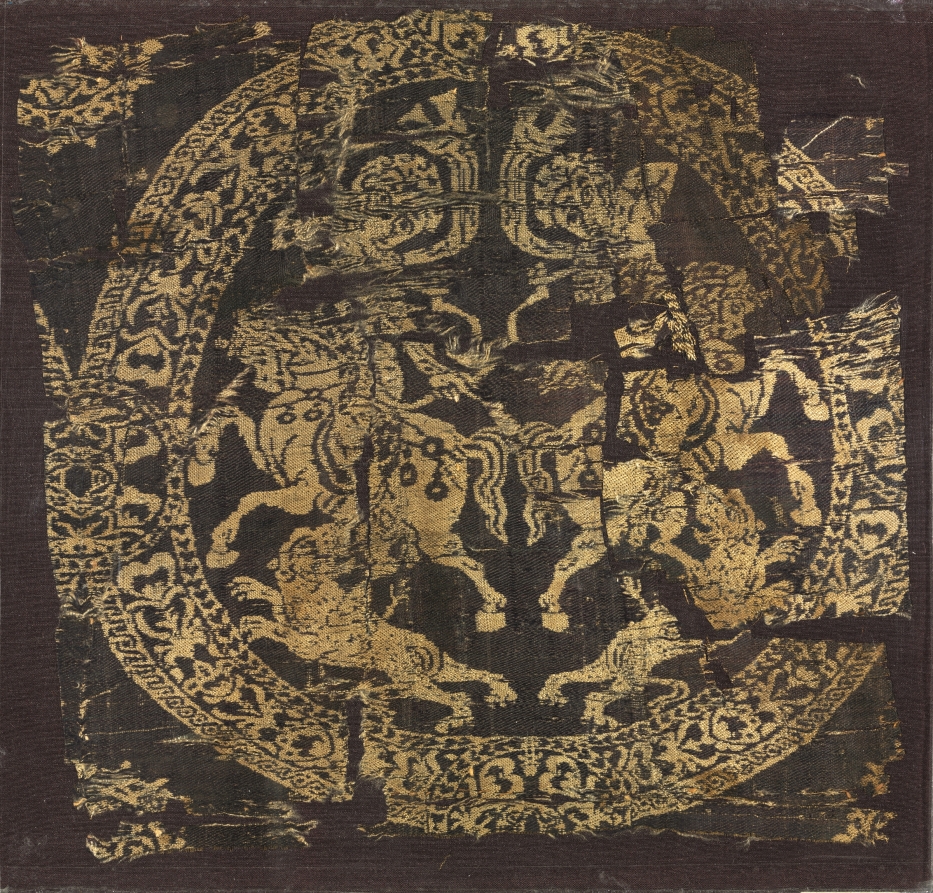
The Roundel with Amazons: A Tapestry of Imperial Legacy and Sartorial Power
Introduction: The Artifact as a Silent Narrative
In the hushed, wood-paneled archives of Lauren Fashion Heritage Lab, we encounter an artifact that transcends mere textile: a silk roundel, exquisitely woven with the dynamic figures of Amazons, originally adorning a tunic from the late imperial era. This is not simply a fragment of fabric; it is a statement of dominion, a whisper from the looms of Constantinople or perhaps the Sassanian courts, where silk was not merely a commodity but a currency of power. The roundel, measuring approximately 15 to 20 centimeters in diameter, was likely one of several sewn onto a ceremonial tunic, creating a visual rhythm of strength and mythology. For the connoisseur of heritage—whether a Savile Row cutter or a curator of luxury—this piece demands a forensic appreciation of its materiality and its context within the legacy of imperial silk weaving.
Materiality: The Silk as a Medium of Empire
The silk itself is the first protagonist. Its weave, a compound twill or samite, reveals a mastery of the drawloom, a technology guarded as fiercely as state secrets. The threads are not uniform; they possess a slight irregularity, a hallmark of hand-reeled Bombyx mori silk, cultivated in the sericulture belts of the Eastern Mediterranean or Central Asia. The warp is tightly spun, providing structural integrity, while the weft—often in vibrant, now-faded hues of madder red, indigo blue, and a golden yellow derived from saffron—creates the pictorial narrative. The roundel’s ground is a deep, almost oxblood crimson, a color reserved for imperial and ecclesiastical use, derived from kermes or lac insects. This is not a fabric for the faint of heart; it is a textile engineered to command attention, to drape with a weight that signifies authority.
The condition of the silk—its subtle fraying at the edges, the gentle loss of pile in the weft—speaks to centuries of handling, of being worn in processions, perhaps in the chill of a palace corridor or the dust of a battlefield. The fibers, when examined under magnification, show signs of mineral deposits, suggesting burial or prolonged contact with metal adornments. Yet the integrity of the weave remains astonishing. This resilience is a testament to the skill of the weavers, who understood that silk, when properly constructed, could outlast the empires that commissioned it.
Iconography: The Amazons as Allegories of Imperial Might
The imagery is where the roundel reveals its intellectual depth. The Amazons, depicted in a dynamic frieze, are not mere mythological figures; they are allegories of the empire’s own martial prowess. Each figure is rendered with a precision that borders on the sculptural: their musculature, the tilt of their heads, the grip on their spears or bows, all speak to a classical influence filtered through a Byzantine or Persian lens. The composition is circular, a form that forces the eye to move perpetually, mirroring the cyclical nature of power and protection. The Amazons are shown in combat with griffins or lions—creatures of heraldic significance—suggesting a triumph of order over chaos, of civilization over the wild.
This iconographic choice was deliberate. In the imperial courts, silk tunics adorned with such roundels were worn by high-ranking officials, military commanders, and even the emperor himself. The Amazon, a figure of female autonomy and martial skill, served as a potent symbol for a regime that sought to project invincibility. The roundel’s placement on the tunic—typically at the shoulder, chest, or hem—ensured that the wearer became a living canvas, a mobile monument to the state’s ideology. For the modern observer, this is a reminder that luxury has always been intertwined with narrative. A Savile Row suit tells a story of craftsmanship; this roundel tells a story of empire.
Context: The Legacy of Imperial Silk Weaving
The legacy of imperial silk weaving is not merely a historical footnote; it is the very foundation of Western textile luxury. The roundel with Amazons belongs to a tradition that spans from the Tang Dynasty’s silks, which traveled the Silk Road, to the Byzantine workshops of the 6th to 12th centuries, where state-run manufactories produced silks for diplomatic gifts and liturgical vestments. The Byzantine Empire, in particular, held a monopoly on silk weaving techniques, with the imperial workshops in Constantinople—the *gynaikeia*—producing fabrics that were as much a symbol of sovereignty as the crown itself. These silks were not sold; they were bestowed, creating a network of obligation and prestige that stretched from the courts of Charlemagne to the caliphates of Baghdad.
The roundel’s design, with its circular framing and repetitive motifs, is characteristic of the *orbiculati* style, a hallmark of late Roman and early Byzantine textile art. This style was later absorbed and reinterpreted by Islamic weavers, who introduced geometric precision and calligraphic elements. The roundel thus stands at a crossroads of cultures, a testament to the fluidity of artistic exchange along the Silk Road. For the heritage specialist, this artifact is a Rosetta Stone, decoding the language of power through thread and dye.
Conservation and Contemporary Relevance
Preserving such an artifact requires a reverence for its materiality and its story. The roundel is currently housed in a climate-controlled environment, with light levels kept below 50 lux to prevent further fading. The silk is supported on a padded mount, its folds stabilized with archival-grade tissue. Any intervention—cleaning, consolidation, or display—must be reversible, respecting the artifact’s integrity. This is not merely a technical exercise; it is an ethical commitment to the generations of weavers, dyers, and wearers who invested this silk with meaning.
In the context of Lauren Fashion Heritage Lab, this roundel serves as a benchmark for contemporary luxury. It challenges us to consider what we value in fabric: the hand, the provenance, the narrative. A modern Savile Row tailor, when handling a bolt of silk from a heritage mill, is participating in a continuum that begins with this roundel. The same principles apply: the selection of materials, the precision of construction, the weight of history. The roundel with Amazons is not a relic; it is a living document, a reminder that true luxury is never ephemeral—it is woven into the very fabric of civilization.
Conclusion: The Thread That Binds
As we conclude this examination, the roundel with Amazons stands as a masterclass in the intersection of art, power, and material science. Its silk threads carry the echoes of imperial workshops, its iconography speaks to timeless themes of strength and protection, and its preservation ensures that future generations can decode its silent narrative. For the heritage specialist, this artifact is not just a study in textile history; it is a call to uphold the standards of craftsmanship that define our shared cultural inheritance. In the measured, discerning tone of Savile Row, we might say this: the roundel is not merely a piece of silk; it is a statement of intent, a legacy woven with purpose. And that, in the world of heritage, is the only fabric that truly endures.