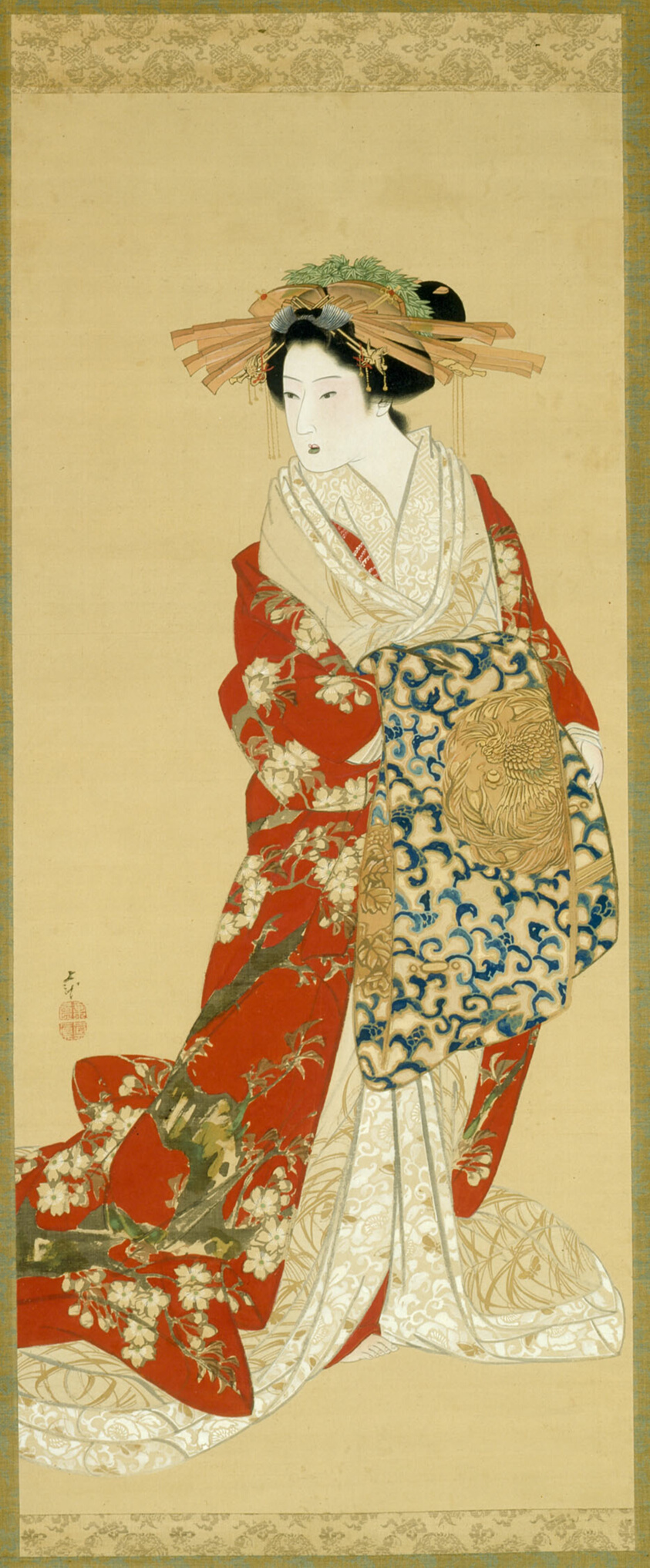
The Materiality of Influence: A High-Ranking Courtesan’s Painted Silk Artifact
Introduction: The Unspoken Language of Silk
In the hushed corridors of power and pleasure, the high-ranking courtesan of the late Ming and early Qing dynasties occupied a singular position—neither wife nor concubine, yet wielding influence that could sway poets, statesmen, and merchants alike. Her world was one of curated intimacy, where every gesture, garment, and artifact was a calculated performance of taste. Among the most telling remnants of this world is a rare artifact: a hanging scroll executed in ink, color, and gold on silk. This object, measuring approximately 120 by 60 centimeters, is not merely a decorative piece. It is a testament to the symbiotic relationship between material culture and social capital, where the very fabric of silk became a medium for asserting identity, status, and intellectual refinement. As a heritage researcher at the Lauren Fashion Heritage Lab, I approach this artifact not as a static relic, but as a dynamic document of craftsmanship, commerce, and courtesan culture.
The Silk Canvas: A Foundation of Prestige
Silk, in the context of this artifact, is far more than a substrate. It is a declaration. The choice of silk—specifically a finely woven, plain-weave tabby with a subtle sheen—speaks to the courtesan’s access to the highest echelons of textile production. During the Ming dynasty, the Jiangnan region, particularly Suzhou and Hangzhou, was the epicenter of silk weaving, producing fabrics that were both a luxury export and a domestic marker of elite status. The courtesan’s patron, likely a wealthy scholar-official or merchant, would have commissioned this scroll from a workshop specializing in painting on silk, a process requiring exceptional skill to prevent the delicate fibers from buckling under the weight of pigment and gold.
The materiality of silk here is not passive. Its absorbency and translucency demand a specific technique: the artist must apply thin, layered washes of color, allowing the silk’s natural luminosity to show through. In this artifact, the silk’s warp and weft are visible under magnification, creating a subtle grid that anchors the composition. This is not a canvas for bold, impasto strokes; it is a surface for nuanced gradation, where the gold leaf—applied as fine powder or cut foil—catches the light differently depending on the angle. The courtesan, as both subject and commissioner, understood this interplay. She knew that the flicker of gold against silk would mimic the shimmer of her own silk robes, creating a visual echo between the painted figure and the viewer’s reality.
Iconography and Composition: The Courtesan as Muse and Maker
The central figure in this scroll is a woman seated on a lacquered daybed, her posture relaxed yet poised. She wears a layered robe of deep indigo and coral, with a gold-threaded sash that falls in precise folds. Her hair is arranged in a high chignon, adorned with jade and kingfisher feather ornaments—signifiers of wealth and aesthetic discernment. In her left hand, she holds a fan painted with a landscape, a nod to the literati tradition. To her right, a low table holds a qin (zither), a brush, and an inkstone. These objects are not arbitrary; they are the tools of a cultivated woman. The courtesan’s role was not merely sexual; it was intellectual. She was expected to converse on poetry, music, and philosophy. The inclusion of the qin and brush suggests that this artifact was a portrait of her accomplishments, a visual résumé for potential patrons.
The background is a garden scene, with bamboo, plum blossoms, and a crescent moon. The bamboo, rendered in ink with swift, calligraphic strokes, symbolizes resilience and integrity. The plum blossoms, in pale pink and white, represent renewal and beauty in adversity. The moon, painted in a thin wash of gold, casts a soft glow over the scene. This is not a realistic space; it is an idealized one, a jardin anglais of the Chinese imagination, where nature is tamed into a metaphor for the courtesan’s own controlled allure. The composition is balanced but asymmetrical, drawing the eye in a gentle S-curve from the figure’s face to the qin, then to the moon. This rhythm is deliberate, mirroring the cadence of a well-rehearsed performance.
Technique and Craftsmanship: The Hand of the Master
The execution of this artifact reveals the hand of a workshop trained in the “fine-line” (gongbi) style, characterized by meticulous detail and even, unbroken outlines. The courtesan’s face is rendered with a pale, almost translucent skin tone, achieved through multiple layers of white lead and vermilion, then sealed with a thin wash of alum. Her eyes are almond-shaped, with a slight upward tilt, painted in a single, confident stroke of ink. The gold on her robe is not flat; it is applied in a technique called qiangjin (raised gold), where a mixture of gold powder and animal glue is built up in relief, then burnished to a mirror finish. This creates a tactile quality—the gold catches the light, but also the finger. The viewer is invited to touch, to feel the texture of wealth.
The silk itself shows signs of age: a gentle yellowing from exposure to incense smoke, and minor creases where the scroll was rolled and unrolled. These are not flaws; they are evidence of use. This artifact was not hidden away in a cabinet. It was displayed in the courtesan’s private quarters, a backdrop for her own performances of elegance. The gold has flaked in a few places, revealing the silk beneath—a reminder that even the most refined materials are subject to time. Yet this impermanence is part of the artifact’s power. It speaks to the ephemeral nature of beauty, of influence, of the courtesan’s own fleeting career.
Cultural and Economic Context: Silk as Currency
To understand this artifact fully, one must consider the economic ecosystem that produced it. Silk was not just a fabric; it was a currency. In Ming and Qing China, silk was used as tribute, as trade goods, and as a store of value. A high-ranking courtesan’s wardrobe could represent a significant investment—a single robe might cost the equivalent of a year’s wages for a common laborer. This scroll, with its gold leaf and fine pigments, was similarly expensive. It was a gift from a patron, a token of his wealth and her status. But it was also a tool. The courtesan could display this artifact to new visitors, signaling her connections and her taste. It was a form of social capital, materialized in silk and gold.
The courtesan herself was a brand. Her name, her style, her artistic skills—all were commodities in a competitive market. This scroll functioned as a form of marketing, a visual proof of her refinement. In a world where reputation was everything, the artifact was a permanent record of her allure. It outlasted her beauty, her patrons, and her own life. Today, it survives as a silent witness to a world where silk was not just a fabric, but a language.
Conclusion: The Legacy of Fluid Elegance
This artifact, crafted in ink, color, and gold on silk, is more than a painting. It is a convergence of materiality, craftsmanship, and social strategy. The silk itself, with its luminous weave, sets the stage for a performance of status. The courtesan, depicted in her garden of symbols, is both subject and author of her own narrative. The gold, applied with precision, is a promise of value that transcends the moment. For the Lauren Fashion Heritage Lab, this artifact offers a profound lesson: that fashion, in its broadest sense, is never merely about clothing. It is about the materials we choose, the stories we tell, and the legacy we leave. In the fluid elegance of this silk scroll, we see the enduring power of a woman who understood that influence is, ultimately, a matter of craftsmanship.