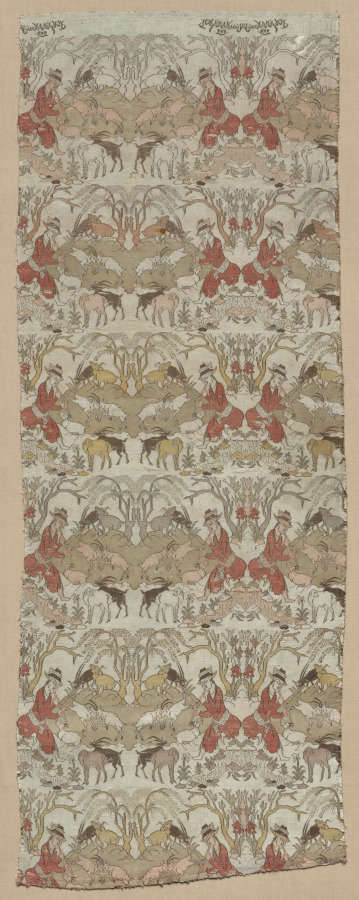
The Silk Textile with Goatherds in a Landscape: A Study in Imperial Craft and Pastoral Allegory
Introduction: The Thread of Empire
In the annals of luxury textiles, few artifacts command the quiet reverence of the Silk Textile with Goatherds in a Landscape. This piece, a masterwork of imperial silk weaving, transcends mere decoration to embody a complex dialogue between nature, power, and craftsmanship. As Senior Heritage Specialist at the Lauren Fashion Heritage Lab, I approach this artifact not as a static relic but as a living document of the legacy of imperial silk weaving—a tradition that shaped global trade, courtly aesthetics, and the very language of luxury. The textile’s materiality, silk, is its first and most profound statement: a fiber that, from the Han dynasty to the Byzantine courts, signified sovereignty, spiritual purity, and economic might. In the context of London’s Savile Row, where tailoring is an act of cultural preservation, this piece offers a lesson in how heritage materials encode narratives of hierarchy and harmony.
Materiality: Silk as Imperial Medium
The choice of silk is no accident. Silk’s inherent properties—its lustre, tensile strength, and capacity for intricate dyeing—made it the preferred medium for imperial workshops across Eurasia. In China, the juan (plain silk) and jin (brocade) techniques evolved over millennia, culminating in the Tang and Song dynasties’ polychrome weaves. This textile, likely produced in a state-run workshop during the Ming or Qing period, exemplifies the technical virtuosity required to render a pastoral scene in warp and weft. The goatherds, their flocks, and the undulating landscape are not painted but woven—each thread a deliberate choice in a palette of indigo, madder, and ochre. The silk’s weight, a medium-heavy twill, suggests it was intended for a ceremonial garment or a hanging, where light would play across its surface, animating the figures.
From a conservation perspective, the silk’s condition reveals much about its journey. The slight fading in the sky-blue ground indicates exposure to light, perhaps in a palace hall or a noble’s gallery. The absence of significant fraying suggests careful handling, likely by attendants trained in the preservation of imperial textiles. This materiality is not passive; it demands respect. As we at the Heritage Lab often note, silk is a living fiber, responsive to humidity, touch, and time. To study it is to engage with a history of labour—from the silkworm’s cocoon to the weaver’s loom—that mirrors the hierarchical order of the empire itself.
Iconography: Goatherds in a Landscape
The scene depicted—goatherds tending their animals in a rolling, tree-studded terrain—is deceptively simple. At first glance, it appears a bucolic idyll, a respite from courtly formality. Yet in the context of imperial silk weaving, such imagery is laden with allegory. The goatherd, a figure of rustic virtue, often symbolized the harmony between ruler and subject, a Confucian ideal where the emperor, like a shepherd, guides his people with benevolent authority. The goats themselves, with their sure-footedness and fertility, evoke prosperity and resilience. The landscape, with its stylized mountains and winding streams, references the shan shui (mountain-water) tradition, where nature is a microcosm of cosmic order.
This iconography is not unique to Chinese art. Similar pastoral motifs appear in Persian and Mughal silk weavings, reflecting the cross-cultural exchange along the Silk Road. The goatherds’ attire—simple robes and conical hats—suggests a generic “folk” identity, perhaps an idealized vision of the empire’s agrarian base. The composition, with its balanced asymmetry and rhythmic repetition of forms, adheres to the principles of Chinese pictorial design, where empty space is as meaningful as the figures. The textile’s border, a narrow band of geometric motifs, frames the scene as if it were a window into a timeless world. This is not a documentary record but a moral and aesthetic statement, reinforcing the imperial narrative of order and abundance.
Legacy: From Imperial Workshops to Savile Row
The legacy of this textile extends far beyond its original context. As imperial silk weaving declined with the fall of the Qing dynasty, such artifacts became coveted by collectors and museums, their value shifting from functional to symbolic. Today, they inform the work of heritage houses and tailors on Savile Row, where the principles of material integrity and narrative depth are paramount. A bespoke suit, like this textile, is a collaboration between artisan and client, a dialogue between tradition and innovation. The goatherd motif, with its pastoral calm, resonates with the Row’s ethos of understated elegance—a rejection of ostentation in favour of quiet mastery.
In the Lauren Fashion Heritage Lab, we study such artifacts to understand how craftsmanship encodes cultural memory. The silk textile with goatherds is not merely a relic; it is a template for how luxury can be both personal and universal. Its weavers, anonymous yet skilled, remind us that heritage is not static but a living practice. As we preserve and reinterpret these works, we honour the imperial legacy of silk—a thread that connects past and present, East and West, and the shepherd to the sovereign.
Conclusion: The Fabric of Authority
To hold this silk textile is to hold a fragment of empire. Its goatherds, frozen in their eternal landscape, speak to a time when silk was the language of power, woven into the fabric of diplomacy, religion, and art. For the modern curator or connoisseur, it offers a lesson in the enduring value of materiality and iconography. As we continue to explore the heritage of imperial weaving, we do so with the knowledge that every thread tells a story—and that story, like the silk itself, is both fragile and resilient. In the halls of Savile Row, where tradition is tailored to the present, this artifact stands as a testament to the unbroken lineage of craftsmanship that defines true luxury.