The Art of Epistolary Seduction: Deconstructing "A Courtesan Reading a Letter" as a Heritage Artifact
Materiality and the Language of Silk
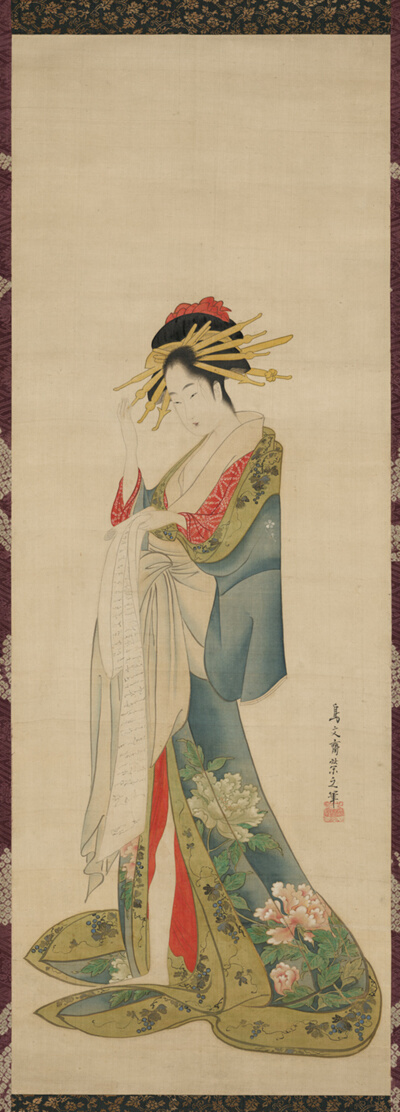
The hanging scroll, A Courtesan Reading a Letter, executed in ink and color on silk, represents a pinnacle of classical East Asian craftsmanship that resonates deeply with the ethos of London’s Savile Row. Here, materiality is not merely a substrate; it is the narrative itself. Silk, with its inherent luminosity and tensile strength, serves as a metaphor for the courtesan’s own duality—a surface of exquisite refinement concealing a life of transactional intimacy. The scroll’s format, designed for contemplative unrolling, mirrors the slow, deliberate process of reading a private correspondence. In the same way a Savile Row tailor selects a bolt of worsted wool for its drape and resilience, the artist chose silk for its ability to hold pigment with a translucent depth, allowing the ink to breathe and the colors to shimmer with a life force that paper could never replicate.
The materiality of this artifact is a testament to the rigorous standards of the Ming and Qing dynasty silk workshops, where weavers achieved densities of over 100 threads per centimeter. This technical mastery is not unlike the precision of a hand-stitched lapel on a bespoke suit—invisible to the untrained eye, yet foundational to the garment’s integrity. The silk’s warp and weft create a subtle grid that disciplines the brushwork, demanding a controlled spontaneity from the artist. Every stroke of ink, every wash of mineral pigment—malachite green, azurite blue, cinnabar red—interacts with the fabric’s weave to produce a texture that is at once smooth and tactile. This is not a passive surface; it is an active participant in the composition, much like the way a fine worsted flannel absorbs and reflects light, altering the perception of a suit’s silhouette throughout the day.
Composition and the Gaze of Intimacy
The courtesan is depicted in a moment of profound privacy, her posture a study in controlled elegance. She is seated, perhaps on a lacquered daybed or a low stool, her body angled slightly away from the viewer, her head bowed over the letter. The scroll’s verticality emphasizes her elongation, a silhouette that recalls the slender grace of a willow branch. Her robes, rendered in layers of translucent silk, cascade in folds that mimic the very fabric on which they are painted. The artist’s use of negative space—the unpainted silk around her—creates an atmosphere of quiet tension, as if the air itself is holding its breath. This is a masterclass in restraint, a quality highly prized in both Savile Row tailoring and classical Chinese painting. The composition does not shout; it whispers, inviting the viewer to lean in, to share in the secret.
The letter itself is a focal point, a small rectangle of white paper that disrupts the chromatic harmony of the scene. The courtesan’s fingers, rendered with delicate brushstrokes, hold the paper with a lightness that suggests both reverence and anxiety. Is this a love letter? A summons? A dismissal? The ambiguity is deliberate. The artist has captured not the content of the letter, but the act of reading—the cognitive and emotional engagement that transforms a piece of paper into a world of meaning. This is the same precision with which a tailor reads a client’s body, translating measurements and posture into a garment that speaks of character and intent. The courtesan’s gaze, though directed downward, is not passive. It is an active, analytical gaze, parsing each character for subtext, for the spaces between the words.
Cultural Context and the Economics of Elegance
To fully appreciate this artifact, one must understand the courtesan’s place in the social hierarchy of pre-modern China. She was not a common prostitute; she was a trained performer, a poet, a musician, and a conversationalist. Her existence was a commodity of refinement, purchased by wealthy merchants and scholars who sought not just physical pleasure, but intellectual and aesthetic stimulation. The courtesan’s body was a canvas for fashion, her attire a display of the latest silks, embroideries, and jewelry. In this scroll, her clothing is rendered with a specificity that allows a connoisseur to date the work to within a few decades. The cut of her collar, the pattern of her sash, the length of her sleeves—all are markers of a particular moment in the evolution of Chinese dress.
This intersection of art, commerce, and social performance finds a parallel in the world of Savile Row. A bespoke suit is not merely clothing; it is a statement of identity, a negotiation between the client’s self-image and the tailor’s expertise. The courtesan’s letter reading is a similar negotiation. She is performing the role of the literate, sensitive woman, a role that enhances her market value. Yet the artist’s choice to depict her in a private moment suggests a subversion of this performance. The letter may be from a lover, but it could also be from a patron, a rival, or a family member. The courtesan’s expression—a subtle downturn of the lips, a slight furrow of the brow—hints at a complexity that transcends her commodified persona. She is, in this moment, fully human.
Preservation and the Legacy of Craft
The survival of this hanging scroll is a minor miracle. Silk is notoriously fragile, susceptible to light, humidity, and handling. The fact that the colors remain vibrant, the ink crisp, is a testament to the meticulous care of generations of collectors and conservators. The scroll’s mounting—the silk borders, the wooden roller, the protective cover—is itself a craft tradition, requiring the same patience and precision as the painting. Each remounting is a dialogue between the original artist and the restorer, a negotiation between preservation and interpretation. This is not unlike the relationship between a Savile Row tailor and a vintage cloth. The cloth carries the memory of its creation; the tailor must honor that memory while adapting it to a new context.
In the Lauren Fashion Heritage Lab, this artifact serves as a touchstone for understanding the enduring power of materiality and narrative in fashion. The courtesan’s silk robe, the ink on the letter, the scroll’s unrolling—all speak to the ways in which fabric and gesture create meaning. For the modern designer, this scroll offers a lesson in the architecture of intimacy. How does a garment shape the way a person is seen? How does a material influence the story it tells? These are questions that transcend time and culture, questions that are as relevant to a Savile Row tailor as they were to a Ming dynasty painter.
The hanging scroll A Courtesan Reading a Letter is not a static object; it is an active participant in a conversation about beauty, power, and the human condition. Its silk surface, its fluid brushwork, its quiet drama—all invite us to consider the ways in which we, too, are read by the world. In the end, the courtesan’s letter is a mirror, reflecting not her secrets, but our own.