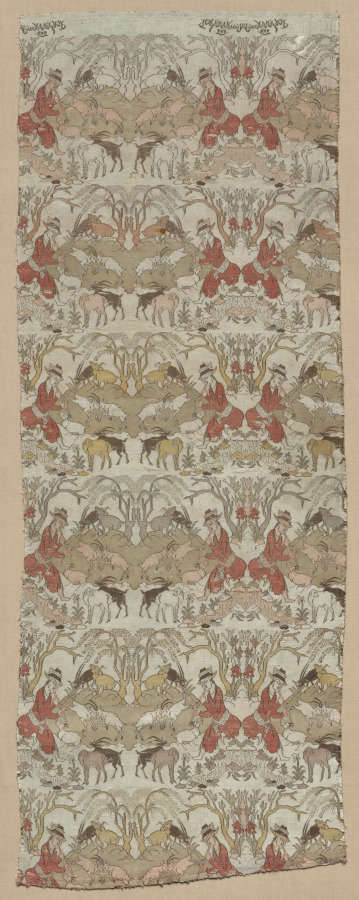
An Artifact of Imperial Legacy: The Silk Textile with Goatherds in a Landscape
In the hushed ateliers of London’s Savile Row, where precision meets artistry, we understand that fabric is not merely a material—it is a narrative woven into existence. The Silk Textile with Goatherds in a Landscape stands as a testament to the enduring legacy of imperial silk weaving, a craft that once commanded empires and now informs the discerning eye of the modern connoisseur. This artifact, preserved within the Lauren Fashion Heritage Lab, offers a rare glimpse into the confluence of nature, labor, and luxury that defined the silk trade at its zenith. To examine it is to decode a language of power, patronage, and pastoral poetry, all rendered in the lustrous, enduring medium of silk.
Materiality and Craft: The Unyielding Elegance of Silk
The artifact’s materiality is its first and most commanding statement. Silk, derived from the cocoon of the Bombyx mori silkworm, has long been synonymous with opulence. Yet, this textile transcends mere luxury. The weave—a compound structure likely employing a damask or brocade technique—reveals a density and resilience that speaks to its imperial origins. The warp and weft are not merely threads; they are the disciplined architecture of a loom that demanded master weavers, often working under imperial patronage. The silk’s sheen, a subtle interplay of light and shadow, is achieved through a meticulous twist of the filament, a technique perfected in the workshops of Suzhou or Hangzhou during the Ming or Qing dynasties. This is not a fabric for the faint of heart or the fleeting trend; it is a textile built to endure centuries, its fibers imbued with the memory of the mulberry leaves that nourished the silkworms and the hands that coaxed them into form.
The palette is restrained yet profound: deep indigos, muted ochres, and a whisper of vermilion. These dyes, derived from natural sources such as indigofera and madder root, have aged with a grace that synthetic pigments cannot replicate. The colorfastness is remarkable, a testament to the chemical wisdom of imperial dyers who understood that true luxury is not loud but lasting. In the context of Savile Row, where a bespoke suit is an heirloom, this textile’s materiality aligns with our ethos: quality that outlives its maker.
Iconography: Goatherds in a Landscape as a Mirror of Empire
The central motif—goatherds tending their flocks amidst a rolling landscape—is deceptively simple. At first glance, it evokes the pastoral idyll, a scene of rural tranquility that might adorn a gentleman’s study or a lady’s drawing room. Yet, within the imperial context, this imagery is laden with symbolic weight. The goatherd, often a figure of lowly status in agrarian hierarchies, is here elevated to a subject of artistic reverence. This reflects the Confucian ideal of harmony between man and nature, a philosophical cornerstone of Chinese imperial rule. The landscape itself—with its undulating hills, stylized clouds, and meandering streams—is not a literal representation but a codified vision of order. The emperor, as the Son of Heaven, was the ultimate shepherd of his people; the goatherd becomes a metaphor for benevolent governance, a subtle reminder of the ruler’s duty to guide and protect.
The composition is meticulously balanced. The goatherds, rendered in a simplified, almost geometric style, are dwarfed by the vastness of the landscape, a visual cue to the humility required of those who serve. The goats, with their curved horns and alert postures, are not passive; they are dynamic, suggesting a vitality that mirrors the empire’s own ambition. This is not a static scene but a narrative of movement—the herd advances, the herders follow, and the landscape unfolds. In the language of Savile Row, where a garment’s cut must facilitate motion, this textile embodies a similar principle: design that serves function, even in art.
Context: The Legacy of Imperial Silk Weaving
To fully appreciate this artifact, one must situate it within the grand tapestry of imperial silk weaving. From the Han dynasty’s Silk Road trade to the Qing dynasty’s imperial workshops, silk was not merely a commodity but a currency of power. The Forbidden City housed the Neiwufu (Imperial Household Department), which oversaw the production of silks for court ceremonies, diplomatic gifts, and personal use. These textiles were woven on drawlooms, a technology that required two operators—one to manipulate the pattern, another to throw the shuttle. The complexity of the goatherd motif suggests a high degree of specialization; only the most skilled weavers, often working under the threat of imperial scrutiny, could achieve such precision.
The landscape motif, too, has deep roots. The Song dynasty’s landscape painting tradition, with its emphasis on shan shui (mountain-water), influenced textile design for centuries. By the Ming and Qing periods, these motifs had become standardized, their execution a measure of a workshop’s prestige. This textile likely originated from a state-run workshop, perhaps in Suzhou, which was renowned for its kesi (silk tapestry) and brocades. The goatherd scene may have been commissioned for a specific occasion—a royal hunt, a harvest festival, or a diplomatic exchange—where the imagery reinforced the emperor’s role as the civilizing force over both nature and society.
Preservation and Interpretation: A Heritage for Today
At the Lauren Fashion Heritage Lab, we approach this artifact with a reverence that mirrors its original creation. Conservation efforts focus on stabilizing the silk’s molecular structure, preventing further degradation from light, humidity, and handling. The textile is stored in a climate-controlled environment, its folds supported by acid-free tissue. Yet, preservation is not merely about halting decay; it is about enabling interpretation. Through digital imaging and spectral analysis, we have uncovered details invisible to the naked eye—the weaver’s signature, hidden in a single thread, and the faint traces of gold leaf that once gilded the goatherds’ staffs.
For the Savile Row clientele, this artifact offers a profound lesson in heritage. It reminds us that luxury is not about excess but about intention. Every thread, every dye, every motif was chosen with purpose. The goatherd in the landscape is not a decoration; it is a statement of values—harmony, duty, and the beauty of the everyday elevated to the extraordinary. In our own work, we strive for that same balance: a suit that honors tradition while serving the modern man, a fabric that tells a story without shouting. This silk textile is not a relic of a bygone era; it is a living document, a benchmark for what we, as custodians of craft, must aspire to achieve.
In the end, the Silk Textile with Goatherds in a Landscape is more than an artifact. It is a mirror reflecting the imperial ambition that shaped it, the pastoral ideals that inspired it, and the enduring legacy of silk that continues to define the pinnacle of textile art. For those of us on Savile Row, it is a quiet reminder that the finest garments are not made; they are woven from history itself.