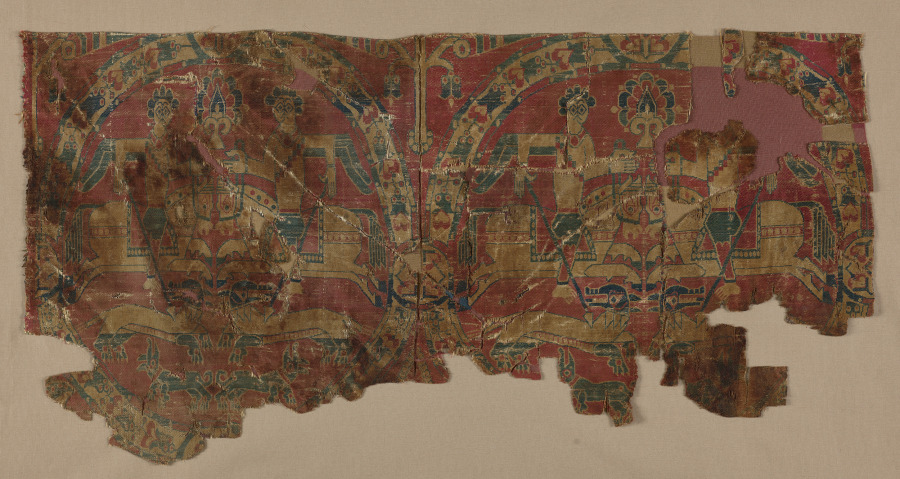
An Examination of the Equestrian Roundel: Imperial Authority Woven in Silk
To comprehend the significance of the silk roundel depicting hunters, one must first appreciate the foundational grammar of the material itself. Silk is not merely a textile; it is a testament to controlled complexity, a language of power articulated through threads. Its very production—from the meticulous cultivation of the silkworm to the orchestration of vast, state-sanctioned kesi workshops—was an imperial prerogative. The fabric, with its inherent luminosity and formidable tensile strength, became the exclusive medium for broadcasting dynastic legitimacy. Within this rarefied context, the recurring motif of the equestrian hunter, captured within the precise geometry of a roundel, emerges not as mere decoration, but as a profound statement of sovereignty, territorial dominion, and cosmic order.
The Architecture of the Roundel: A Microcosm of Empire
The roundel, or tondo, is a form of severe discipline. Its bounded circle imposes a formal structure upon the dynamic, often violent, narrative it encloses. This is not a casual vignette; it is a heraldic assertion, framed and presented with the solemnity of a state seal. The circular form itself is cosmologically resonant, echoing the perfection of the heavens and the cyclical nature of imperial mandate—the Mandate of Heaven, as it were. To encase the figure of the hunter within this boundary is to elevate a specific, martial ideal to a universal principle. The silk ground, typically a deep, resonant hue of sapphire, crimson, or ochre, serves not as a backdrop but as a symbolic field—the very territory over which imperial authority holds sway.
Consider the hunter himself. He is invariably depicted in a state of poised action, a study in controlled exertion. Mounted upon a steed captured in mid-gallop, his torso is twisted in the classic Parthian shot posture, bow drawn, aim fixed upon a quarry often just beyond the roundel’s edge. This iconography is one of relentless pursuit and unerring skill. It speaks to the martial virtues required to secure and maintain an empire: vigilance, precision, and the capacity for decisive force. The hunter is not a commoner; his attire, the trappings of his horse, the quality of his weaponry—all are rendered with a specificity that denotes elite, likely royal, status. He is the emperor as hunter, the guardian of the realm who pacifies chaos (the wild beast) through superior prowess.
Material Execution: The Weave as a Testament to Command
The true gravity of this artifact is fully apprehended only through an understanding of its material execution. The depiction is achieved not through surface embroidery—a later, more accessible craft—but through the supremely demanding technique of tapestry weave (kesi, or slit-tapestry) or complex compound weaves. This is where imperial will translates into tangible form. The design is integrated into the very structure of the cloth during the weaving process on the drawloom, a monumental apparatus requiring multiple operatives working in concert under master weavers.
Each colour transition, each subtle shading in the horse’s musculature or the hunter’s embroidered tunic, requires a separate bobbin of silk thread. The process is one of staggering patience and technical regimentation. The resulting image is inseparable from the ground; it is the ground. This method of manufacture mirrors the administrative machinery of the empire itself: hierarchical, specialized, and capable of producing works of breathtaking complexity that were, by their very nature, impossible to replicate outside the sanctioned ateliers. The silk roundel is thus a product of logistical mastery, as much an administrative achievement as an artistic one.
Context and Legacy: From Imperial Robes to a Language of Prestige
These roundels were seldom conceived as isolated artworks. They were integral components of the imperial vestment system. Arranged in strict, repeating sequences across the vast expanse of a robe or a ceremonial hanging, they transformed the garment into a moving panorama of power. The wearer became the axis around which these symbols of dominion orbited. On a practical level, the repeated, symmetrical pattern facilitated the cutting and tailoring of ceremonial garments from woven lengths with minimal waste of the precious cloth—a concession to efficiency within overwhelming opulence.
The legacy of this form is enduring. The language of the silk roundel migrated along trade routes, its authority subtly transmuting as it was adopted and adapted by other cultures seeking to clothe themselves in the aura of ancient empires. The motif persists, a ghost in the machine of later textile traditions, a reminder that the most potent symbols are those woven into the very fabric of civilization. The precision of the hunter’s form, the balance of the composition within its circular frame, speaks to an aesthetic and political philosophy where order is paramount, and power is both beautiful and absolute.
In conclusion, the silk roundel featuring the hunter is a consummate heritage artifact. It represents the apex of a material tradition where technology, art, and ideology were inextricably fused. It is a declaration woven in thread: a statement of imperial identity, a map of controlled territory, and a permanent record of the belief that true authority lies in the capacity to impose perfect, elegant order upon the world—whether on the field of the hunt or the loom of history.