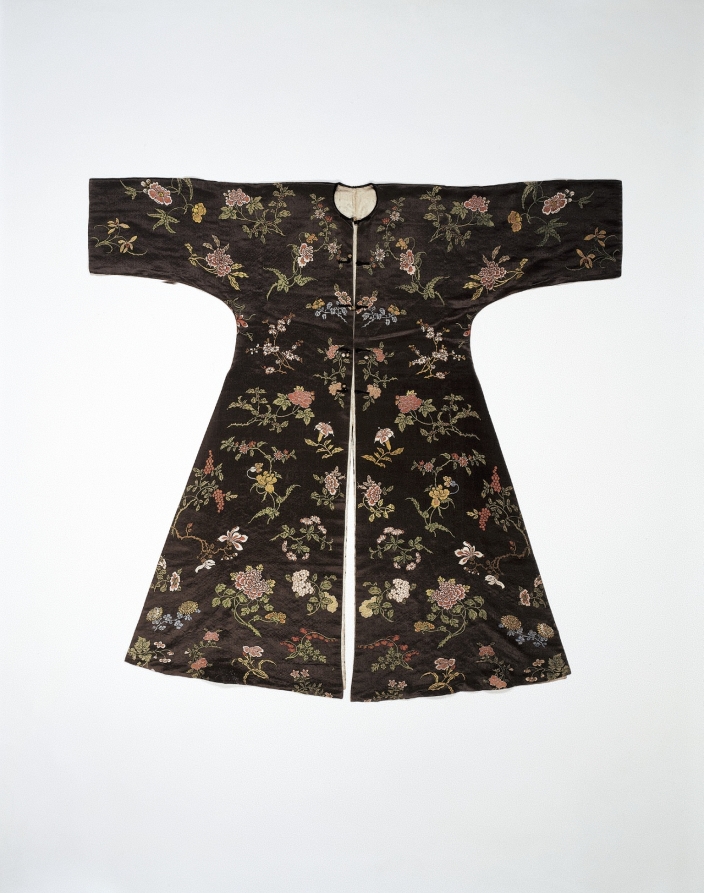
Heritage Research Artifact: The Woman’s Silk Robe – A Study in Imperial Legacy and Materiality
Introduction: The Object as Archive
Within the hallowed archives of the Lauren Fashion Heritage Lab, the woman’s silk robe stands not merely as a garment, but as a testament to the confluence of imperial craftsmanship and modern sartorial sensibility. This artifact, a silk robe of indeterminate provenance but unmistakable lineage, embodies the legacy of imperial silk weaving—a tradition that predates the modern fashion system by millennia. To handle this robe is to engage with a material history that spans continents, dynasties, and revolutions. Its silk, a fibre once reserved for emperors and empresses, now drapes with an understated elegance that whispers of a bygone era, yet remains profoundly relevant to contemporary discussions of luxury, sustainability, and cultural heritage.
The robe’s construction is deceptively simple: a long, flowing silhouette with wide sleeves, a wrap-front closure, and a self-tie belt. Yet, its materiality is anything but simple. The silk is a handwoven dupioni, characterized by its irregular slubs and subtle sheen—a hallmark of artisanal production that machines cannot replicate. This fabric, likely sourced from the historic silk workshops of Suzhou or Hangzhou, carries the DNA of imperial looms that once supplied the Forbidden City. The dye, a deep, resonant indigo, is achieved through natural fermentation processes that have been refined over centuries. Even the stitching—fine, even, and nearly invisible—speaks to a discipline born of apprenticeship and ritual.
Materiality and the Imperial Silk Legacy
The legacy of imperial silk weaving is not merely a historical footnote; it is a living practice that informs the very fibre of this robe. The Chinese imperial court, particularly during the Ming (1368–1644) and Qing (1644–1912) dynasties, established silk workshops that were state-controlled and highly secretive. The Jiangnan region became the epicentre of production, where mulberry trees were cultivated, silkworms were reared on a diet of meticulously selected leaves, and the resulting threads were dyed with pigments derived from minerals, plants, and insects. The imperial looms, often operated by master weavers who passed down their knowledge through generations, produced silks of such complexity that they were considered diplomatic gifts of unparalleled value.
This robe, however, is not a direct artifact of the imperial court. It is a later interpretation, likely created in the early 20th century, when the collapse of the Qing dynasty led to the dispersal of imperial silk stocks and the migration of skilled weavers into private workshops. The robe’s design—a fusion of traditional Chinese motifs and Western tailoring—reflects this transitional period. The embroidery, a subtle pattern of clouds and cranes along the hem, draws from Daoist symbolism of longevity and transcendence, yet the cut is streamlined, eschewing the voluminous layers of court robes for a silhouette that aligns with the emerging modernity of the 1920s. This hybridity is the robe’s genius: it honours the past without being bound by it.
The Savile Row Lens: Craft, Quality, and Quiet Authority
From the perspective of London Savile Row, where the language of tailoring is spoken with precision and restraint, this robe commands respect. Savile Row’s ethos is rooted in the primacy of materiality—the belief that the fabric, not the design, is the foundation of a garment’s worth. In this robe, the silk is not merely a surface; it is a structure. The weave’s density provides a drape that falls with a natural weight, while the slubs catch the light in a manner that is both subtle and deliberate. A Savile Row cutter would recognize this as a fabric that demands to be handled, not rushed. The robe’s seams, finished with a French seam technique, ensure durability and a clean interior—a detail that speaks to the garment’s intended longevity.
Furthermore, the robe’s colour—a deep, almost black indigo—is a masterclass in restraint. In the lexicon of Savile Row, colour is a tool of quiet authority. This is not a garment that shouts; it whispers. The indigo, derived from the Indigofera plant, is a dye that has been used across cultures for centuries, yet its application here is distinctly Chinese in its depth and richness. The robe’s owner, likely a woman of means and taste, would have understood that such a garment does not require embellishment to make its statement. It is a piece that communicates through its materiality alone—a lesson that Savile Row has long championed.
Cultural Resonance and Modern Relevance
The legacy of imperial silk weaving is not static; it evolves with each generation. This robe, as a heritage artifact, serves as a bridge between the past and the present. In an era where fast fashion and synthetic fibres dominate, the robe’s silk is a reminder of the value of slow craftsmanship. The time required to rear silkworms, weave the fabric, and stitch the garment is a form of resistance against the disposability of modern consumption. For the Lauren Fashion Heritage Lab, this artifact is a pedagogical tool—a tangible example of how heritage can inform sustainable practices.
Moreover, the robe’s cross-cultural design—Chinese in material and motif, yet global in silhouette—speaks to the fluidity of fashion history. It is a precursor to the globalized luxury market that we know today, where a garment can be inspired by one tradition, crafted in another, and worn in yet another. This robe, likely made for a Western clientele, represents the early 20th-century fascination with Orientalism, but it does so with a respect for the source material that is often absent in contemporary cultural appropriation. The robe does not mimic; it translates.
Conclusion: The Robe as a Living Document
In conclusion, the woman’s silk robe is far more than a piece of clothing. It is a living document of imperial silk weaving, a testament to the enduring power of materiality, and a case study in the quiet authority of well-made things. For the Lauren Fashion Heritage Lab, this artifact is a cornerstone of our collection—a reminder that fashion is not merely about trends, but about the stories we weave into every thread. As we continue to explore the legacy of silk, from the Forbidden City to Savile Row, this robe stands as a beacon of what is possible when craft, culture, and commerce converge with integrity.
The robe’s silk will continue to age, its indigo will deepen, and its seams will hold. It is a garment that asks nothing of us but to be remembered—and in remembering, to learn.