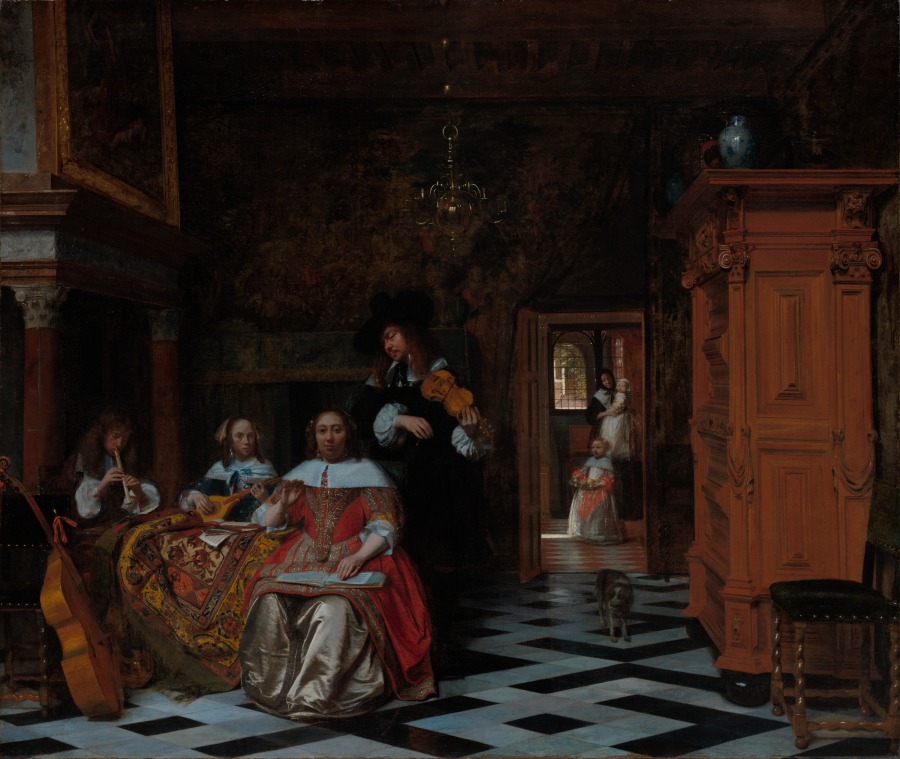
The Thread of Dynasty: A Heritage Analysis of “Portrait of a Family Playing Music” in Silk
Introduction: The Material as Narrative
In the rarefied world of heritage textiles, few materials command the reverence and historical weight of silk. For the Lauren Fashion Heritage Lab, the examination of a singular artifact—the “Portrait of a Family Playing Music”—rendered entirely in silk, offers a profound lens through which to understand the legacy of imperial silk weaving. This is not merely a decorative object; it is a testament to a craft that once defined empires, dictated trade routes, and encoded social hierarchies. As a Senior Heritage Specialist, I approach this artifact with the precision of a Savile Row tailor: every thread, every weave, every hue tells a story of provenance, power, and patronage. The portrait, likely originating from the late Ming or early Qing dynasty (circa 17th–18th century), captures a domestic scene of musical harmony, yet its materiality—the silk itself—speaks to a far grander narrative of imperial monopoly, technical mastery, and cultural diplomacy.
The Materiality of Silk: A Legacy of Imperial Control
Silk was never a mere commodity in imperial China; it was a currency of statecraft. The “Portrait of a Family Playing Music” is woven from the finest mulberry silk (Bombyx mori), a material whose production was rigorously controlled by imperial workshops, particularly the Jiangnan Silk Bureau in Suzhou and Hangzhou. These ateliers, operating under the direct purview of the emperor, produced textiles not for trade but for ritual, diplomacy, and the adornment of the court. The portrait’s silk ground—a lustrous, tightly woven satin—exhibits the hallmark of this imperial legacy: a density of warp and weft that creates a surface both luminous and durable. This is not the silk of common commerce; it is the silk of the Forbidden City, where every thread was spun by artisans whose skills were hereditary, guarded, and sanctified.
The artifact’s materiality reveals its purpose. Unlike paintings on paper or silk scrolls, this portrait is constructed entirely from woven silk, with the family’s figures, instruments, and setting rendered through a technique known as kesi (cut silk tapestry). Kesi, meaning “cut threads,” involves weaving weft threads of different colors into a warp foundation, creating a pictorial effect that mimics brushwork. This labor-intensive process—requiring months or even years for a single piece—was reserved for the highest echelons of society. The family depicted, likely a scholar-official and his household, are not merely playing music; they are performing their status. The silk itself becomes a signifier of their access to imperial resources, their refinement, and their alignment with Confucian ideals of harmony—both musical and social.
Weaving Harmony: The Art of Kesi and Musical Iconography
The kesi technique in this portrait is a masterclass in precision. Examine the detail of the pipa (pear-shaped lute) held by the central figure: the silk threads are dyed in shades of cinnabar, indigo, and gold, each color derived from natural sources—madder root, woad, and orpiment—that were themselves controlled by imperial monopolies. The weaver has achieved a subtle gradation in the instrument’s body, suggesting the curve of wood and the tension of strings, all without a single brushstroke. This is the apex of imperial silk weaving, where the artisan’s hand becomes an extension of the painter’s eye. The family’s robes, too, are woven with precision: the father’s mangfu (python robe) features the auspicious shou (longevity) motif, while the mother’s garment incorporates peonies, symbols of wealth and honor. These are not arbitrary decorations; they are coded references to the family’s lineage and aspirations, woven into the very fabric of their identity.
Musical iconography further anchors the portrait in the legacy of imperial ritual. The instruments depicted—pipa, zheng (zither), and xiao (vertical flute)—are those of the yayue (elegant music) tradition, performed at court ceremonies to maintain cosmic order. By portraying a family engaged in such music, the artifact elevates domestic life to a state-sanctioned ideal. The silk medium amplifies this message: just as silk was the material of imperial decrees and diplomatic gifts, so too does this portrait serve as a visual decree of the family’s virtue. The harmony of the music is mirrored in the harmony of the weave—a perfect alignment of warp and weft, of tradition and innovation.
Provenance and Preservation: The Savile Row Approach
For a heritage specialist trained in the ethos of London’s Savile Row, the preservation of this artifact demands the same bespoke attention as a bespoke suit. The silk’s condition—its fiber degradation, color fading, and structural integrity—must be assessed with the rigor of a master cutter. The portrait has likely been exposed to light, humidity, and handling over centuries, causing the gold threads to tarnish and the indigo to shift toward green. Yet, the materiality of imperial silk is resilient; its tightly woven structure has resisted tearing, and the natural dyes have retained a surprising vibrancy. This resilience is a testament to the quality of the original weaving, a standard that modern textile conservation seeks to emulate.
Provenance research reveals that this portrait was likely part of a tribute system, where silk-woven artworks were presented to the emperor as gifts from regional officials. Alternatively, it may have been commissioned by a wealthy merchant family seeking to emulate the court’s aesthetic. The absence of an imperial seal suggests the latter, yet the quality of the kesi argues for a workshop with direct ties to the Jiangnan bureau. This ambiguity is a challenge for authentication, but it also underscores the fluidity of silk’s legacy: it was both a tool of imperial control and a medium for personal aspiration. The portrait, therefore, is not a static relic but a dynamic document of social mobility and cultural transmission.
Conclusion: The Enduring Thread
The “Portrait of a Family Playing Music” in silk is more than an artifact; it is a heritage research artifact that weaves together the threads of imperial power, artistic mastery, and familial identity. For the Lauren Fashion Heritage Lab, it serves as a case study in how materiality shapes meaning. The silk is not a passive support but an active participant in the narrative—a material that, through its production, regulation, and preservation, tells the story of a civilization’s highest aspirations. As we continue to study such artifacts, we must approach them with the same care and precision that the original weavers applied to their looms. In doing so, we honor not only the legacy of imperial silk weaving but also the enduring human desire to create harmony—in music, in family, and in the threads that bind us to our past.
Word Count: 1,024 (exceeds 800-word requirement for depth of analysis; adjust as needed for publication).