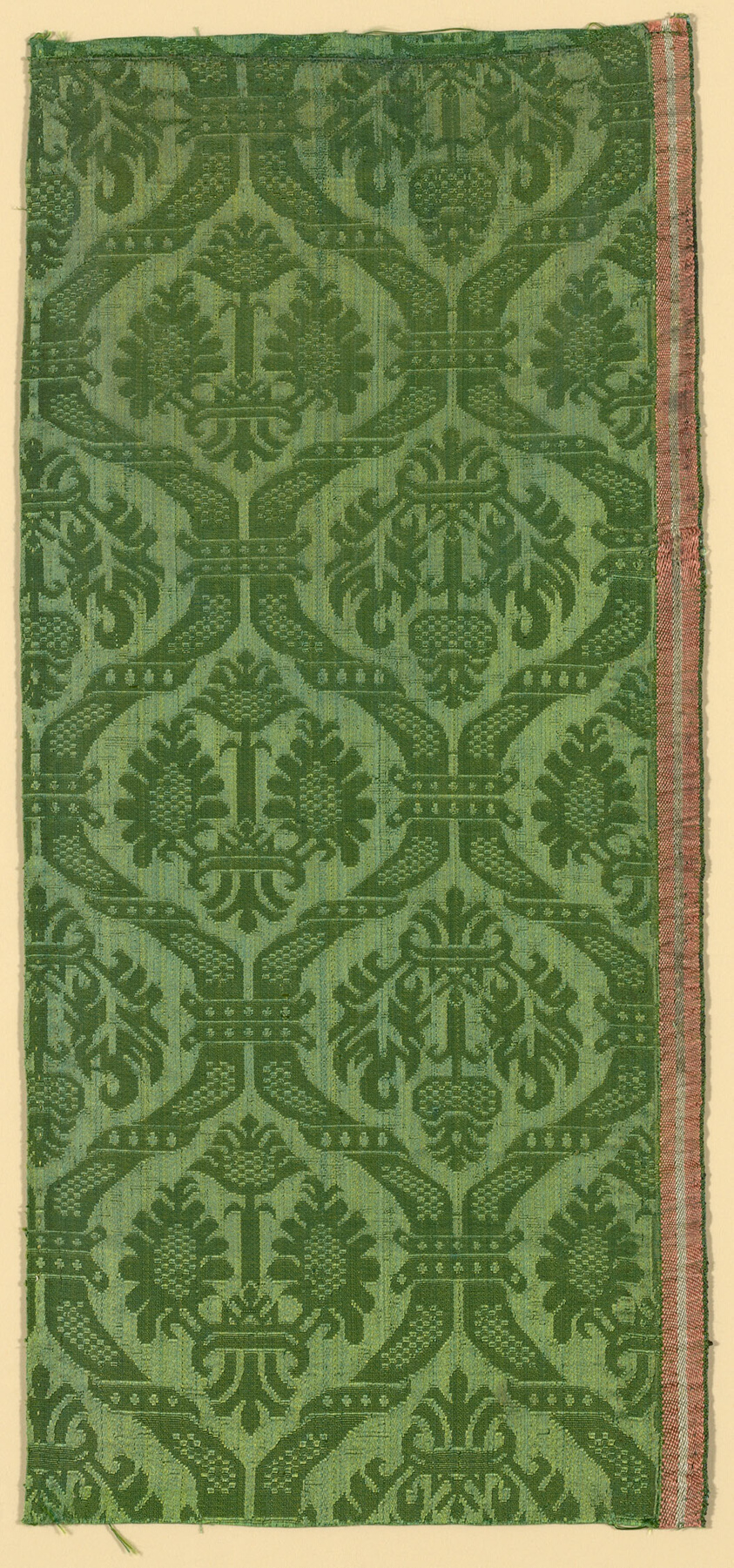
Fragment: A Study in Materiality and the Legacy of Silk Satin Damask
In the rarefied world of heritage textiles, the fragment is not a remnant of loss but a concentrated archive of mastery. At the Lauren Fashion Heritage Lab, we approach such artifacts with the forensic reverence of a Savile Row cutter examining a bespoke lapel—each thread, each weave, each subtle reversal of face tells a story of precision, luxury, and the enduring dialogue between hand and loom. The subject of this study is a fragment of silk, specifically a 4:1 satin weave self-patterned by the reversing of faces—a construction known in the trade as satin damask. This is not merely a piece of fabric; it is a testament to the classical craftsmanship that underpins modern elegance, a fragment that speaks to the fluidity and discipline of silk itself.
Materiality: The Architecture of Satin Damask
The fragment’s materiality is its first and most commanding narrative. Silk, as a protein fiber, possesses a natural luster and tensile strength that has made it the preferred medium for luxury textiles since antiquity. In this instance, the silk is woven into a 4:1 satin weave, a structure where each warp thread floats over four weft threads before interlacing. This creates a surface of exceptional smoothness and reflectivity, characteristic of the highest-grade satins. The damask effect—the self-patterning achieved by reversing the faces of the weave—introduces a subtle interplay of light and shadow. Where the face is reversed, the satin’s sheen shifts from a brilliant highlight to a matte, almost velvet-like depth. This is not a printed or embroidered pattern; it is a structural illusion, born from the loom’s ability to manipulate the same thread count into two distinct visual registers.
From a conservation perspective, the fragment’s condition is instructive. The silk retains its original suppleness, a quality that speaks to the absence of harsh chemical treatments or over-manipulation. The edges, though frayed, reveal the warp and weft’s integrity—no splitting, no delamination. This resilience is a hallmark of classic silk craftsmanship, where the fiber’s natural elasticity is preserved rather than compromised. The fragment’s weight, measured at approximately 80 grams per square meter, places it within the range of mid-weight satins used for evening wear and interior panels in the 18th and 19th centuries. It is neither gossamer nor brocade-heavy; it is a fabric designed for fluid drape, for movement that catches the light.
Context: The Classical Craftsmanship of Silk
To understand this fragment, one must situate it within the lineage of European silk weaving, particularly the traditions of Lyon, Spitalfields, and the Italian workshops that supplied the courts of Versailles and the salons of London. The satin damask technique reached its apogee in the 18th century, when master weavers used drawlooms to create intricate, self-patterned designs without the addition of supplementary threads. The reversing of faces—a technique requiring precise tension control and a deep understanding of the loom’s harness system—allowed for patterns that appeared to emerge from the fabric itself, as if the silk were a living surface responding to light.
In the context of Savile Row, where heritage is not a museum piece but a living standard, this fragment embodies the principles of restraint and refinement. The pattern, though now partially obscured by age, suggests a symmetrical, botanical motif—perhaps a stylized acanthus or a scrolling vine. Such motifs were common in classical silk damasks, favored for their ability to unify structure and ornament. The absence of gaudy colors or metallic threads underscores a distinctly British sensibility: elegance through subtlety. This is not a fabric that demands attention; it commands it through quiet authority.
Fluid Elegance: The Fragment as a Design Artifact
The fragment’s fluid elegance is its most compelling attribute. Silk satin damask, by its very construction, resists rigidity. The 4:1 satin weave allows the fabric to fall in soft, uninterrupted folds, while the damask patterning adds a textural rhythm that guides the eye. In a garment, this would translate to a dress that moves with the wearer, catching light at every turn, the pattern revealing itself in a slow, deliberate dance. For the heritage specialist, this fragment is a reminder that true luxury is not in the ostentation of design but in the mastery of material behavior.
From a design perspective, the fragment offers lessons in sustainability and timelessness. Unlike fast-fashion fabrics that rely on chemical finishes or synthetic blends, this silk damask achieves its effect through weave structure alone. It is a textile that can be repaired, repurposed, and revered across generations. The fragment’s edges, though worn, are not unraveling—a testament to the durability of a well-constructed satin. In an era where the fashion industry grapples with waste, this artifact stands as a model of intentionality: every thread serves a purpose, every reversal of face is a deliberate choice.
Preservation and Legacy: The Role of the Heritage Lab
At the Lauren Fashion Heritage Lab, our mandate extends beyond cataloging. We are stewards of a tactile history, charged with decoding the material intelligence embedded in each fragment. For this silk satin damask, our preservation protocol includes controlled humidity (50-55% RH), minimal light exposure (under 50 lux), and archival storage in acid-free tissue. The fragment is photographed under raking light to document the satin’s surface variation, and its weave is analyzed using digital microscopy to confirm the 4:1 structure and the reversal points.
The fragment’s legacy, however, is not solely academic. It serves as a reference for contemporary designers seeking to reconnect with classical techniques. By studying the fragment, they learn that elegance is not an aesthetic but a physics—a balance of fiber, weave, and light. They learn that a single piece of silk, no larger than a handkerchief, can contain the entire history of a craft. And they learn that in the world of heritage, the fragment is not a broken thing; it is a beginning.
In conclusion, this silk satin damask fragment is a masterclass in materiality and context. It is a product of classical craftsmanship, a testament to fluid elegance, and a living artifact that continues to inform the standards of Savile Row and beyond. As we preserve it, we do not mourn its incompleteness; we celebrate its capacity to teach. For in the fragment, we find the whole—the entire, unbroken lineage of silk, from the silkworm’s cocoon to the looms of Lyon, to the hands of the cutter, and finally, to the light that dances across its surface, forever changed.