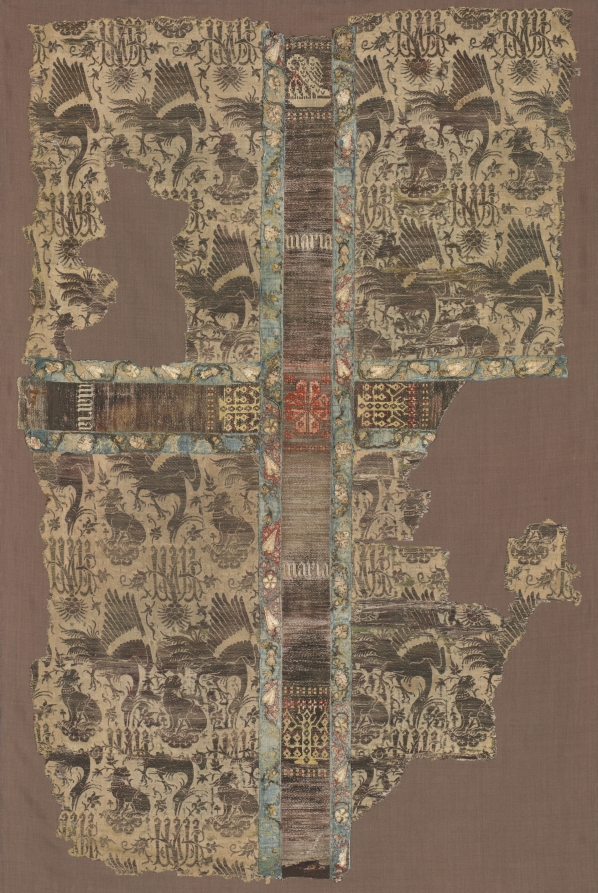
Fragmentary Chasuble with Woven Orphrey Band: A Study in Imperial Silk Legacy
In the hushed corridors of textile conservation, few objects command the reverence of a fragmentary chasuble bearing a woven orphrey band. This artifact, a remnant of ecclesiastical vestment crafted from imperial silk, speaks not merely of liturgical function but of a profound material heritage that bridges the sacred and the sovereign. As Senior Heritage Specialist for the Lauren Fashion Heritage Lab, I approach this piece with the precision of a Savile Row tailor—where every thread, every weave, and every dye tells a story of craftsmanship that transcends centuries. The fragment, though incomplete, is a masterclass in materiality: its silk, once the preserve of emperors and popes, now whispers of a legacy that shaped the very fabric of Western luxury.
Materiality and the Imperial Silk Trade
The chasuble’s silk is not merely a textile; it is a geopolitical artifact. Silk, as we understand it in the context of imperial weaving, was a commodity of immense strategic value. From the Han Dynasty’s monopolistic control of sericulture to the Byzantine Empire’s establishment of state-run workshops in Constantinople, silk was a currency of power. The fragment’s weave—a compound structure typical of 14th- to 16th-century Italian or Spanish production—betrays its origins in the post-Silk Road era, when European workshops began to rival Eastern looms. The orphrey band, a decorative strip often woven with gold or silver thread, is a hallmark of liturgical opulence. Yet, its presence here is not merely ornamental; it is a testament to the technical mastery required to produce such intricate patterns. The silk’s lustrous finish, even in its fragmentary state, suggests a high twist in the warp threads—a technique that imparted durability and sheen, essential for vestments that endured both ceremonial use and the weight of centuries.
The Orphrey Band: A Woven Narrative
The orphrey band, typically applied vertically down the front of a chasuble, serves as both structural reinforcement and iconographic canvas. In this fragment, the band’s design—likely depicting saints or heraldic motifs—is partially obscured, yet its weave reveals a sophistication that aligns with the finest Italian silks of the Renaissance. The use of lampas weave, where a pattern is created by supplementary wefts bound to a ground weave, allowed for the incorporation of metallic threads. These threads, often gilded silver, were not merely decorative; they reflected light in a manner that evoked the divine, transforming the vestment into a mobile reliquary. The orphrey’s survival, even in fragmentation, underscores its role as a focal point of the chasuble’s design—a visual anchor that drew the congregation’s eye during the Eucharist. For the heritage specialist, this band is a Rosetta Stone: its weave density, thread count, and dye composition offer clues to the workshop’s provenance. The presence of kermes or cochineal in the red tones, for instance, would indicate a Mediterranean origin, while indigo in the blue suggests trade routes that stretched to the Indies.
Context: The Legacy of Imperial Silk Weaving
To understand this chasuble is to understand the imperial silk weaving tradition as a continuum of power. In Byzantium, the imperial monopoly on purple silk—dyed from the murex shell—was a symbol of autocracy. Charlemagne, upon his coronation, donned a silk dalmatic woven in Constantinople, signaling his claim to Roman legitimacy. By the 15th century, Italian city-states like Florence and Venice had become the new epicenters of luxury weaving, supplying the Vatican and European courts. This fragment, therefore, is not an isolated object but a node in a network of patronage, trade, and artistry. The chasuble’s wear—the frayed edges, the faded hues—is not decay but biography. Each abrasion marks a moment of use: a bishop’s hand gripping the orphrey during benediction, the friction of a wooden altar, the humidity of a stone cathedral. In the context of the Lauren Fashion Heritage Lab, we treat such wear as data. Spectral analysis of the silk’s degradation can reveal the environmental conditions of its storage, while microscopic examination of the metallic threads can identify the alloy composition, linking it to known mining regions in the Carpathians or the Andes.
Conservation and the Tailor’s Eye
Conserving a fragmentary chasuble demands the same rigor as cutting a bespoke suit on Savile Row. The silk, weakened by age, requires stabilization through stitch conservation—a technique where fine silk threads are used to support the original weave without introducing new tension. This is not restoration but preservation; we do not seek to return the chasuble to its pristine state, but to halt its decline while honoring its history. The orphrey band, with its metallic threads, poses particular challenges. Tarnishing is inevitable, but cleaning must be minimal; a gentle dry-cleaning with cyclododecane can lift surface grime without damaging the silk’s sericin coating. For the heritage specialist, every decision is a negotiation between material integrity and historical authenticity. The fragment’s incomplete state—perhaps a third of the original chasuble—invites speculation. Was it cut down for reuse, as was common in the Reformation when vestments were repurposed as altar cloths? Or did it succumb to the ravages of time, its silk fibers slowly hydrolyzing in a damp sacristy? The answers lie in the weave’s structural logic, a language that the trained eye can read.
Implications for Modern Luxury
The legacy of imperial silk weaving extends beyond the museum vitrine. Today, the Lauren Fashion Heritage Lab draws on these historical techniques to inform contemporary design. The orphrey band’s use of metallic threads, for instance, prefigures the Lurex and brocade of modern evening wear. The chasuble’s silhouette—a bell-shaped garment that allowed for movement—echoes in the draped gowns of haute couture. Yet, the true lesson is one of patience. Imperial silk weavers spent months on a single piece, their looms producing inches of fabric per day. In an age of fast fashion, this fragmentary chasuble is a rebuke and an inspiration. It reminds us that luxury is not abundance but intention—the deliberate choice of material, the mastery of technique, the endurance of beauty. As we conserve this artifact, we are not merely preserving the past; we are curating a standard for the future.
Conclusion
The fragmentary chasuble with woven orphrey band is a silent testament to the imperial silk weaving tradition—a tradition that defined the material culture of Europe for centuries. Its silk, once a symbol of divine and earthly power, now resides in the controlled environment of the Lauren Fashion Heritage Lab, where it continues to teach. For the heritage specialist, it is a puzzle to be solved, a story to be told. For the fashion historian, it is a benchmark of craftsmanship. And for the Savile Row tailor, it is a reminder that true elegance is woven, not manufactured. In its fragmentary state, this chasuble is whole in meaning—a legacy that endures, thread by thread.