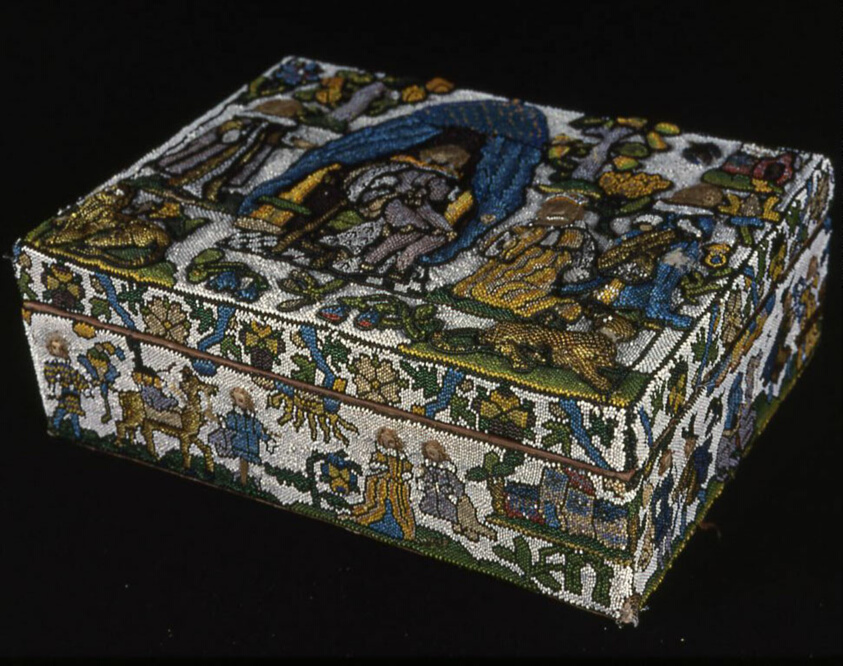
An Artifact of Regal Commerce: A Deconstruction
Within the curated silence of the Lauren Fashion Heritage Lab, one encounters artifacts not merely as objects of beauty, but as complex documents of cultural and commercial dialogue. The subject—a writing box depicting King Solomon and the Queen of Sheba—presents itself not as a simple container, but as a profound statement of crafted authority. Its materiality speaks the refined language of global exchange, its narrative a timeless allegory for the very essence of bespoke engagement. To analyse this piece is to understand heritage not as a static history, but as a continuing conversation between power, artistry, and the most exquisite of materials: silk.
The Canvas: A Foundation of Silent Prestige
The foundation, a wooden box, establishes immediate gravitas. It is the Savile Row suit’s canvas—the robust, structured chassis upon which all expression hangs. This is no mere substrate; it is the architectural integrity, the promise of protection and permanence for the delicate communications within. The metal hinges, functionally discreet yet unequivocally present, are the precise engineering of a master tailor’s inner construction—the hidden boning, the reinforced buttonholes—that guarantees flawless performance and enduring form. They speak of a craftsmanship that considers eternity in every pivot.
The Narrative Stitch: Allegory as Brand Ethos
The chosen tableau is singularly apt. The meeting of Solomon and Sheba is not a mere biblical scene; it is the ultimate narrative of sovereign exchange. It represents a confluence of intellect and wealth, of wisdom meeting curiosity, of two powerful entities engaging in a dialogue that enriches both realms. In the lexicon of heritage, this is the quintessential client relationship. Solomon, the established paragon of judgement and discernment; Sheba, the discerning seeker of truth and excellence, arriving with gifts but demanding proof of legendary repute. The box, therefore, becomes more than a desk accessory; it is a symbolic vessel for the fruits of such enlightened exchange—the contracts, the correspondence, the sealed agreements that follow a meeting of minds at the highest level.
The Material Lexicon: Silk as the Conduit of Elegance
Here, the analysis turns to the core of the artifact’s statement: its application of silk in multiple, masterful disciplines. The satin weave ground is the foundation fabric of a peak lapel—immaculately smooth, possessing a depth of colour and a fluid drape that synthetic fibres cannot emulate. It is the silent, luxurious background against which the narrative drama unfolds.
The true virtuosity, however, lies in the raised appliqué. The figures, worked over cotton padding and silk, achieve a sculptural quality. This is the sartorial equivalent of precision padding in a jacket’s shoulder or chest—a subtle, artful manipulation of form to create idealised, powerful silhouettes. The beading, executed in silk and glass, translates light into language. The silk beads provide a matte, dignified lustre, while the glass beads offer pinpoint highlights, much like the careful play of light on a finely picked stitching thread or the discreet gleam of a quality horn button.
The embroidery in satin and single satin stitches is where the hand declares its presence. This is the visible hand-stitching on a bespoke garment—the needlework that, upon close inspection, reveals a personal, human touch beneath the imposing perfection. The couching work and seed pearls are the final flourishes: the silk cord couching akin to elegant top-stitching, defining edges and contours; the seed pearls serving as minute, precious buttons or the subtle ornamentation on a boutonniere. Each element is subordinate to the whole, yet indispensable to the narrative of opulent restraint.
Context and Connoisseurship: The Fluidity of Legacy
The stated context—“Classic silk craftsmanship and fluid elegance”—is precisely observed. The classicism resides in the technique, a heritage passed through generations of artisans. The fluid elegance is the result: the seamless integration of diverse materials into a singular, harmonious vision. There is no jarring element; the wood, metal, silk, glass, and pearl converse in a coherent dialect of luxury.
This artifact, therefore, stands as a benchmark for heritage in a modern context. It instructs that true luxury is an ecosystem of expertise. The woodworker, the metal smith, the silk weaver, the embroiderer—each is a specialist of the highest order, their labour directed by a unifying creative intelligence. This is the very principle of a Savile Row establishment, where the cutter, the coat-maker, the trouser-maker, and the finisher collaborate under a house style to produce a singular statement of personal authority.
In conclusion, this writing box is far more than an embellished object. It is a treatise on the principles of enduring value. It argues, through material and motif, that significant exchange—be it of ideas, goods, or vows—deserves a vessel of commensurate substance and narrative depth. It posits silk not as a mere fabric, but as the essential medium for expressing power, diplomacy, and refined taste. For the modern purveyor of heritage, it serves as a masterclass: legacy is woven not from nostalgia alone, but from the ongoing, impeccable execution of timeless dialogues, stitched with precision and couched in the deepest understanding of material eloquence.