← BACK TO ARCHIVES
Silk
Heritage Synthesis: Lampas with griffins in roundels, from the Reliquary of Saint Librada in Siguenza Cathedral
Curated on Jul 16, 2026 // Node: LDN-01
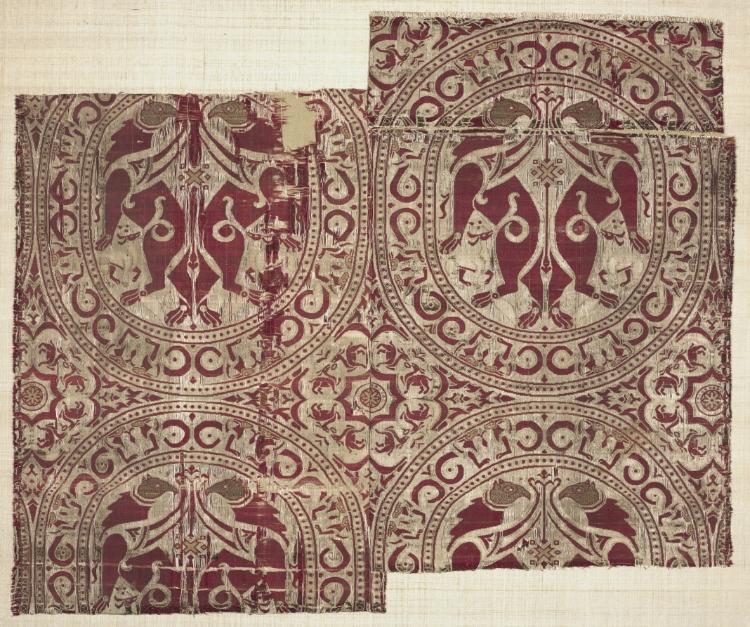
The Thread of Empire: A Heritage Analysis of the Lampas with Griffins in Roundels, Reliquary of Saint Librada, Sigüenza Cathedral
In the hushed, vaulted silence of the Sigüenza Cathedral, within the gilded confines of the Reliquary of Saint Librada, lies a fragment of textile history that speaks with the authority of a lost empire. This is not merely a piece of fabric; it is a material document, a woven testament to the legacy of imperial silk weaving. As a Senior Heritage Specialist, I present this analysis of the **Lampas with griffins in roundels**—a silk artifact whose technical mastery and iconographic power demand the same rigorous scrutiny we apply to a bespoke suit from Savile Row: an examination of cut, cloth, and provenance, where every thread is a statement of intent.
Materiality: The Silk of Sovereignty
The primary material is **silk**, a fibre that, in the medieval world, was the equivalent of the finest cashmere or vicuña today—rare, costly, and reserved for the highest echelons of power. This is not the silk of common trade; it is imperial silk, likely originating from the workshops of Al-Andalus or, more precisely, from the looms of the Islamic Mediterranean, which had inherited and perfected the techniques of Byzantine and Sassanian weavers. The materiality of this lampas is defined by its structure: a compound weave where a pattern ground is created by a warp-faced weave, and the pattern itself is brought to the surface by a supplementary weft. This is not a simple print or embroidery; it is an integral part of the cloth’s very architecture. The silk’s lustre, even after centuries in a reliquary, retains a deep, resonant sheen—a testament to the quality of the raw filament and the skill of the dyer. The colours, though faded, speak of a palette of authority: deep crimson, now softened to a russet; gold, now a muted ochre; and a ground of ivory or pale beige, which once would have provided a stark, luminous contrast. This is a cloth that was designed to catch the light, to shimmer in the candlelit processions of a cathedral, to announce the presence of the sacred.
Design and Iconography: The Griffin as Guardian
The pattern is a repeating **roundel**, a motif of cosmic and imperial order. Within each circle, a **griffin**—the mythical beast with the body of a lion and the head and wings of an eagle—is depicted in a state of poised, symmetrical tension. This is not a random decorative choice. The griffin, in the medieval bestiary, was a symbol of Christ’s dual nature (divine and human) and a guardian of treasure. In the context of the Reliquary of Saint Librada, the griffin serves as the eternal sentinel, protecting the sacred remains within. But the iconography also carries a more terrestrial weight. The roundel itself is a legacy of Sassanian and Byzantine imperial art, where such motifs signified the authority of the emperor. When a Christian reliquary is wrapped in a silk bearing these symbols, it is a deliberate act of appropriation—taking the visual language of earthly power and redirecting it toward the divine. The symmetry of the griffins, their stylized wings and curled tails, speaks to a weaving tradition that valued precision and repetition. Each griffin is identical to the next, a feat of engineering that required the weaver to manage hundreds of threads per inch, a discipline akin to the exacting standards of a Savile Row cutter who must ensure every stripe on a suit aligns perfectly at the seam.
Context: The Legacy of Imperial Silk Weaving
To understand this artifact, one must consider the broader context of **imperial silk weaving**. The Silk Road was not merely a trade route; it was a conduit of power. From the looms of Constantinople to the *tiraz* workshops of Cordoba, silk was a currency of diplomacy, a marker of rank, and a medium for political propaganda. The lampas weave itself is a technological inheritance from the Byzantine Empire, which had guarded the secrets of sericulture and complex weaving for centuries. When the Islamic world conquered these territories, they did not destroy the looms; they refined them. The result was a hybrid aesthetic—Islamic geometric precision married to Hellenistic and Persian figuration. This silk from Sigüenza is a product of that fusion. It is a relic of a time when the Iberian Peninsula was a crossroads of Christian, Muslim, and Jewish cultures, and when the finest silks were produced not in Paris or London, but in Almería, Murcia, and Seville.
The placement of this lampas within the Reliquary of Saint Librada is a final, telling detail. The silk was not merely a covering; it was an active participant in the cult of the saint. The cloth would have been touched, kissed, and venerated. Its materiality—the cool, smooth surface of the silk—would have been a sensory experience for the faithful, a tactile connection to the divine. In this, the lampas performs a function similar to the lining of a bespoke overcoat: it is the hidden luxury, the secret that only the wearer (or, in this case, the saint) knows.
Preservation and Legacy: A Call for Custodianship
As a heritage specialist, I must note that this artifact is fragile. The silk is brittle, the colours fugitive. The legacy of imperial silk weaving is not just a story of conquest and trade; it is a story of material decay. The very fibres that once signified eternal power are now subject to the entropy of time. The conservation of this lampas requires the same meticulous attention as the restoration of a vintage suit: controlled humidity, minimal light exposure, and a deep understanding of the original weave structure. We must treat this not as a dead object, but as a living document.
In conclusion, the **Lampas with griffins in roundels** from the Reliquary of Saint Librada is a masterclass in the language of luxury. It is a cloth that speaks of empires, of faith, and of the enduring human desire to wrap the sacred in the finest that the world can offer. For those of us in the heritage sector, it serves as a reminder that true craftsmanship—whether in a 12th-century silk or a 21st-century suit—is never merely decorative. It is a statement of identity, a record of skill, and a thread that connects us to the past. And, like the best of Savile Row, it is built to last, even as it fades.
Heritage Lab Insight
Lab Insight: CMA Silk Archive Node integration.