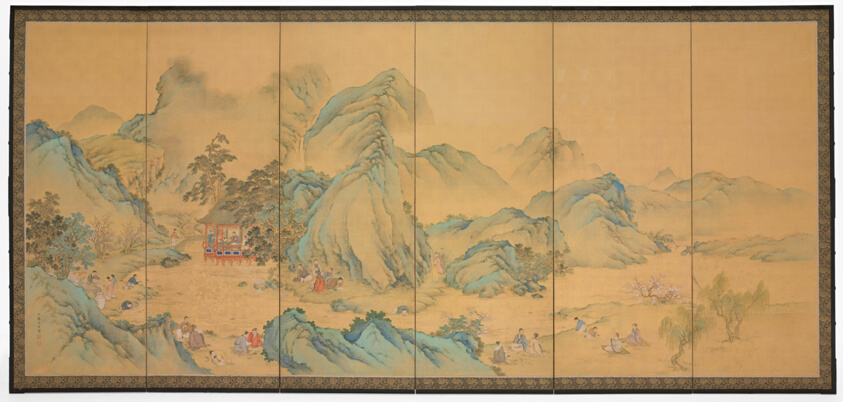
Heritage Research Artifact: The Gathering at the Orchid Pavilion (Front) / Geese among Reeds (Back)
Introduction: The Confluence of Art and Craft
In the rarefied world of luxury heritage, where provenance and materiality converge to define enduring value, the pair of six-panel screens known as The Gathering at the Orchid Pavilion (front) and Geese among Reeds (back) stands as a masterclass in the dialogue between narrative and texture. Commissioned during the late Ming dynasty—a period revered for its refinement in silk craftsmanship and poetic sensibility—these screens are not mere decorative objects. They are artifacts of a civilization that understood the profound relationship between surface and story, between the hand of the artisan and the breath of the artist. For the connoisseur of Savile Row, where cloth is cut with the precision of a sonnet and the drape of a jacket is a form of calligraphy, this piece resonates with a familiar ethos: that true elegance lies in the invisible mastery of technique.
Materiality: Silk as a Living Canvas
The front panels are executed in ink, colors, and gold on silk, a medium that demands an almost surgical control of the brush. Silk, unlike paper, does not absorb pigment passively; it resists, repels, and reflects. The artisan must coax the ink into submission, layering washes of mineral blues and malachite greens with the same deliberation a tailor applies to a basted seam. The gold leaf, applied in fine flakes to delineate the flowing river and the robes of the literati, catches the light in a manner that mimics the shimmer of water under a spring sun. This is not decoration for its own sake—it is a deliberate choice to elevate the narrative of the Orchid Pavilion, where the poet Wang Xizhi composed his immortal “Preface” in 353 AD, into a tactile experience. The silk’s weave, a tight satin ground, provides a surface that is both luminous and durable, much like the worsted wool of a Huntsman jacket. The front panel’s composition—scholars gathered by a winding stream, cups of wine floating on lotus leaves—is rendered with a fluidity that suggests the very act of creation is as transient as the moment it depicts.
Conversely, the reverse panels, Geese among Reeds, employ ink and silver on paper. This is a deliberate counterpoint. Paper, with its fibrous, absorptive nature, allows for a softer, more atmospheric rendering. The silver pigment, now tarnished to a muted pewter, evokes the misty stillness of a marsh at dawn. The geese, depicted in mid-flight or poised on one leg, are rendered with a brevity that borders on abstraction—a few strokes of ink for the body, a flick of silver for the wing. This duality—silk’s opulence versus paper’s austerity—mirrors the Savile Row principle of a garment’s exterior and interior. The front, like the face of a bespoke suit, is for the world: bold, structured, and declarative. The back, like the lining, is a private revelation, a whisper of the maker’s soul. The contrast is not accidental; it is a lesson in balance.
Narrative and Craft: The Art of the Literati
The front panel’s subject—the Orchid Pavilion gathering—is a cornerstone of Chinese cultural heritage, celebrating the spontaneous creativity of scholars in nature. But in the hands of these screen-makers, the narrative becomes a meditation on craft. The figures are not merely painted; they are composed with the same attention to proportion and flow that a tailor applies to a lapel. The winding stream, rendered in gold, is a continuous line that guides the eye, much like a well-cut shoulder guides the drape of a coat. The trees, with their gnarled branches and delicate leaves, are executed in a style that recalls the “boneless” technique, where color is applied without ink outlines—a daring approach that requires absolute confidence in the brush. This is the same confidence a cutter must have when wielding shears against a length of cloth, knowing that a single misstep cannot be undone.
The reverse, Geese among Reeds, is a study in restraint. The composition is sparse: a few stalks of reed, a crescent moon, and the geese themselves. The silver, now darkened, creates a sense of age and memory. This is not a scene of action but of atmosphere, a reminder that the finest craftsmanship often lies in what is omitted. For the Savile Row practitioner, this is the equivalent of a hand-stitched buttonhole—a detail that speaks volumes without shouting. The geese, with their elongated necks and poised wings, are a calligraphic exercise in economy. Each stroke is deliberate, each space between strokes a pause that gives the image breath.
Context: The Artisan’s Ethos
These screens were likely created for a scholar’s studio, a space where contemplation and creation coexisted. The front, with its vibrant gold and colors, would face the visitor, announcing the owner’s erudition and taste. The back, visible only when the screens were moved or viewed from a private angle, offered a moment of quiet introspection. This duality is a hallmark of the finest heritage craftsmanship: the object is not a monolith but a conversation between its surfaces. In the same way, a Savile Row suit is not just a garment but a dialogue between the outer cloth and the inner canvas, between the visible seams and the hidden ones. The silk of the front, with its gold, is a statement of status; the paper of the back, with its silver, is a statement of soul.
The choice of materials—silk for the front, paper for the back—is also a commentary on durability and ephemerality. Silk, though fragile, was prized for its ability to hold color and gold for centuries. Paper, more perishable, was a medium for the fleeting moment, for sketches and poems that were never meant to last. Yet here, the paper has survived, its silver tarnished but intact, a testament to the care with which it was handled. This is a lesson for the modern collector: that heritage is not about permanence but about the respect for process. The artisan who painted these screens knew that the gold would fade, the silver would darken, and the silk would crack. But they also knew that the gesture—the brushstroke, the line, the choice of material—would endure as a record of their hand.
Conclusion: A Legacy of Elegance
The Gathering at the Orchid Pavilion / Geese among Reeds is more than a pair of screens. It is a treatise on the art of making, a dialogue between the visible and the hidden, the opulent and the austere. For the heritage specialist, it offers a rare glimpse into the mind of the artisan, who understood that true luxury is not in the abundance of gold but in the precision of the line, not in the richness of the silk but in the restraint of the brush. This is the same philosophy that underpins the finest tailoring: that a garment, like a screen, is a story told in layers. The front is for the world; the back is for the wearer. And in that distinction lies the essence of enduring craftsmanship.