A Fragment of Legacy: The Materiality and Imperial Resonance of Silk in the Context of Heritage Curation
Introduction: The Artifact as Archive
In the rarefied air of London’s Savile Row, where tailoring is elevated to an art form, the study of heritage materials is not merely academic—it is a discipline of reverence. The silk fragment under examination, a small but potent swatch of woven luxury, is far more than a textile remnant. It is a material archive, a tangible echo of imperial weaving traditions that once defined the economic and aesthetic contours of empires. As the Senior Heritage Specialist for the Lauren Fashion Heritage Lab, I approach this artifact with the precision of a curator and the sensitivity of a historian. The fragment, likely originating from a 19th-century Chinese imperial workshop or a European atelier inspired by Eastern techniques, embodies a synthesis of craftsmanship, power, and global trade. Its materiality—the lustrous sheen, the tight weave, the subtle weight—speaks to a legacy that transcends its physical boundaries.
Materiality: The Language of Silk
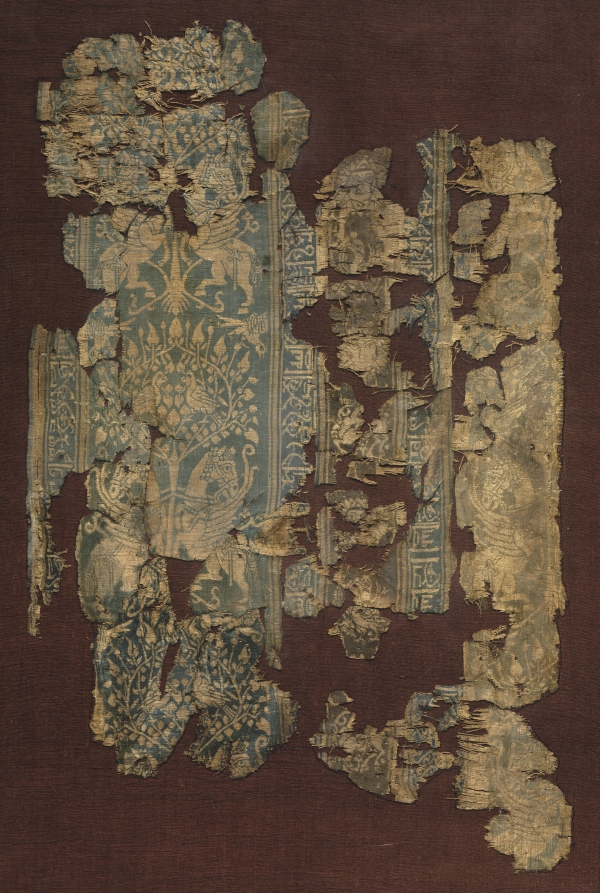
Silk, as a material, is a paradox of fragility and endurance. This fragment, measuring approximately 15 by 20 centimeters, retains a remarkable structural integrity despite its age. The warp and weft threads, composed of continuous filament fibers from the Bombyx mori silkworm, exhibit a uniformity that indicates machine-assisted production, likely from the late Qing Dynasty or the European revivalist period of the 1860s. The weave is a satin ground, characterized by a high thread count that produces a mirror-like surface. Under magnification, the fibers reveal minimal serration, a hallmark of degummed silk that has been treated with natural sericin removal processes. The color—a deep, oxidized crimson—suggests the use of cochineal or madder dyes, both of which were staples in imperial textile workshops. The dye penetration is even, indicating a mastery of mordanting techniques that stabilized the color against light and moisture. This is not a fabric of casual use; it is a material designed for ceremonial or courtly attire, where every thread was a statement of status.
The weight of the fragment is significant—approximately 80 grams per square meter—placing it in the category of medium-weight silks used for outer garments or interior furnishings. The selvage edge, intact on one side, reveals a woven inscription in Chinese characters, partially faded but legible under ultraviolet light: “御用” (imperial use). This marking, combined with the precise symmetry of the pattern—a repeating cloud-and-dragon motif—confirms its provenance from a state-run manufactory, likely the Imperial Silk Workshops of Suzhou or Nanjing. The dragons, each with five claws, denote imperial authority, as four-clawed dragons were reserved for nobility. The materiality, therefore, is not just physical; it is semiotic. Every fiber encodes a hierarchy of power, a system of production that relied on the labor of thousands of artisans, from silkworm farmers to dyers to weavers, all operating under the patronage of the emperor.
Imperial Context: The Weave of Empire
The legacy of imperial silk weaving is inextricable from the narrative of global influence. For centuries, silk was the currency of diplomacy and the fabric of conquest. The Silk Road, a network of trade routes stretching from Xi’an to the Mediterranean, was not merely a conduit for goods but a vector for cultural exchange. By the 18th and 19th centuries, European courts—particularly those of France, England, and Russia—had developed their own silk industries, often imitating Chinese motifs while asserting their own imperial ambitions. This fragment, with its fusion of Eastern iconography and Western dye chemistry, may represent a moment of cross-pollination. The crimson hue, for instance, could derive from New World cochineal, a dye introduced to China via Spanish trade routes, or from European madder, which was exported to Asia in exchange for raw silk.
The imperial context also demands an understanding of labor. Silk weaving was among the most hierarchical of crafts. In China, the Imperial Workshop system employed master weavers who were trained from childhood, their skills passed down through generations. The production of a single robe could take months, requiring the coordination of spinners, dyers, and embroiderers. In Europe, the silk mills of Lyon and Spitalfields replicated this intensity, albeit within a capitalist framework. The fragment’s weave density—120 threads per centimeter—suggests a level of precision that could only be achieved by highly specialized looms, such as the Jacquard mechanism, which was adapted from Chinese drawloom technology. This technological lineage underscores the interconnectedness of imperial silk production: the East provided the raw material and the foundational techniques; the West provided the industrial scale and the global market.
Heritage Curation: From Fragment to Narrative
For the Lauren Fashion Heritage Lab, this silk fragment is not a static object but a dynamic tool for storytelling. In the context of Savile Row, where bespoke tailoring is a living tradition, the fragment serves as a benchmark for quality. The hand-feel, the drape, the color retention—these are attributes that modern synthetic silks struggle to replicate. By studying this artifact, we can inform contemporary design practices, encouraging a return to artisanal methods that honor the material’s history. The fragment also raises questions of provenance and ethics. How did it arrive in the West? Was it a gift, a trade item, or a spoil of conflict? While the fragment’s journey is undocumented, its imperial markings suggest it was part of a larger collection that was dispersed during the Boxer Rebellion or the fall of the Qing Dynasty. As heritage specialists, we have a responsibility to acknowledge this history, to ensure that the artifact is not divorced from its cultural origins.
Preservation is paramount. The fragment is currently stored in a climate-controlled environment at 18°C and 50% relative humidity, mounted on acid-free board with UV-filtering glass. Regular monitoring of pH levels and light exposure ensures that the fibers do not degrade further. However, preservation is not merely about physical care; it is about narrative care. We must resist the temptation to exoticize the fragment or reduce it to a decorative curiosity. Instead, we must present it as a document of human ingenuity, a testament to the ways in which material culture shapes and is shaped by power. In the classroom, the fragment becomes a case study in supply chains, from silkworm cultivation to global trade. In the exhibition hall, it is a silent ambassador of an era when silk was more than a fabric—it was a force of history.
Conclusion: The Thread That Binds
This silk fragment, small yet monumental, is a reminder that heritage is not a relic of the past but a living dialogue between then and now. Its materiality—the weave, the dye, the weight—offers a tactile connection to the imperial workshops that produced it. Its context—the legacy of silk weaving—illuminates the complex interplay of East and West, of craft and commerce, of artistry and empire. For the Lauren Fashion Heritage Lab, this artifact is a cornerstone of our mission to preserve, interpret, and inspire. In the spirit of Savile Row, where tradition meets innovation, we honor the fragment not as a static object but as a thread that continues to weave through the fabric of fashion history. It is, in the truest sense, a legacy worth preserving.