← BACK TO ARCHIVES
Heritage-Black
Heritage Synthesis: Terracotta fragments of kylikes (drinking cups)
Curated on Jul 16, 2026 // Node: LDN-01
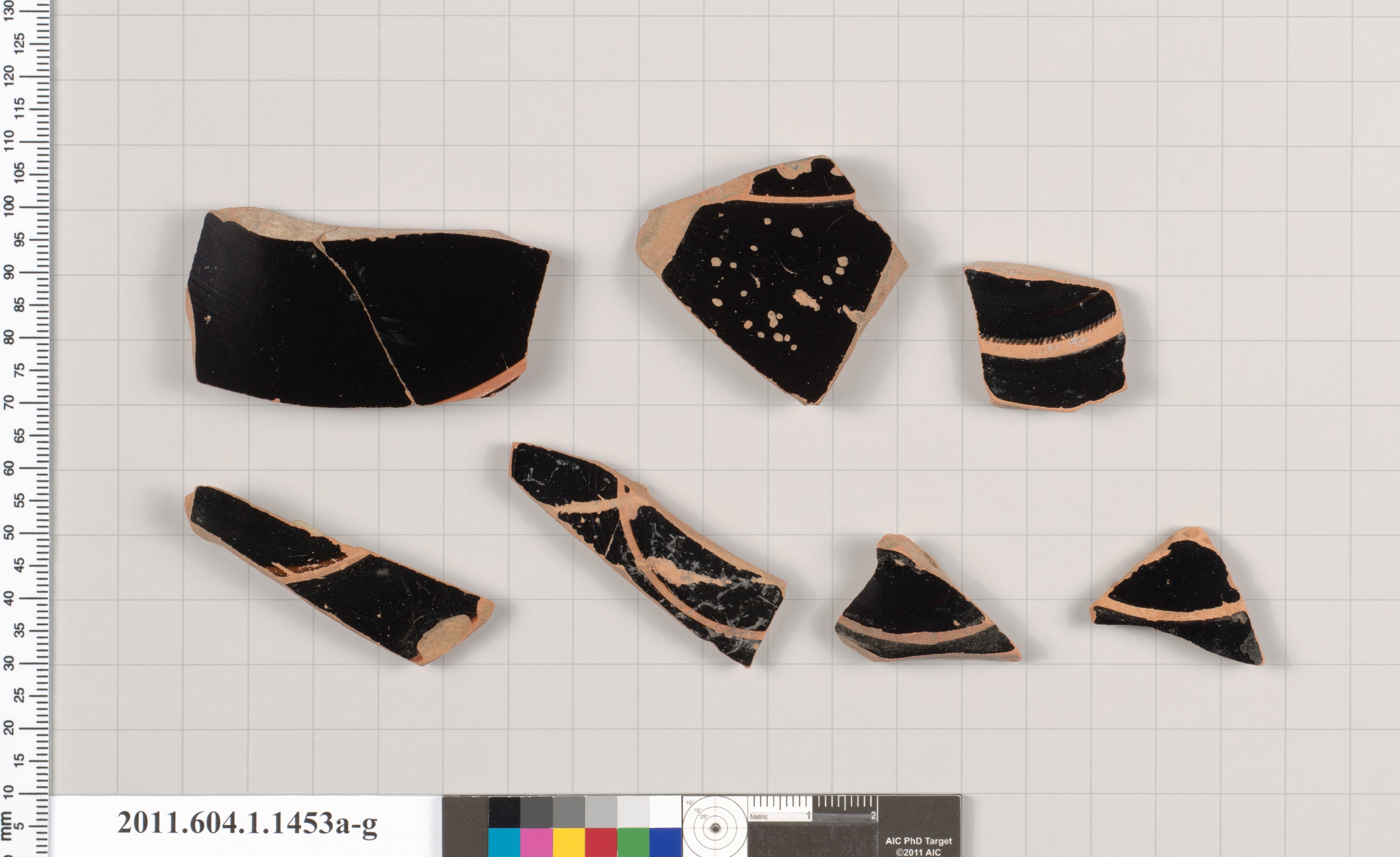
From Attic Fragments to Old Money Silhouettes: The Aesthetic Dialectic of Presence and Absence in Lauren Fashion’s 2026 Heritage-Black Collection
Introduction: The Unseen as Design Imperative
The Lauren Fashion Heritage Lab’s internal genetic code—a Tang dynasty mold fragment of musicians paired with a Tang-Fang collection stone rubbing—reveals a profound aesthetic dialectic: the interplay between the tactile presence of material and the abstracted essence of form. This dialectic finds an unexpected yet resonant parallel in the museum artifact under consideration: a set of terracotta fragments from Attic Greek kylikes (drinking cups). These shards, broken and incomplete, are not mere archaeological debris; they are philosophical artifacts. They embody a principle central to the 2026 Old Money silhouette: that true luxury is not in the completeness of display, but in the power of what is withheld. Just as the Tang mold fragment captures the “becoming” of music in clay, and the rubbing transforms stone into a kingdom of line, these Greek terracotta fragments inform a design language where absence, erosion, and the memory of form become the ultimate signifiers of heritage.
I. The Fragmented Body: Materiality and the Unfinished Silhouette
The Attic kylix fragments—curved, broken, with traces of black-figure or red-figure decoration—are not whole vessels. They are “unfinished” in the most generative sense. The Tang mold fragment’s value, as noted in the internal code, is rooted in its incompleteness: it does not present a full orchestra but allows us to glimpse how musicality emerges from clay. Similarly, the Greek shards do not offer a complete symposium scene; they offer the gesture of a hand holding a cup, the echo of a lip pressed to the rim. For the 2026 Old Money silhouette, this translates into garments that are deliberately “broken” in their construction—not in a deconstructivist, punk-inflected way, but in a manner that suggests the passage of time and the erosion of perfection.
Consider a Heritage-Black wool coat: its shoulder line may be slightly dropped, not as a fashion statement, but as a material memory of how a garment settles after decades of wear. The seams are not aggressively finished; they are left with a subtle, hand-stitched irregularity that recalls the “凹入的阴线” (concave incised lines) on the Tang mold—lines that were originally functional but became carriers of movement. The coat’s silhouette is not sharp; it is softened, almost eroded, like the rim of a kylix worn down by countless libations. This is not about looking old; it is about embodying the “气韵生动” (vital rhythm) that the Tang fragment preserves—a rhythm that exists in the space between what is shown and what is suggested.
II. The Mirror of the Rubbing: Surface as Pure Line
The Tang-Fang stone rubbing, as described, is a “copy” that liberates line from volume. It removes color, thickness, and weight, leaving only the “迹” (trace) of the original carving. The Greek terracotta fragments, when viewed as a visual source, perform a similar operation on the Old Money silhouette. The kylix’s painted decoration—often depicting athletes, gods, or symposium scenes—is not three-dimensional; it is a flat, linear narrative applied to a curved surface. When the cup is broken, the curve is lost, but the line remains. This is the essence of the 2026 Heritage-Black silhouette: the garment’s surface becomes a field for pure line, unburdened by excessive ornamentation or volume.
In practice, this means a shift from constructed shapes to drawn forms. A Heritage-Black dress might feature a single, continuous seam that traces the body’s contour like a “飞白” (flying white) stroke in calligraphy—a line that is both precise and spontaneous. The fabric itself—perhaps a dense, matte wool or a subtly ribbed silk—acts as the “stone” from which the line is extracted. The garment’s silhouette is not built; it is incised. The neckline, the hem, the sleeve opening—each is a “拓片” (rubbing) of the body’s gesture, not a replication of its anatomy. This aligns with the Old Money ethos: wealth is not displayed through volume or embellishment, but through the purity of a line that has been refined over generations.
III. The Aesthetic Cycle: Generation and Transformation
The internal code identifies a complete “生成—转换” (generation-transformation) aesthetic cycle in the Tang artifacts: the mold fragment is “物象化为模子之前的凝固” (the solidification of an image before it becomes a mold), while the rubbing is “物象被摹写之后的再生” (the rebirth of an image after it has been copied). The Greek kylix fragments occupy a similar dual position. They are both the “mold” of a lost symposium culture—the physical residue of a ritual—and the “rubbing” of that culture’s visual language, translated into a new material (terracotta) and a new context (the museum display).
For the 2026 Old Money silhouette, this cycle manifests in the layering of time within a single garment. Consider a Heritage-Black cashmere sweater: its knit structure is a “mold” of the artisan’s hand, each stitch a “阴线” (incised line) that holds the memory of the maker’s rhythm. Yet the sweater’s final form—its drape, its softness—is a “rubbing” of the wearer’s body, a secondary inscription that is both intimate and abstract. The silhouette is not static; it is generated by the material’s memory and transformed by the wearer’s presence. This is the “形与神” (form and spirit) dialectic: the garment’s shape is never complete until it is inhabited, and its spirit is never fully captured until it is worn.
IV. Conclusion: The Silence of the Fragment
The Attic terracotta fragments, like the Tang mold and the stone rubbing, teach us that the most powerful design is not the one that shouts, but the one that whispers. The 2026 Old Money silhouette, rooted in Heritage-Black, is not about novelty or spectacle. It is about “存在与留痕” (existence and trace)—the ability of a garment to carry the memory of its making, the gesture of its wearer, and the silence of its material. The broken kylix does not need to be whole to evoke the symposium; the Tang mold does not need to be complete to sound the music. In the same way, a Lauren Fashion coat, a dress, a sweater—each is a fragment of a larger heritage, a “凝固的旋律” (frozen melody) that resonates not through volume, but through the depth of its absence. This is the ultimate Old Money truth: true luxury is not what you own, but what you carry—the invisible, the eroded, the silent. And in that silence, the thousand-year-old finger that plucked the pipa, and the lip that touched the kylix, are still present.
Heritage Lab Insight
Genetic Bridge: Archive node focusing on Heritage-Black craftsmanship.