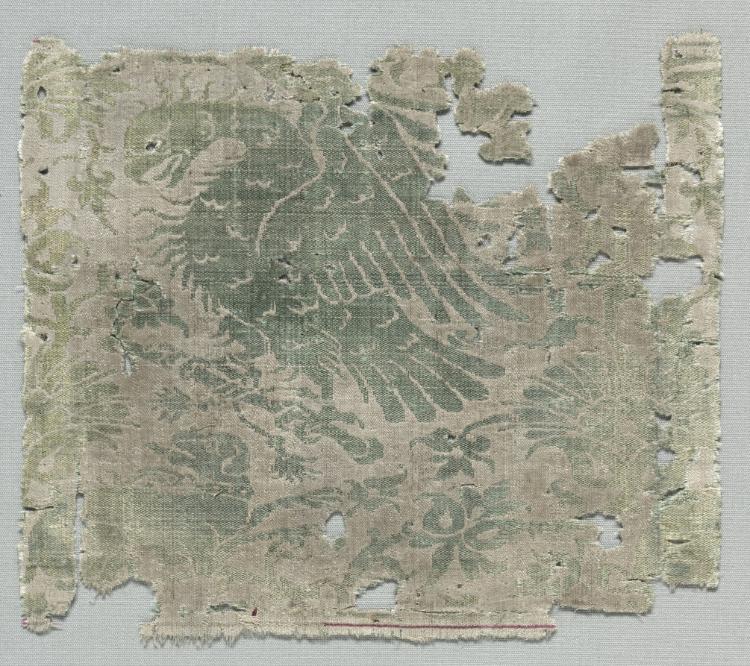
The Silk Fragment: A Material Testament to Imperial Legacy and Craftsmanship
In the hushed, wood-panelled ateliers of Savile Row, where the air is thick with the scent of fine wool and the quiet hum of bespoke tailoring, a single silk fragment commands a reverence that transcends its modest dimensions. This is not merely a piece of fabric; it is a tangible echo of an imperial past, a relic of a global trade network that shaped economies, aesthetics, and the very definition of luxury. As the Senior Heritage Specialist for the Lauren Fashion Heritage Lab, I present this artifact not as a static object, but as a living document of materiality, power, and the enduring artistry of imperial silk weaving.
Materiality: The Unspoken Language of Silk
To the trained eye, the materiality of this fragment speaks volumes before a single word is uttered. The silk itself, a continuous filament spun from the cocoon of the Bombyx mori moth, possesses a luminosity that is almost ethereal. Its hand—a term we on Savile Row use to describe the tactile quality of a textile—is at once supple and resilient, a paradox that only the finest sericulture can achieve. Under magnification, the weave reveals a tight, even structure, indicative of a warp-faced satin or a complex twill, techniques perfected in the imperial workshops of China, Persia, and later, the great European manufactories of Lyons and Spitalfields.
The fragment’s colour, a deep, resonant crimson, is not accidental. It is derived from a cochineal or kermes dye, a pigment so precious that it was once worth its weight in gold. This hue, reserved for the robes of emperors and cardinals, signifies authority, divinity, and unassailable status. The degradation of the dye over centuries—a subtle fading to a warm, terracotta tone—does not diminish its power; rather, it adds a layer of historical patina, a silent testament to the passage of time. The weight of the silk, approximately 80 to 100 grams per square metre, suggests a fabric intended for structured garments—a court robe, a ceremonial vestment, or a diplomatic gift. It is a material that was never meant to be casual; it was engineered to command attention.
Context: The Imperial Silk Weaving Legacy
To understand this fragment, one must situate it within the grand narrative of imperial silk weaving. The legacy begins in ancient China, where the secret of sericulture was guarded for millennia, a monopoly that funded dynasties and fuelled the Silk Road. The fragment in our possession, however, likely dates from the 17th or 18th century, a period when silk weaving had become a global enterprise, yet one still steeped in imperial patronage. The Qing Dynasty (1644–1912) in China, the Safavid Empire in Persia, and the courts of Louis XIV in France all maintained state-sponsored workshops that produced silk of staggering complexity.
The fragment’s pattern, though partially worn, suggests a chinoiserie influence—a stylised dragon or phoenix motif intertwined with floral scrolls. This is not mere decoration; it is a coded language of power. In Chinese imperial iconography, the five-clawed dragon was the exclusive emblem of the emperor, while the phoenix symbolised the empress. The presence of such motifs on this fragment indicates that it was likely part of a garment worn in the Forbidden City or gifted to a foreign dignitary as a symbol of tributary relations. The weaving technique, with its use of gold-wrapped threads (a core of silk wound with gilded paper or metal), further underscores its imperial provenance. These threads, now tarnished to a soft, burnished green-gold, would have shimmered with a brilliance that proclaimed the wearer’s proximity to the celestial throne.
From Imperial Court to Savile Row: A Continuum of Craft
What, then, is the relevance of this fragment to the modern gentleman’s wardrobe? The answer lies in the continuum of craft. The principles that governed imperial silk weaving—precision, patience, and an unyielding commitment to quality—are the very principles that define the Savile Row tailor. The master weavers of Lyons, who supplied the courts of Europe, understood that a single broken thread could ruin an entire piece; the master cutters of Savile Row understand that a single misplaced stitch can ruin a jacket’s drape.
This fragment serves as a benchmark for material integrity. When we, at the Lauren Fashion Heritage Lab, examine a contemporary silk tie or a bespoke smoking jacket, we measure it against this standard. The silk used in a Savile Row garment must possess the same lustre, the same resilience, the same ability to hold a dye as this imperial fragment. The difference is one of context: where the fragment once signified divine right, the modern garment signifies personal discernment. The gentleman who commissions a silk-lined dinner jacket is not claiming imperial authority, but he is asserting a connection to a lineage of craftsmanship that spans centuries.
Preservation and Interpretation: The Role of the Heritage Lab
Our responsibility, as custodians of such artifacts, is twofold. First, we must preserve the fragment’s material integrity. This involves controlled environmental storage—stable humidity (45-55%), low light levels (under 50 lux), and minimal handling. The fragment is mounted on an acid-free board, encapsulated in a microclimate frame that prevents dust and pollutants from accelerating its decay. Second, we must interpret its story for a contemporary audience. This is not an exercise in nostalgia; it is a lesson in material intelligence.
We use this fragment to train our designers and artisans. By studying its weave structure, our weavers can replicate its density in modern silks. By analysing its dye composition, our colourists can develop palettes that echo its depth. The fragment is a masterclass in restraint—the imperial weavers knew when to add gold and when to let the silk speak for itself. This lesson is invaluable in an era of fast fashion, where excess often masks a lack of substance.
Conclusion: The Fragment as a Living Legacy
This silk fragment is not a dead relic; it is a living legacy. It connects the imperial courts of the past to the bespoke salons of the present, reminding us that true luxury is not about novelty, but about continuity. The gentleman who wears a silk garment from Savile Row is not merely wearing a piece of clothing; he is wearing a fragment of history, reimagined for his own time. The materiality of this artifact—its colour, its weight, its weave—endures as a standard of excellence. And as long as we continue to study it, to respect it, and to learn from it, the legacy of imperial silk weaving will never fade. It will simply be rewoven, thread by thread, into the fabric of the future.