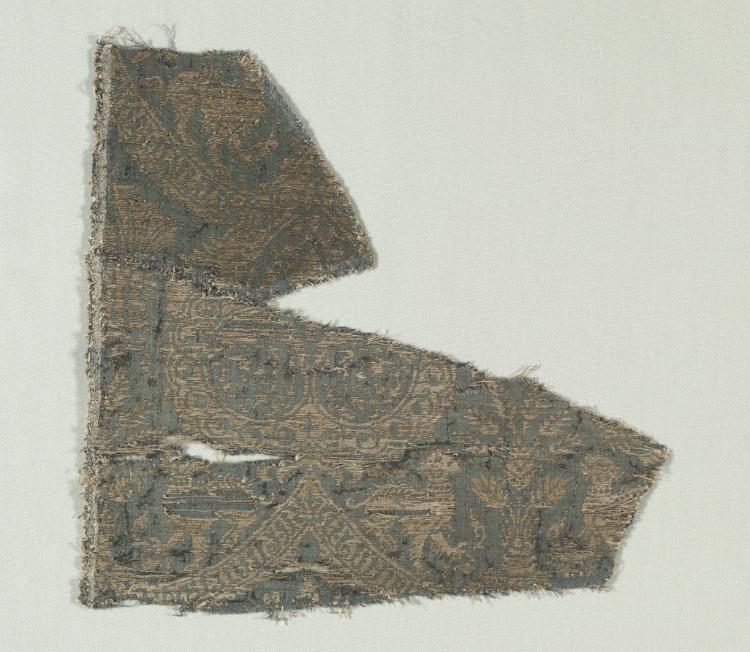
A Scrutiny of the Artefact: Canine Motifs and Kufic Script in Swaying Bands upon a Silk Ground
One approaches this particular fragment not as a mere textile, but as a document. Its very existence, preserved against the relentless attrition of centuries, demands a particular form of respect—the respect owed to a complex negotiation of power, piety, and prestige. The subject, as presented, is deceptively simple: silk, woven with dogs and Arabic script in swaying bands. To the untutored eye, a curiosity. To the specialist, a confluence of statements. The materiality, silk itself, is the first and paramount declaration. In the context of imperial legacies, from Byzantium to Baghdad, from Samarkand to the Serenissima, silk was never merely a fibre. It was a controlled substance, a currency of state, and the definitive medium for messages of sovereignty.
The Imperial Loom: A Theatre of Legitimacy
To comprehend the artefact, one must first apprehend the stage upon which it was produced. Imperial silk weaving was less an industry and more a rigorously administered arm of statecraft. The workshops, or tiraz, were often situated within palace complexes, their output as carefully governed as the minting of coinage. The looms produced a hierarchy of splendour, with specific patterns, colours, and inscriptions reserved for the ruler’s khil’a, or robes of honour, bestowed upon favoured dignitaries to literally cloak them in the aura of the sovereign’s authority. Thus, every length of imperial silk was a potential instrument of policy. The presence of Arabic script—invariably the Kufic variant in early examples—transforms the textile from patterned fabric into a legible proclamation. These inscriptions were typically benedictory, offering prayers for the ruler, naming the caliph, or citing the workshop and date. They are not decoration; they are woven jurisprudence, binding the wearer or recipient within a covenant of allegiance and divine favour.
Anomaly and Symbol: The Canine Motif
Herein lies the profound intrigue of our subject: the introduction of the canine motif. Within the classical Islamic artistic tradition, the representation of animate beings, while not expressly forbidden in all contexts, was often treated with circumspection, particularly in religious or official ceremonial regalia. The dog, moreover, carries a complex symbolic burden. In certain readings, it is an unclean animal. In others, particularly within Perso-Turkic courtly traditions pre-dating and coexisting with the Islamic empires, the dog—specifically the hunting hound or saluki—was an emblem of nobility, fidelity, and the martial pursuit of the chase, a central pillar of aristocratic identity.
The appearance of dogs within the formal, script-laden structure of imperial silk, therefore, is nothing short of a bold hermeneutic challenge. It suggests one of several compelling narratives. It may indicate a commission for a specific, high-ranking personage whose tribal or personal iconography demanded its inclusion—a powerful amir whose loyalty was worth the concession in design. Alternatively, it may signal a period of cultural syncretism, perhaps from the Seljuk or later Mongol Ilkhanid periods, where the nomadic steppe traditions of the ruling elite forcefully interjected their own visual language into the established grammar of the Islamic court. The dogs are unlikely to be casual genre scenes; they are heralds, positioned with deliberate rhythm within the swaying bands, their forms stylised yet potent. They are symbols of terrestrial power and lineage, woven inseparably into the divine text.
The Architecture of the "Swaying Band"
The structural framework of the design, the so-called "swaying band," is itself a masterstroke of textile rhetoric. Unlike static roundels or rigid vertical panels, the undulating band implies motion, a rhythmic fluidity that guides the eye along the surface of the cloth. It is a design that acknowledges the destiny of the fabric: to be worn, to drape, to move with the body of the dignitary. The script woven within these bands would thus appear to pulse and flow with the wearer’s gait, a dynamic manifestation of the spoken blessings. The integration of the canine motifs within these same bands creates a deliberate visual dialogue—perhaps a chase scene forever frozen in its arc, or a procession of hounds accompanying the sacred words. The technical proficiency required to engineer this complex, non-repeating interplay of figurative and calligraphic elements on a draw-loom speaks of a workshop operating at the zenith of its craft, under direct imperial patronage.
Conclusion: A Fabric of Contested Meanings
This silk fragment, therefore, stands as a testament to the negotiated nature of imperial identity. It is a palimpsest of conflicting and complementary codes. The silk asserts economic and political supremacy. The Kufic script asserts religious authority and dynastic legitimacy. The swaying bands assert a sophisticated, courtly aesthetic. The dogs assert a pre-existing or parallel social order—tribal, martial, aristocratic. Together, they form a cohesive whole only because a power existed that could compel such a synthesis. To drape oneself in this cloth was to embody a complex political statement: a man of faith, a servant of the caliph, a scion of an ancient noble line, a master of the hunt. It is the very opposite of a bland uniform; it is a heraldic skin, woven on the imperial loom where culture was not merely reflected, but actively, and deliberately, manufactured. Its legacy is not one of mere pattern, but of the profound weight that cloth could be made to carry when thread was spun with intention, and the loom operated as an instrument of state.