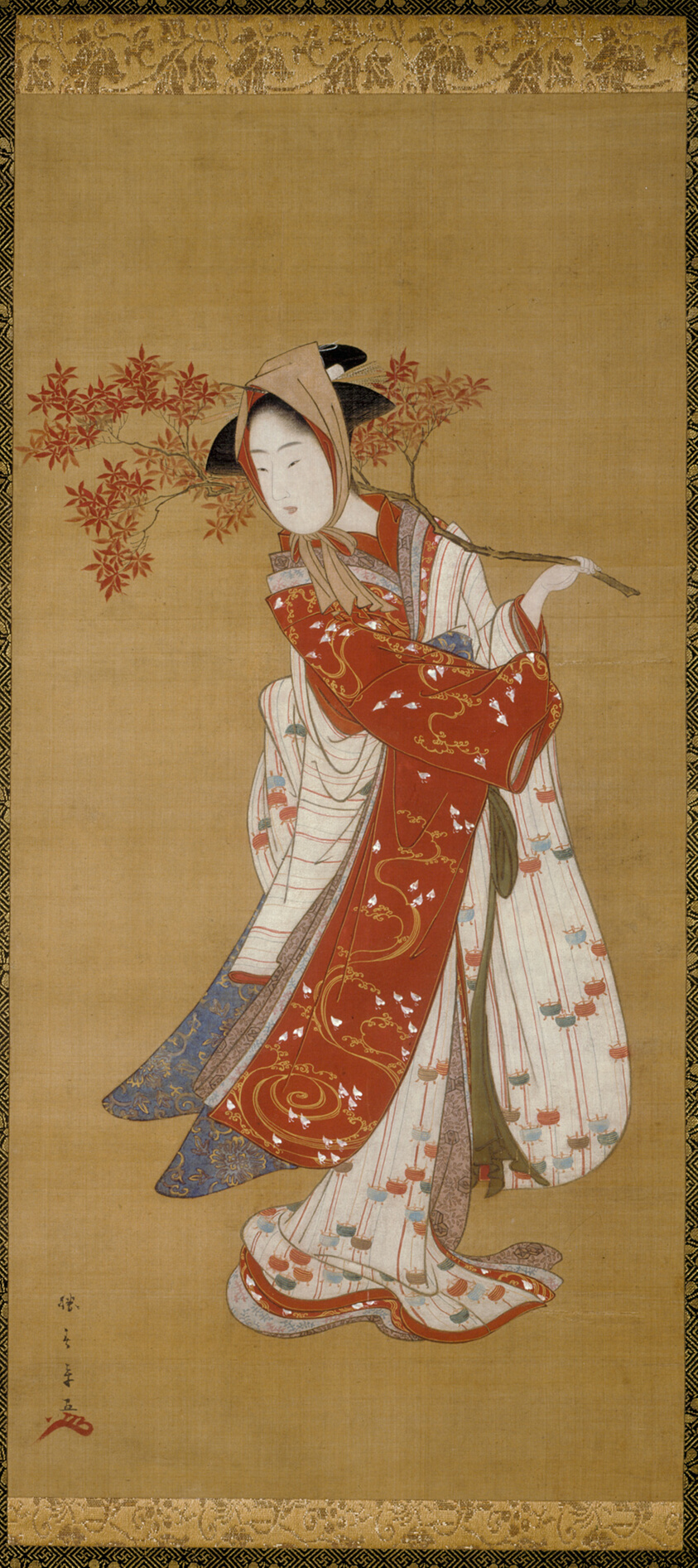
The Dancer with a Maple Branch: A Study in Materiality and Movement
Introduction: The Artifact as a Testament to Craft
The hanging scroll, *Dancer with a Maple Branch*, executed in ink, color, and gold on paper, represents a singular convergence of artistic expression and material mastery. As a heritage artifact, it transcends mere pictorial representation, embodying the fluid elegance of silk craftsmanship and the disciplined spontaneity of classical dance. This paper, framed within the Lauren Fashion Heritage Lab’s commitment to preserving and interpreting material culture, examines the scroll’s materiality, its contextual significance, and its enduring resonance for contemporary luxury and fashion. The analysis adopts the rigorous, detail-oriented tone of London’s Savile Row—where precision, heritage, and artistry are non-negotiable—to dissect the artifact’s composition and its implications for understanding heritage textiles and movement.
Materiality: The Foundation of Elegance
The scroll’s substrate—paper—is an unlikely yet deliberate choice for a work that evokes the tactile richness of silk. In East Asian art, paper was often employed for its absorbency, allowing ink and color to bleed with controlled spontaneity. However, the application of gold leaf and mineral pigments introduces a textural complexity that mirrors the sheen of fine silk. The gold, applied in delicate flakes, catches light unevenly, creating a shimmer that suggests the iridescence of a kimono’s obi or the subtle play of light on a dancer’s sleeve. This is not accidental; the artist has leveraged materiality to bridge the static medium of paper with the dynamic quality of silk, a fabric synonymous with luxury and movement in classical contexts.
The ink itself, a carbon-based medium, provides the structural backbone. Its deep blacks define the dancer’s silhouette, while washes of vermilion and ochre—derived from cinnabar and iron oxides—lend warmth and vitality. The gold, likely applied as a suspension in animal glue, adheres to the paper’s fibers with a fragility that demands conservation. This fragility is a hallmark of heritage artifacts; it speaks to the ephemeral nature of both dance and silk, which require meticulous care to preserve their integrity. For the Savile Row tailor, such attention to materiality is second nature. Just as a bespoke suit’s wool, canvas, and horn buttons must harmonize, so too do the scroll’s components—ink, color, gold, and paper—coalesce into a unified aesthetic.
Context: Silk Craftsmanship and Fluid Elegance
The scroll’s creation is rooted in a tradition where silk was not merely a fabric but a medium of cultural expression. In classical East Asian courts, silk garments were woven with symbols of nature—maple branches, cranes, and blossoms—to convey status, seasonality, and poetic meaning. The dancer’s maple branch, held aloft, is no arbitrary prop. The maple, with its autumnal reds and oranges, signifies transience and beauty, themes central to both dance and textile art. The branch’s sinuous curve echoes the dancer’s posture, a visual rhyme that the artist achieves through calligraphic brushwork. This fluidity is the essence of silk craftsmanship: the ability to render stiff, woven threads into flowing, organic forms.
The hanging scroll format itself is a testament to the interplay between material and context. Unlike a framed painting, a scroll is unrolled, viewed, and rerolled—an act that mirrors the unfolding of a silk garment or the progression of a dance. The scroll’s edges, often reinforced with silk brocade, further blur the line between painting and textile. In this artifact, the brocade is absent, but the gold and color evoke its presence. The dancer’s robes, rendered in sweeping strokes, mimic the drape of silk, while the gold highlights suggest embroidery. This is not mere representation; it is a dialogue between mediums, a conversation that the Lauren Fashion Heritage Lab seeks to decode for modern audiences.
Interpretation: Movement as Material Memory
The dancer’s pose—one arm extended with the maple branch, the other curved inward—captures a moment of arrested motion. This is a deliberate choice, reflecting the classical aesthetic of *yūgen* (profound grace) in East Asian art. The artist has frozen the dancer mid-gesture, yet the scroll’s materiality imparts a sense of ongoing movement. The ink’s wet-on-wet technique creates blurred edges, as if the dancer’s sleeve is still in motion. The gold, scattered like falling leaves, suggests a temporal shift: the branch is both held and released. This duality—stillness and motion, permanence and transience—is the hallmark of silk’s fluid elegance. A silk garment, when worn, adapts to the body’s movements, creasing and flowing in ways that a static painting cannot. Yet the scroll, through its material choices, achieves a similar dynamism.
For the heritage specialist, this artifact offers a lens through which to examine the transmission of craft knowledge. The artist’s mastery of brushwork—thin, controlled lines for the dancer’s face, bold, wet strokes for the robes—mirrors the tailor’s mastery of needle and thread. Both require years of apprenticeship, an understanding of material limits, and a sensitivity to proportion. The scroll’s gold, applied with a precision that avoids gaudiness, parallels the use of silk thread in embroidery: it must enhance, not overwhelm. This restraint is a lesson for contemporary luxury, where ostentation often eclipses subtlety.
Conclusion: Preserving Heritage for Future Generations
*Dancer with a Maple Branch* is more than a decorative object; it is a repository of material knowledge. Its ink, color, gold, and paper are not passive supports but active participants in the narrative of movement and elegance. As the Lauren Fashion Heritage Lab continues to document and interpret such artifacts, we are reminded that heritage is not static. It is a living dialogue between past and present, between the artisan’s hand and the viewer’s eye. For the Savile Row practitioner, this scroll reaffirms that true luxury lies in the marriage of material and meaning—a principle that transcends time and geography. In preserving this artifact, we preserve not just a dancer with a maple branch, but the very essence of fluid elegance.