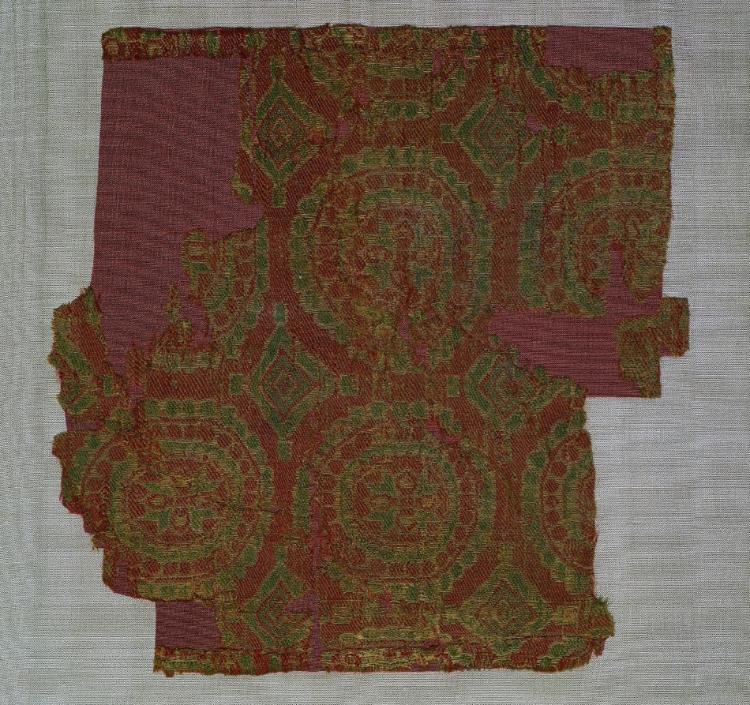
The Samite with Roundels of Rosettes: A Legacy of Imperial Silk Weaving
In the hallowed ateliers of London’s Savile Row, where precision tailoring meets centuries of textile mastery, the study of heritage fabrics is not merely academic—it is a living dialogue between past and present. Among the most evocative artifacts in this discourse is the samite with roundels of rosettes, a silk textile whose materiality and design encapsulate the zenith of imperial silk weaving. This paper examines the artifact as a heritage research object, tracing its origins, technical execution, and enduring influence on luxury craftsmanship. For the modern connoisseur, this samite represents a benchmark of artistry, a testament to the silk weaver’s ability to transform raw material into a narrative of power, beauty, and cultural exchange.
Materiality: The Essence of Silk
The foundation of this artifact lies in its materiality: silk, a protein fiber derived from the cocoon of the silkworm, Bombyx mori. In the context of imperial weaving, silk was not merely a textile; it was a currency of prestige, a medium of diplomacy, and a symbol of divine authority. The samite, a heavy, twill-weave fabric often shot with gold or silver threads, demanded exceptional skill to produce. Its dense structure, achieved through a weft-faced weave, allowed for intricate patterns to emerge with a lustrous, almost metallic sheen. The roundels of rosettes, repeated in precise symmetry, required the weaver to manipulate multiple warp and weft threads simultaneously, a technique that underscored the weaver’s mastery over both material and machinery.
The choice of silk for this artifact was deliberate. Silk’s natural luster and ability to absorb dyes—from madder reds to indigo blues—made it ideal for capturing the opulence of imperial courts. In the hands of skilled artisans, silk became a canvas for political and religious iconography. The rosette, a motif with roots in Persian, Byzantine, and Chinese traditions, symbolized eternity, renewal, and the cosmic order. By weaving these roundels into samite, the artisan not only created a decorative object but also reinforced the imperial narrative of universal dominion.
Context: The Legacy of Imperial Silk Weaving
The samite with roundels of rosettes must be understood within the broader legacy of imperial silk weaving, a tradition that spanned from the Silk Road to the courts of Byzantium, Tang China, and Renaissance Europe. In the Byzantine Empire, for instance, silk weaving was a state-controlled monopoly, with workshops in Constantinople producing fabrics for the emperor and his court. These textiles, often woven with gold thread and intricate geometric patterns, were used in religious vestments, diplomatic gifts, and ceremonial robes. The roundel motif, in particular, was a hallmark of Byzantine silk, reflecting the empire’s synthesis of Roman, Greek, and Eastern influences.
Similarly, in Tang China (618–907 CE), silk weaving reached unparalleled heights. The imperial workshops of Chang’an produced samite-like fabrics known as kesi or “cut silk,” where weft threads were woven to create pictorial designs. The rosette, often combined with phoenixes or dragons, symbolized imperial authority and cosmic harmony. These textiles were traded along the Silk Road, influencing Persian and Sogdian weavers, who in turn adapted the motifs for their own patrons. The samite with roundels of rosettes thus represents a convergence of these traditions—a global artifact born from centuries of cross-cultural exchange.
By the time of the European Renaissance, silk weaving had become a hallmark of aristocratic luxury. Italian city-states like Venice, Florence, and Genoa established their own workshops, producing velvets and brocades that rivaled their Eastern counterparts. The roundel motif, now infused with classical and Christian symbolism, appeared in ecclesiastical garments and courtly attire. The samite, though less common than lighter silks, remained a symbol of wealth and status, its weight and sheen signaling the wearer’s proximity to power.
Technical Execution: The Art of the Weaver
To produce a samite with roundels of rosettes, the weaver required not only technical proficiency but also an intuitive understanding of design. The fabric’s structure—a twill weave with a weft-faced surface—meant that the pattern was created by the weft threads, which were often thicker and more lustrous than the warp. The roundels, typically arranged in staggered rows, were formed by alternating colored wefts, with gold or silver threads adding a luminous quality. The rosettes themselves, composed of concentric petals or stylized leaves, demanded precise tension control to ensure symmetry and clarity.
The loom used for such work was likely a drawloom, a sophisticated device that allowed the weaver to lift individual warp threads to create complex patterns. This technology, which originated in China and spread westward along the Silk Road, was a marvel of pre-industrial engineering. The weaver worked in tandem with a “drawboy” who operated the pattern harness, while the master weaver controlled the shuttle. This collaborative process, often involving months of labor for a single piece, elevated the samite to the status of art. The roundels of rosettes, repeated with mathematical precision, were a testament to this synergy between human skill and mechanical innovation.
Heritage and Modern Relevance
For the heritage specialist, the samite with roundels of rosettes is more than a historical artifact; it is a blueprint for contemporary luxury. On Savile Row, where tradition and innovation coexist, the study of such textiles informs the creation of bespoke garments that honor the past while embracing the future. The weight and drape of silk, the interplay of light and shadow in a rosette pattern, the tactile richness of a twill weave—these elements are as relevant today as they were in the imperial courts of Byzantium or Tang China.
Moreover, the artifact’s legacy underscores the importance of preserving traditional weaving techniques. In an era of mass production and fast fashion, the samite reminds us of the value of patience, precision, and craftsmanship. For the discerning client, a garment woven from such fabric is not merely an article of clothing but a piece of history—a connection to the artisans who, centuries ago, transformed silk into a symbol of human achievement.
Conclusion
The samite with roundels of rosettes stands as a monument to the legacy of imperial silk weaving. Its materiality—the lustrous silk, the intricate weave, the golden threads—speaks to a tradition of excellence that transcends time and geography. For the heritage researcher, it offers a window into the cultural and technical achievements of past civilizations. For the modern tailor, it serves as a reminder that true luxury is born from mastery, not haste. As we continue to study and reinterpret such artifacts, we honor the weavers who, with every thread, wove the fabric of history itself.