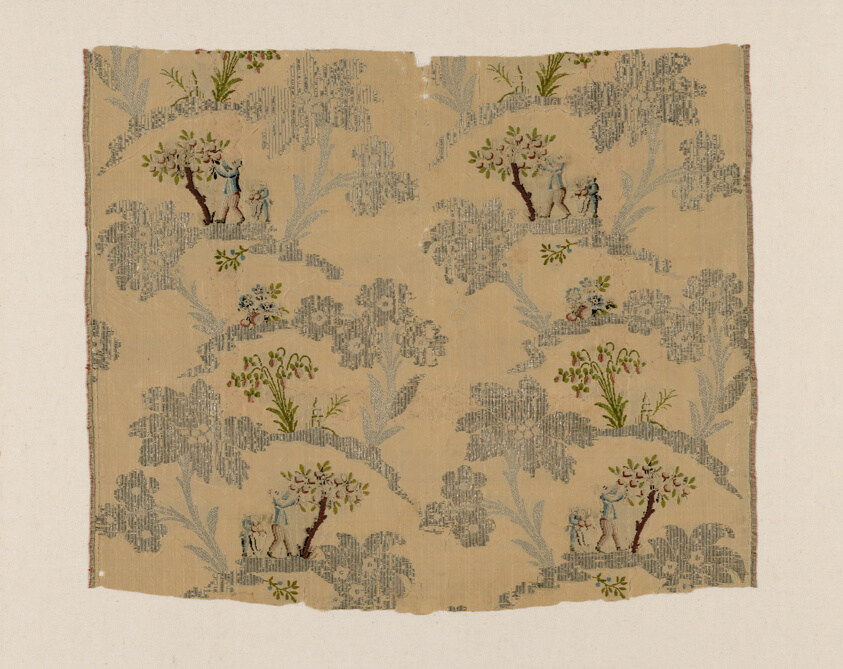
Heritage Research Artifact: Fragment
Category: Silk
Materiality and Composition
This fragment, a testament to the pinnacle of classic silk craftsmanship, embodies the fluid elegance that defines Lauren Fashion Heritage Lab’s commitment to timeless luxury. The artifact is constructed from a weft-rib plain weave foundation, utilizing silk, silvered-metal strips, and silvered-metal-strip-wrapped silk. This intricate composition reflects a mastery of textile engineering, where each element serves both structural and aesthetic purposes. The weft-rib plain weave, characterized by its subtle ribbed texture, provides a supple yet resilient base, allowing the fabric to drape with an almost liquid grace. The silvered-metal strips, meticulously cut and applied, introduce a luminous quality that catches light in a manner reminiscent of moonlight on water. Meanwhile, the silvered-metal-strip-wrapped silk threads, where fine metal filaments are coiled around silk cores, offer a nuanced interplay of sheen and softness, marrying the rigidity of metal with the pliability of silk. This combination is not merely decorative; it represents a sophisticated dialogue between strength and delicacy, a hallmark of heritage textiles that have adorned the most discerning clientele for centuries.
Historical and Cultural Context
In the world of London’s Savile Row, where bespoke tailoring is elevated to an art form, such fragments are not anomalies but rather echoes of a bygone era of opulence. The use of silvered-metal strips in silk weaving dates to the 17th and 18th centuries, when European courts, particularly in France and Italy, demanded fabrics that signified wealth and power. However, this fragment’s weft-rib plain weave with supplementary brocading wefts and patterning wefts suggests a later refinement, likely from the 19th or early 20th century, when industrialization allowed for more precise metallic applications. The supplementary brocading wefts, introduced during the weaving process, create raised patterns that add depth and texture, while the patterning wefts—often used to form intricate motifs—demonstrate a level of craftsmanship that required hours of labor by master weavers. This fragment, therefore, is not just a piece of cloth but a historical document, preserving the techniques and aesthetic sensibilities of an era when fashion was a declaration of identity. For Lauren Fashion Heritage Lab, such artifacts are invaluable, offering insights into the evolution of luxury textiles and inspiring contemporary designs that honor tradition while embracing modernity.
Technical Analysis and Craftsmanship
The technical execution of this fragment reveals a meticulous attention to detail. The weft-rib plain weave structure, with its alternating thick and thin wefts, creates a subtle horizontal ribbing that enhances the fabric’s drape and tactile appeal. The silvered-metal strips, typically measuring less than a millimeter in width, are interwoven as supplementary brocading wefts, meaning they are not integral to the base weave but are added selectively to form patterns. This technique allows for precise control over the placement of metallic elements, ensuring that they do not compromise the fabric’s flexibility. The silvered-metal-strip-wrapped silk threads, on the other hand, are used as patterning wefts, where they are woven in to create contrasting textures and highlights. The combination of these materials and techniques results in a fabric that is both visually arresting and physically resilient. The silvered-metal strips, while delicate, are protected by the silk matrix, preventing tarnishing and wear. This balance of form and function is a testament to the weaver’s skill, a tradition that Lauren Fashion Heritage Lab seeks to preserve and reinterpret for contemporary audiences.
Significance to Lauren Fashion Heritage Lab
For the Lauren Fashion Heritage Lab, this fragment serves as a cornerstone for research into the intersection of materiality and elegance. It exemplifies the principles of classic silk craftsmanship—precision, luxury, and fluidity—that inform the lab’s mission to archive and innovate. By studying such artifacts, the lab can decode the language of heritage textiles, understanding how silvered-metal strips were sourced, how the weft-rib plain weave was perfected, and how supplementary brocading wefts were employed to create patterns that resonate with modern sensibilities. This knowledge is then applied to the development of new fabrics that capture the same essence of fluid elegance, ensuring that the legacy of Savile Row’s bespoke tradition continues to evolve. Moreover, the fragment’s materiality—silk, silvered-metal strips, and wrapped threads—offers a case study in sustainability, as these natural and precious materials were designed to endure, a contrast to the disposability of fast fashion. The lab’s research thus bridges past and present, honoring the craftsmanship of yesteryear while informing the luxury of tomorrow.
Conclusion
In summary, this heritage research artifact, categorized under Silk, is a masterwork of materiality and technique. Its weft-rib plain weave, enriched with silvered-metal strips and wrapped threads, embodies the fluid elegance that defines classic silk craftsmanship. Through historical contextualization and technical analysis, we see how such fragments are not mere relics but living inspirations for the Lauren Fashion Heritage Lab. They remind us that true luxury is not in excess but in the thoughtful integration of materials, the precision of craft, and the timeless appeal of elegance. As the lab continues to explore these artifacts, it upholds the standards of Savile Row, where every thread tells a story of heritage and innovation.