On the Material Constitution of a Border
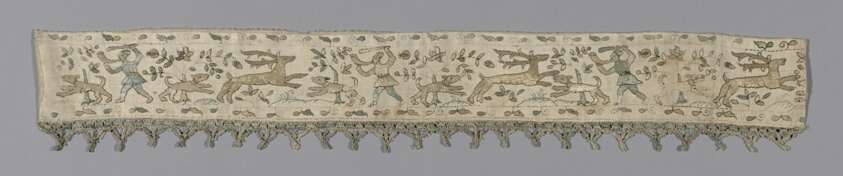
The consideration of any sartorial artifact demands, first, a dispassionate audit of its constituent parts. Here, we are presented with a foundation of linen, plain weave. This is not a mere substrate; it is a deliberate statement. Linen, with its inherent rigidity and crisp authority, provides the structural integrity upon which the narrative is built. It is the canvas, yes, but more pertinently, it is the immutable law of the garment—the fixed parameter against which all subsequent artistry will be measured. Its plain weave is the quintessence of order, a grid of utmost rationality. This is the foundational constitution of the piece.
The Discourse of Stitch and Thread
Upon this disciplined field, the discourse commences in silk. The embroidery—executed in back, double running, overcast, running, and split stitches—represents a sophisticated lexicon of technique. Each stitch is a word chosen for its specific weight and texture. The double running, or *Holbein stitch*, is of particular note; it is reversible, presenting an identical face on both sides of the linen law. This is a stitch of absolute integrity, of declarations made without reservation, suitable for defining a clean, unassailable line. It speaks of borders that are not merely decorative afterthoughts but are integral to the structural identity of the whole.
The introduction of couching and French knots, however, signals a shift in rhetorical tone. Couching binds a passive thread to the surface with a finer one, creating a raised, flowing line of immense control yet apparent softness. The French knot is a deliberate point of complexity, a condensed sphere of tension and density. These are the flourishes of persuasion, the points of emphasis in an otherwise linear argument. They suggest that a border need not be a mere barrier, but a locus of accumulated meaning and crafted detail.
The Final Arbitration: The Lace Edge
The ultimate arbitration of this constructed margin lies in its finishing: an edging of silk and linen bobbin lace. This is where the artifact transcends mere boundary-making and enters the realm of high diplomacy. Bobbin lace is an act of astonishing discipline, constructing a void from a multitude of threads. It is substance composed entirely of interval, a permeable frontier that is the apotheosis of controlled fluidity. To edge the embroidered border with such a material is a masterstroke of sartorial rhetoric. It declares that the border is not an end, but a transition; not a wall, but a finely negotiated interface. The combination of silk and linen within the lace itself reiterates the central dialogue of the piece—the fluid elegance of silk perpetually in conversation with the structured authority of linen.
Contextual Analysis: Fluidity as a Crafted Condition
The provided context—"Classic silk craftsmanship and fluid elegance"—must not be misconstrued as a mere description of aesthetic effect. It is, rather, a statement of philosophical intent. True fluidity in the classic canon is never accidental; it is the hard-won result of supreme technical command. The elegance described here is not the effortless drape of raw silk, but the far more considered elegance of silk mastered—silken threads deployed with geometric precision through a battery of stitches to create a line that appears organic but is, in fact, meticulously legislated.
This artifact, therefore, stands as a profound meditation on the very nature of a border. It rejects the vulgar notion of a border as a simple demarcation of exclusion. Instead, it presents the border as the most articulate part of the whole. It is where the internal structure engages with external space. It is a site of maximum investment, where foundational materials are elevated through consummate craft into a state of articulate grace. The linen provides the necessary tension, the silk embroidery provides the narrative, and the lace provides the resolution—a testament to the fact that the most elegant borders are those that invite contemplation of what lies on either side, rather than seeking to obliterate the view.
In the final analysis, this piece resides in the rarefied air where textile conservation meets constitutional philosophy. It demonstrates that the highest function of heritage craftsmanship is not merely to decorate, but to materialize complex ideas. Here, the idea is that limitation, when crafted with this level of authority and finesse, does not constrict but defines and, paradoxically, liberates the form it contains. The border is not a periphery; it is the consummate expression of the center's intent.