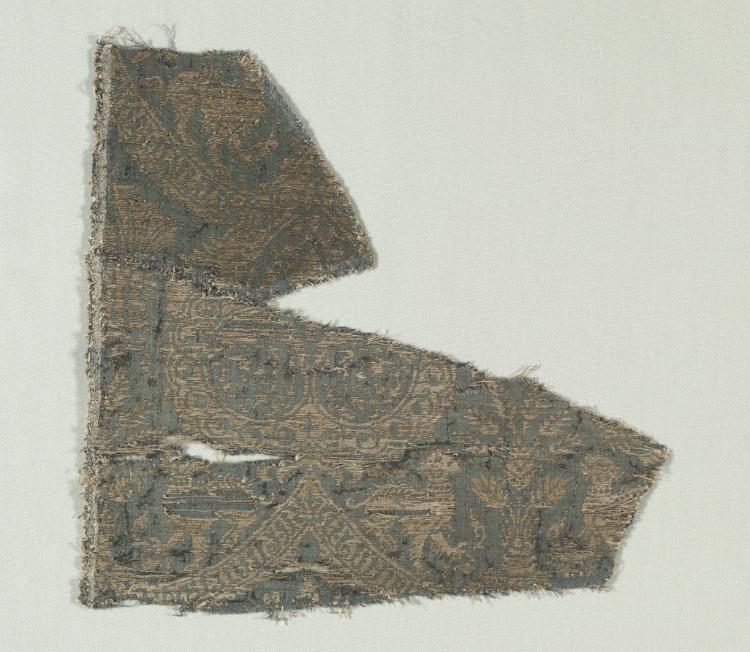
A Scrutiny of the Artefact: Canine Motifs and Kufic Script in Swaying Bands upon a Silk Ground
One approaches this particular fragment not as a mere textile, but as a document. Its very existence, preserved against the considerable odds of time and entropy, demands a tailored examination—precise, structured, and devoid of superfluous sentiment. The subject, a silk weaving presenting dogs amidst bands of Arabic script, is a proposition of some complexity. To comprehend its stature, one must first appreciate the foundational cloth upon which this narrative is built: the legacy of imperial silk weaving. This was not a trade, but a regimented, state-sanctioned enterprise. The materiality of silk itself was a controlled substance, its production a closely guarded secret, its circulation a privilege of power. Looms were instruments of statecraft, and the patterns they produced were less decoration than declaration.
The Imperial Loom: A Theatre of Power
Consider the context. From the Sassanian Persian taq-e kesra to the Byzantine gynaeceum, and most pertinently, the early Islamic tiraz workshops, the manufacture of figured silks was a sovereign monopoly. These were fabrics of proclamation, worn by the court, bestowed as diplomatic honours, and enshrined in reliquaries. The cost of production—the sheer quantity of skilled labour, the exotic dyes, the logistical chain from mulberry grove to draw-loom—rendered each length a capital reserve. The pattern, therefore, carried a weight akin to a royal cipher or a minted coin. It spoke of the patron’s reach, piety, and aesthetic authority. Into this rigorous theatre, our fragment makes its entrance.
Deciphering the Motif: The Hound in Formal Attitude
The presence of canine figures within this formal schema is the first point of analytical interest. These are not the curs of the street, but creatures rendered with a heraldic, almost numismatic, rigidity. They are captured in a state of arrested motion, a formalised trot or seated alertness, contained within the architectonic frames of the swaying bands. In the visual lexicon of pre-modern Eurasia, the dog could embody multifarious symbolism: loyalty, the hunt, aristocratic leisure, or, in certain Zoroastrian and broader Near Eastern contexts, protective virtues. Their deployment here is deliberate and symbolic, likely speaking to the martial or noble virtues of the patron. They are emblems, not pets; their value is totemic, woven into the fabric of power.
The Scriptural Band: The Word Made Damask
Far more significant, however, is the companion element: the bands of Arabic script, typically in a formal, angular Kufic. This transforms the fabric from a patterned textile into a tiraz in the truest sense. The word itself, derived from Persian for ‘embroidery’, came to denote inscribed textiles bearing benedictory phrases, the caliph’s name, or Qur’anic verses. To wear such a script was to wrap oneself in a portable assertion of faith and fealty. The “swaying” or undulating band is a masterstroke of the weaver’s art—a concession to fluidity within a supremely ordered format. It suggests a scroll or a banner, its movement a clever artifice that showcases the technical prowess required to render legible script on the unforgiving grid of the warp and weft. Each character must be meticulously plotted; a single mis-tie of the loom cords would render the pious phrase gibberish.
A Synthesis of Sovereignties
The confluence of the canine motif with the sacred script is where the artefact’s profound narrative resides. It represents a synthesis of pre-Islamic imperial tradition with the new dispensation of the Caliphate. The regal hunt, the symbolic beast, the language of courtly power—these are ancient themes, inherited from Sassanian and Byzantine predecessors. The Arabic script, however, overlays this with the incontrovertible authority of the Divine Word and the political reality of its earthly custodians. The dog, once perhaps a symbol of royal *farr* (divine glory), now stands adjacent to the *basmalah*. It is a visual diplomacy, a means of integrating a conquering aristocracy’s existing symbolic language into the fresh framework of Islamic rule. The silk becomes a site of cultural negotiation, woven not just with silk thread, but with threads of continuity and change.
Conclusion: A Legacy Measured in Threads
To hold this fragment—to note the subtle sheen of the undyed silk, the precise geometry of the Kufic, the stylised posture of the hounds—is to handle a piece of calculated state ideology. Its heritage is one of supreme confidence and consummate craft. It speaks of a world where beauty was inseparable from authority, where the loom was as potent as the scribe’s pen, and where identity was literally woven into the fabric of society. The legacy of imperial silk weaving is precisely this: the elevation of textile to text, and the use of that text to clothe the metaphysical ambitions of an empire in the most tangible, and luxurious, of materials. This artefact, in its elegant synthesis of the zoomorphic and the epigraphic, stands as a definitive statement from the *ateliers* of history—a statement tailored, one might say, to last a millennium.