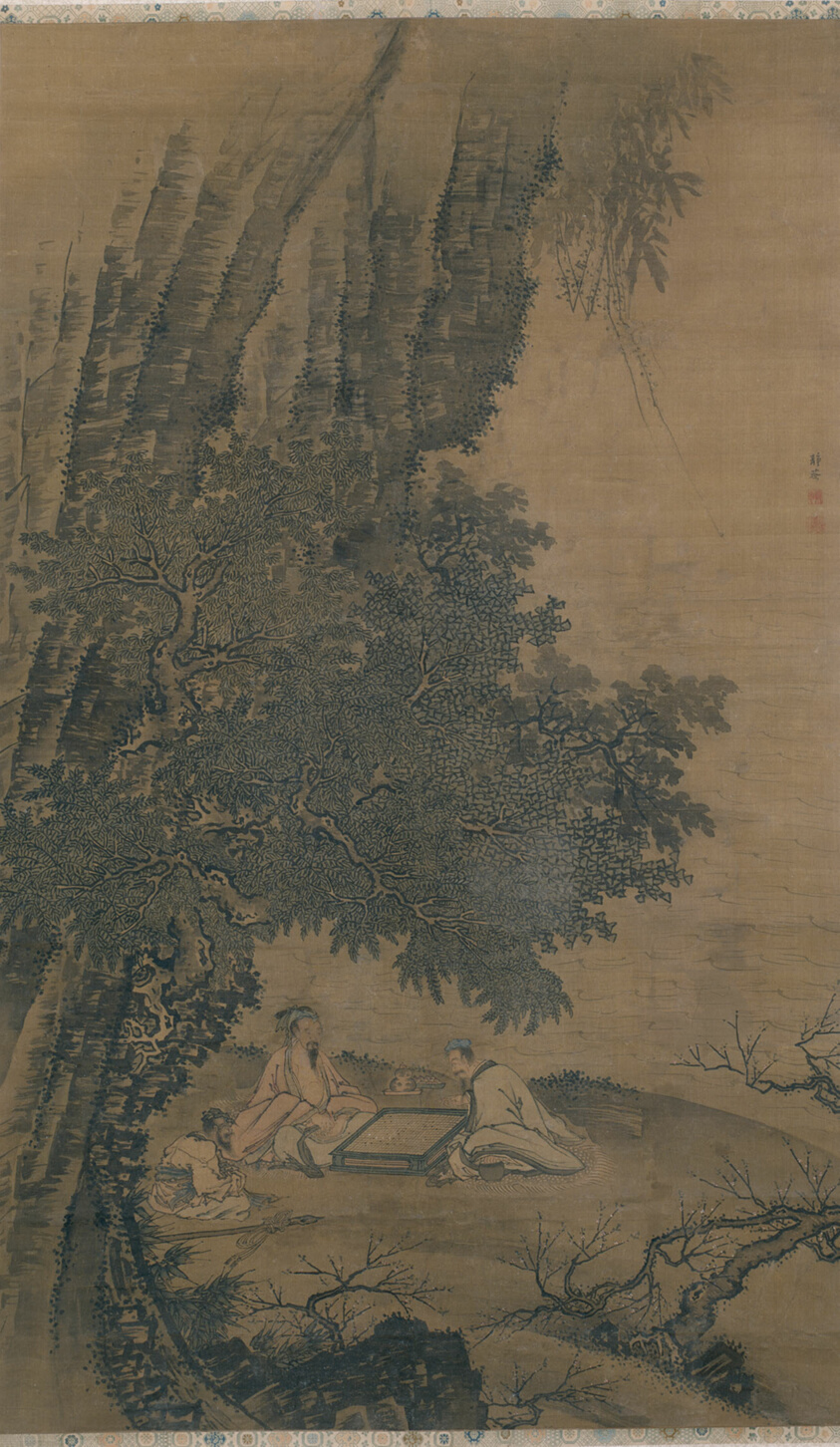
An Examination of “Landscape with Daoist Immortals Playing Weiqi”: Materiality and Metaphor in Classical Silk Craftsmanship
Introduction: The Confluence of Luxury and Philosophy
In the rarefied world of heritage artifacts, few objects command the same reverence as the hanging scroll executed in ink and colors on silk. The piece under scrutiny, “Landscape with Daoist Immortals Playing Weiqi,” is not merely a painting; it is a testament to the symbiotic relationship between materiality and meaning. For the connoisseur accustomed to the bespoke tailoring of Savile Row—where the cut of a jacket speaks volumes before a single word is uttered—this scroll offers a parallel narrative. The silk is the cloth; the ink and colors are the thread; and the composition is the final, impeccable garment. This paper argues that the scroll’s materiality, rooted in classic silk craftsmanship, is not a passive substrate but an active participant in conveying the Daoist ideals of transcendence, balance, and the fluid elegance of the natural world.
The Silk Substrate: A Foundation of Prestige and Perfection
To understand the scroll, one must first appreciate its foundation. Silk, in the context of Chinese heritage, is not a mere fabric but a symbol of civilization itself. The production of silk—from the cultivation of mulberry leaves to the delicate reeling of filaments—has been a closely guarded secret and a source of imperial prestige for millennia. In the creation of a hanging scroll, the silk is selected with the same exacting standards as a Savile Row tailor choosing a bolt of Super 150s wool. The weave must be even, the surface smooth, and the tension consistent to accept the brush’s touch without distortion.
The “Landscape with Daoist Immortals Playing Weiqi” employs a finely woven silk, likely of a tabby or plain weave, which provides a luminous, slightly absorbent surface. This is critical: unlike paper, which can absorb ink rapidly and create crisp, defined edges, silk allows for a more fluid, almost ethereal diffusion of pigment. The ink and colors settle into the weave, creating a soft, hazy quality that mimics the misty mountains and distant peaks of the Daoist landscape. This is not a flaw but a deliberate aesthetic choice. The silk’s materiality imparts a sense of “qi”—the vital life force—flowing through the composition, a concept central to Daoist philosophy. The viewer is not simply looking at a landscape; they are experiencing the breath of the universe, captured in silk.
Ink and Colors: The Palette of Immortality
The scroll’s palette is restrained yet profound. The ink, derived from soot and animal glue, provides the structural bones of the composition—the craggy cliffs, the gnarled pines, the precise lines of the weiqi board. The colors, primarily mineral-based pigments of malachite green, azurite blue, and cinnabar red, are applied in thin, translucent washes. This technique, known as “gongbi” (meticulous brushwork) combined with “xieyi” (freehand style), requires extraordinary skill. The brush must be loaded with just the right amount of pigment; too much, and the silk becomes saturated and muddy; too little, and the image lacks presence.
The choice of colors is deeply symbolic. The Daoist immortals, or “xian,” are often depicted in robes of muted blues and greens, blending with the natural environment. Their playing of weiqi—an ancient board game of strategy and balance—is a metaphor for the cosmic dance of yin and yang. The weiqi board itself, rendered in precise black and white lines, becomes a microcosm of the landscape. The immortals are not separate from nature; they are part of it. The silk, with its inherent fluidity, allows the colors to bleed and merge, suggesting that the boundary between the players and the landscape is permeable, even illusory. This is the ultimate expression of Daoist thought: the unity of all things.
Hanging Scroll Format: The Art of Display and Contemplation
The format of the hanging scroll is itself a study in materiality and function. Unlike a framed painting, which is static and fixed, a hanging scroll is a dynamic object. It is rolled, stored, and unrolled for viewing, a ritual that mirrors the cyclical nature of Daoist cosmology. The scroll’s mounting—typically a silk brocade border, a wooden roller, and a decorative ribbon—is as important as the painting itself. The choice of mounting silk, often in muted golds or deep indigos, frames the artwork without overwhelming it. The roller, usually made of sandalwood or jade, adds weight and tactile pleasure.
In the context of a Savile Row sensibility, the hanging scroll is the equivalent of a bespoke suit’s internal structure. The canvas is the silk; the lining is the mounting; the buttons are the roller. Every element is considered for its contribution to the whole. The scroll’s vertical orientation encourages a contemplative gaze, drawing the eye upward from the earthly foreground—where the immortals sit—to the misty peaks above. This verticality is a metaphor for spiritual ascent, a journey from the material to the transcendent. The silk, with its subtle sheen, catches the light differently at each viewing, ensuring that no two encounters are identical.
Conclusion: The Enduring Legacy of Craft and Philosophy
In conclusion, “Landscape with Daoist Immortals Playing Weiqi” is a masterwork of heritage that transcends its physical form. The silk is not a passive surface but an active agent in the expression of Daoist ideals. The ink and colors, applied with meticulous precision, evoke the fluid elegance of the natural world. The hanging scroll format, with its ritualistic display, invites the viewer into a contemplative space. For the scholar and the collector, this artifact is a reminder that true luxury lies not in ostentation but in the seamless integration of materiality, craftsmanship, and philosophy. Like a perfectly tailored suit, it is an object of enduring beauty, designed to be appreciated for generations.